










































Presidents and Vaccines: Head of State Inoculation as a Tool for Vaccine Promotion
University of Antwerp (Collart, Lunanga, Stoop, Verpoorten); FWO - Research Foundation Flanders (Collart, Stoop); Université Catholique de Bukavu (Lunanga); University of Leuven (Stoop, Verpoorten)
"When trust in leaders is lacking, or news on their actions is inaccessible, alternative ambassadors and effective communication methods become crucial in motivating and informing the public. This fact may be especially relevant in fragile states and remote regions."
Vaccine hesitancy, which threatens global health, has increased since the onset of the COVID-19 pandemic. The public vaccination of high-profile figures, such as heads of state, has been described as a promising tool for increasing vaccine acceptance among the general population. However, information on the nature and impact of such role modelling is lacking, particularly in low- and middle-income countries. This study aims to fill this gap by providing experimental evidence on vaccine role modelling in the Democratic Republic of Congo (DR Congo), a country that has been particularly affected by declining vaccine confidence during the COVID-19 pandemic.
The social identity model of leadership clarifies how and why heads of state can influence citizens' life and attitudes - not only by implementing policies but also by communicating with the public, both with words and symbolic actions. One low-cost action that a head of state can take is to get vaccinated publicly. With this action, political leaders can signal to the public that vaccines are safe and effective, thereby building public confidence in vaccines.
The fact that both words and actions by heads of state can have tremendous impact on crisis management, both positive and negative, was amply demonstrated during the COVID-19 crisis. Through a systematic search of internet sources, the researchers document that most global leaders supported the COVID-19 vaccination campaign and actively communicated their vaccination status to the public - and they did so using more than words. Specifically, 168 out of 173 leaders explicitly supported the vaccination campaign. Moreover, 108 leaders (78% of those vaccinated) distributed a picture or a video of their vaccination.
In DR Congo, President Félix Tshisekedi initially went against the vaccine promotion strategy of his own government by refusing to get vaccinated for 6 months, casting doubt on the AstraZeneca vaccine, and promising to launch a Congolese "anti-COVID" product in August 2021. Less than 2 weeks after that statement, he reversed course and received his COVID-19 vaccine live on Congolese television. The news was distributed by diverse national media channels and on Facebook and Twitter. However, only 18% of those interviewed for the study after the president got vaccinated were aware of his vaccination. This fact can be linked to the fact that only 19.4% percent of Congolese households owns a television, where they might have been directly exposed to images of the president's live vaccination, and internet penetration at home, where they might have been exposed to news about the vaccination afterwards, stands at only 1.3%.
In a randomised survey experiment (September-October 2021) including 600 Congolese citizens, the researchers prompted 1/3 of respondents to consider the hypothetical vaccination of President, Tshisekedi. They prompted another 1/3 of respondents to consider the hypothetical vaccination of Fridolin Ambongo Besungu, the Congolese Cardinal of the Catholic Church. While the survey was ongoing (on September 12 2021), as noted above, President Tshisekedi publicly received the COVID-19 vaccine. The study compared participants' stated willingness to accept a COVID-19 vaccine to that of a control group who did not receive such a prompt, as well as participants' stated vaccine acceptance before and after Tshisekedi's vaccination.
While 98% of households in this study had vaccinated their children against at least one of the diseases of diphtheria, polio, measles, and yellow fever, only 22% of respondents indicated they would accept the COVID-19 vaccine if it was available to them. Aside from rumours and conspiracy theories, the low vaccination rate in DR Congo was compounded by the country's limited healthcare infrastructure, low numbers of health workers, and broader governance issues, including rampant corruption and political instability.
These governance issues not only affect the country's ability to provide basic services to its citizens but also erode general trust of Congolese citizens in public institutions and President Tshisekedi. This study found that only 17% of respondents expressed trust in the president amidst the COVID-19 crisis, and a December 2021 opinion poll by the Congo Research Group revealed that only 29% of Congolese surveyed had a positive opinion of Tshisekedi. In contrast, the 2021 poll indicated that 47%% of Congolese trusted the Cardinal.
The study found that, while the hypothetical vaccination of the Cardinal had no significant impact on vaccine acceptance, the results for the president were moderated by public trust. For Congolese who reported trusting the president, the experiment boosted acceptance from 27% to 52%: They were twice more likely to indicate willingness to get a COVID-19 vaccine (p < 0.01). Stated vaccine acceptance for respondents who trusted the president and were exposed to the president treatment was 4.75 times higher (p < 0.01) than that of respondents in the base category (those who did not trust the president and were not exposed to president treatment). For those who mistrusted the president, the experiment decreased acceptance from 17% to 11%. When the president got vaccinated during the survey period, vaccine acceptance increased from 15% to 35%, but only for respondents who were aware of the president's vaccination.
Thus, these findings show that the following two conditions are necessary (but not sufficient) for public vaccination of heads of state to effectively serve as a vaccination advocacy tool:
- The leader is perceived as trustworthy by citizens.
- The live inoculation is widely communicated, preferably through diverse channels that also reach areas with low media access.
These conditions were largely absent in the study area. In such a context, vaccination of local public figures - for instance, village leaders or respected older adult community members, might be more effective to improve vaccine acceptance. Indeed, data shared here shows that trust in local leaders is almost twice as high as trust in the president. In addition, despite the remoteness of these territories, local news travels through word of mouth, as communities are tightly knit and easily exchange information. However, the null result regarding the cardinal's hypothetical vaccination suggests that it is not sufficient to pick any well-known and well-trusted person. Future research could delve deeper into identifying suitable vaccine ambassadors across varied contexts.
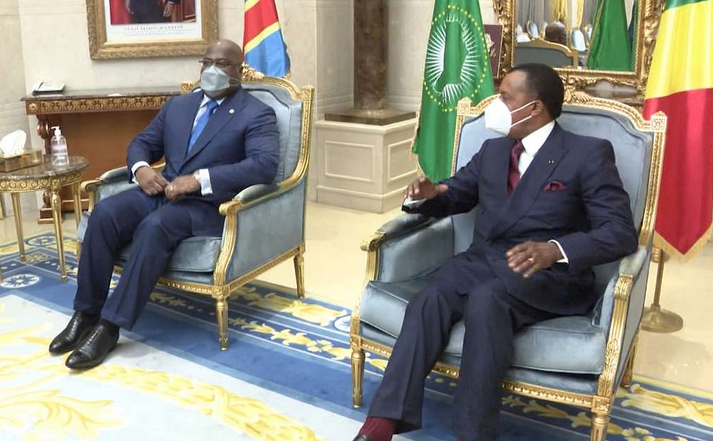
Frontiers in Public Health, Volume 12 - 2024 | https://doi.org/10.3389/fpubh.2024.1364927. Image caption/credit: President of DR Congo Félix Tshisekedi and President of the Republic of the Congo, Denis Sassou-Nguesso, met in Brazzaville on July 16 2020. Credit: picryl (public domain)