










































Qualitative Assessment of Outta Road, an Entertainment-Education Radio Soap Opera for Jamaican Adolescents
Population Media Center (PMC)
This report presents the results of a qualitative participatory assessment study of youth listeners to the Jamaican radio serial drama Outta Road. This programme, which aired from March 2007 to March 2008 on RJR FM and from November 2007 to July 2008 on Roots 96.1 FM, was designed by the United States (US)-based Population Media Center (PMC) with the purpose of motivating Jamaican adolescents to adopt healthy behaviours and reduce the risk of violence, early sex, and use of illegal drugs.
The purpose of this qualitative study, conducted by 3 PMC staff members in April 2008, was to assess how listeners engaged with Outta Road and to what extent they found personal meaning and were influenced by the educational messages and themes in the drama. The research design consisted of conducting focus group discussions (FGDs), individual interviews, and sketching exercises with adolescent boys and girls.
This report: provides an overview of the Outta Road drama, including the story line and key characters; lists all research questions that guided the inquiry; discusses the qualitative participatory methods used for the study; presents the results using participant verbatim responses from discussions and sketches followed by a summary, and; provides a summary of main themes from findings and a conclusion.
The plot of Outta Road was designed around several intersecting story lines, each centred on an educational purpose. The social ills identified through the formative research helped guide the development of characters and plot lines. Using the Sabido methodology, story lines were delineated by a set of positive, negative, and transitional role models to address issues including love, friendship, peer pressure, violence, sex, drugs, HIV/AIDS, and more. Outta Road also used epilogues to provide listeners with more information about the topics addressed and issues raised. Outta Road listeners' clubs meet regularly to discuss the drama and provide feedback to scriptwriters.
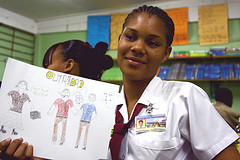
The following methodological note explains one of the research techniques, participatory sketching, described here as: "an emerging communication evaluation method that assesses how audience members engage with and derive personal meaning from an entertainment-education program ([Arvind] Singhal, 2007). The advantage to using this method is that it allows audience members to participate by making a visual representation of how the program may have influenced them. This technique has been advocated by Paulo Freire, an educator from Brazil who believes that assessments of educational programs would benefit from more participatory methods including using sketches and photographs to represent the reality of participants' lives."
Through the qualitative review, researchers found that "[m]ost participants were able to comprehend the nature of the drama, its intent, and discuss major educational themes and content...particularly violence and illegal drugs. Many participants understood that the drama is meant to demonstrate to young people that making the right choices and not succumbing to peer pressure can lead to good things in life....Overall most participants were able to describe character attributes and behaviors that placed them in relation to their roles in the drama as being positive or negative."
Furthermore, "[m]any participants reported making positive changes that resulted from learning or understanding more about themselves from listening to Outta Road. This included making the 'right decisions,' 'mature decisions,' and 'sacrifices' in an effort to, as one participant mentioned, 'get you going on the right track, the track of success.'....Overall, the findings...suggest that in some cases the behavior modeled by Outta Road characters provided rich vicarious learning experiences for listeners that resulted in newly acquired skills, changed behavior, and elevated self-efficacy....For both females and males, the ability to resist peer pressure and to express independence by staying away from 'bad company' and 'choosing your friends wisely' were skills some listeners incorporated into their day-to-day lives. For males, being abstinent, avoiding violence, obeying parents, and making your 'first priority education' were other skills that participants incorporated into their day-to-day lives."
The researchers also note that "[m]ost participants offered that they had shared some of the information they heard or lessons they had learned from Outta Road with their peers. Females shared this information by giving advice to their friends about sexual health, preventing pregnancy and/or HIV by using condoms. Male participants internalized and shared numerous messages with their friends, [which] included 'respecting your parents' and focusing on education. It should be noted that several of the male participants who received Outta Road episodes on CD for listening at home had made copies of the CD for their friends..."
A female listener describes how the programme connected with Jamaican youth: "It's easy to catch on with the names and the language that they use. Yes, we as Jamaicans are really familiar with that type of language like 'One Dog.' It's kind of easier for us to relate, because that is the language on the streets." But, in general, the researchers found that boys appeared more engaged with the programme than did girls - possibly due to the fact that there were more major male characters than major female characters. Related to this point, girls would have liked to see more female characters in the drama.
In conclusion, the findings from this study suggest that for most study participants there was improved knowledge, attitudes, and skills related to healthy lifestyle and appropriate behaviour.
PMC website, accessed September 23 2009.

- Log in to post comments