










































A Qualitative Study of Parental Knowledge and Perceptions of Human Papillomavirus and Cervical Cancer Prevention in Rural Central Java, Indonesia: Understanding Community Readiness for Prevention Interventions
The University of Melbourne (Spagnoletti, Bennett, Keenan); Gadjah Mada University (Spagnoletti, Bennett, Wahdi, Wilopo)
"...a well-informed starting point for developing educational content that responds directly to the observed knowledge, knowledge gaps, and perceptions in this community."
Cervical cancer (CC) is a leading cause of cancer deaths among Indonesian women. Pilot prevention programmes, including human papillomavirus (HPV) vaccination for young adolescent girls and cervical screening for women, have been implemented. However, many communities are yet to receive these interventions or targeted education regarding CC prevention. This study explored community readiness and acceptance of HPV vaccination and CC screening, as well as knowledge and perceptions of HPV and CC, to determine facilitators and barriers to upscaling CC prevention in rural Central Java.
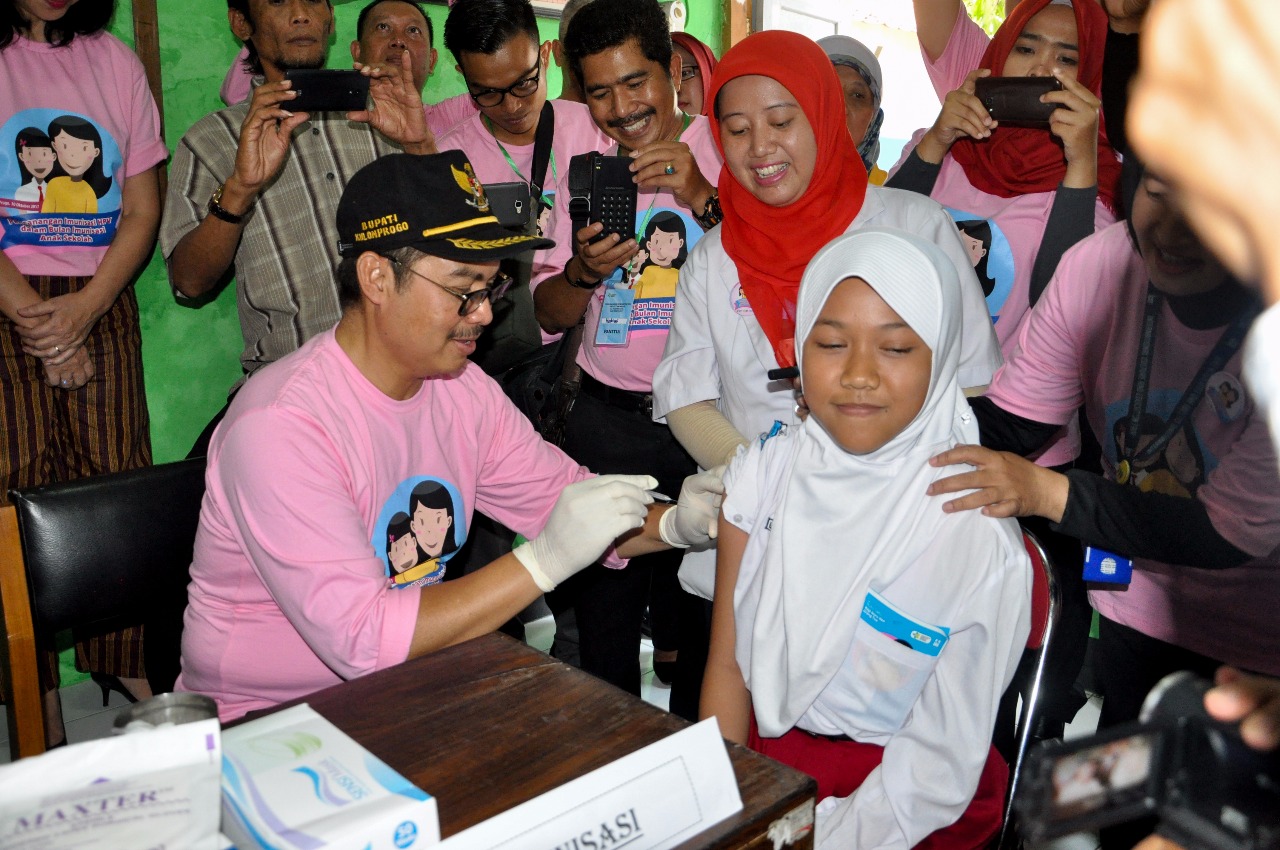
The HPV Demonstration Program, which provides free vaccination to girls in primary school, was initiated in 2017 and piloted as a school-based programme in Jakarta and Surabaya, and in 2 rural districts in Yogyakarta. In 2018, the programme was expanded to include Manado and Makassar. Purworejo Regency in rural Central Java was not a target location for the expansion of the HPV Demonstration Program at the time this research was conducted.
Qualitative data collection in October 2015 consisted of 22 semi-structured interviews with married women and 4 focus group discussions (FGDs) with married women and men. (While women suffer the embodied realities of CC, both men were included to acknowledge their roles as decision makers in relation to their daughters' reproductive health and their responsibilities as their wives' sexual partners.) All 57 participants, 39 women and 15 men, lived in Purworejo in rural Central Java.
Selected results:
- Most participants had heard of CC, although understandings of symptoms and causes were very poor. Except for one participant whose mother had experienced CC, knowledge of HPV was lacking among all interview and FGD participants, regardless of sex. Most participants had no knowledge of the causal link between HPV and CC.
- Both men and women did not hesitate to name and discuss sexual promiscuity as a cause of CC, both within the group context of FGDs and in one-on-one interviews. This finding counters the common assumption that Indonesians are unwilling to discuss sexual behaviour in the context of health.
- Participants of both sexes identified a range of sources where they had obtained information about CC. These included: the internet, television and radio shows on health, printed health promotion materials available in the primary health care system, and during consultations with midwives, nurses, and doctors.
- Two of the 6 women who perceived themselves as at risk had not acted on their risk perception, and had never been screened for HPV or any other sexually transmitted infection (STI).
- Women perceived several barriers to CC screening: feeling uncomfortable about pelvic exams; feeling embarrassed to be checked by a male doctor; not knowing where to be tested; not being able to afford testing; fearing a positive result; and being asymptomatic and not perceiving the need for screening. Several women also remarked that CC screening was not yet commonplace in the community due to a poor understanding of risk.
- Vaccination in general was regarded as important for disease prevention and immunity by all participants, regardless of gender. In FGDs, vaccination was discussed as a normative practice typically associated with maternal and child health. Trust in the primary health system to provide appropriate vaccinations was also expressed in all FGDs.
- Most women and men were supportive of the introduction of HPV vaccination; in interviews, 17 women expressed the desire for themselves to be vaccinated, and 20 perceived it to be important for their children to receive the HPV vaccine. Knowledge that the HPV vaccine is strongly recommended prior to sexual debut was not present among any of the women interviewed.
- Five women expressed conditional support for their children being vaccinated against HPV. These conditions included obtaining permission from their husbands, needing their child to consent to vaccination, or their child not being informed that the vaccine was to protect them from contracting HPV because it is an STI. The third condition was grounded in the fear that if adolescents had knowledge of HPV, it could lead to sexual promiscuity. No participants of either gender expressed any concerns that vaccination was haram (forbidden) for any reason according to Islam.
In light of the fact that the women and men in this study lacked an accurate understanding of both HPV and CC, as well as their causal relationship, the researchers suggest that extensive community education about HPV and CC is crucial to support the introduction of the HPV Demonstration Program and the upscaling of CC screening. They suggest that tailored education materials should be developed for men, women, and the adolescents who will receive HPV vaccination. Health workers involved in CC prevention programmes also require additional education to ensure they are confident in educating community members about HPV and CC prevention. Knowledge about HPV and CC prevention should also be embedded within the school health programme curriculum, and teachers who deliver this education should also receive adequate training.
According to the researchers, community education should focus on 4 interrelated areas: knowledge of HPV, HPV vaccination, CC, and CC screening. They outline specifics for each of these areas. For example, with regard to HPV vaccination, they suggest explicitly addressing false perceptions of an association between HPV vaccination and sexual promiscuity. Also, the finding of an absence of any knowledge regarding the potential side effects of HPV vaccination should be addressed to ensure that consent to vaccinate is fully informed. In fact, more broadly, "issues of consent for vaccination, screening and treatment should be openly discussed in the community. These conversations should be guided by a reproductive rights framework that acknowledges women's and girl's rights to health and bodily autonomy, and men's responsibilities to promote the health of their wives and daughters."
Along those lines, the findings also demonstrated "the willingness of this community to engage in frank discussions about how sexual behaviour is linked with HPV and other STIs. This is crucial if behavioural interventions that promote condom use and marital fidelity are also to be promoted. Openness to discussing sexual health could also facilitate the acceptance of providing comprehensive information to women and girls on HPV, other STIs, and the link with CC. This information should be integral to the process of informed consent for those undergoing HPV vaccination and CC screening and treatment."
In addition, low incomes among rural families underline the need for the HPV vaccine to be provided free within the National Immunization Program and for CC screening to be free at primary health clinics.
Asian Pacific Journal of Cancer Prevention Article 28, Volume 20, Issue 8, August 2019, Pages 2429-34. DOI: 10.31557/APJCP.2019.20.8.2429. Image credit: Sehat Negeriku - kemenkes
- Log in to post comments