










































Research Report on Children with Disabilities and Their Families in Da Nang
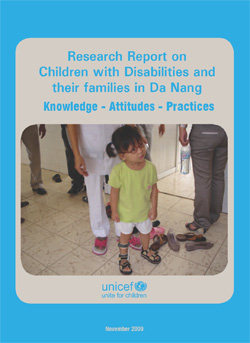
This 46-page report details research carried out to shape an advocacy and communication strategy for a multi-sectoral, rights-based programme carried out by the United Nations Children's Fund (UNICEF) Viet Nam, with support from the Ford Foundation. The project's aim is to address health care, education, water and sanitation, child protection and social inclusion) for children with disabilities (CWD) - including victims of Agent Orange - in Vietnam.
As detailed here, UNICEF Viet Nam's programme, launched in 2008, builds on existing UNICEF-supported work and partnerships to strengthen policies, legislation, and programmes for CWD and their families. It includes both national and sub-national components. At the sub-national level, the project focuses on capacity development, advocacy, service delivery, and research. Da Nang in central Viet Nam has been chosen as the first of 3 proposed sites for this project, which is guided by both the Convention on the Rights of the Child (CRC) and the more recent United Nations (UN) Convention on the Rights of Persons with Disabilities (PWD).
The project is grounded in a social model of disability, which focuses on facilitating inclusion of CWD into society - facilitated by required changes in society in terms of attitudes, social support, information, and physical structures that will enable the potential of disabled people to contribute to society. "The social model puts the person at the forefront. It emphasizes dignity, independence, empowerment, participation, equality, choice and privacy. The aim is to see the person first, not the impairment. The social model of disability focuses thus on changes required in society, in terms of attitudes, social support, information and physical structures. The social model also outlines the potential of disabled people to contribute to society and add economic value, if given equal rights and suitable facilities and opportunities as others."
The purpose of this research study is threefold: (i) to understand the KAP of CWD and their families, including their main issues and expectations, and the barriers they deal with in their day-to-day lives; (ii) to understand the perceptions of the community towards CWD - how they see them and understand their problems; and (iii) to understand the role of stakeholders (key governmental and non-governmental) in this area - how they help CWD and their families, what their main activities are, and whether or not they have enough support and tools. A 2-phase research design was necessary to meet the information needs. A human-rights-based approach incorporated a quantitative phase (community survey, involving face-to-face interviews) and a qualitative phase (research with CWD and their families and collection of information, education, and communication (IEC) materials).
An excerpt from the "Conclusions and Recommendations" section of the report follows:
"The social model of disability promotes community-based and family-based solutions rather than institutional care. Viet Nam has long applied institutional care, although we can now see a state of transition....For example, the perceptions that exist in the majority of the community provide a strong foundation to target with a message of social inclusion for CWD...
At a social agency level, clearly better coordination is required to ensure the efforts of all are leveraged towards clear and relevant priority outcomes. Better information for action plans (statistics) will strongly support this. The issue around 'labeling' of disabilities needs to be addressed at both this level, and also through a planned communications strategy that seeks to remove stigmatization around those disability types (especially intellectual disability and multiple disabilities) that are considered different and/or less inclined to social inclusion than others...
...[B]etter education around healthcare for CWD and their families, as well as healthcare practitioners is essential....The issues around inclusive education are similar....Developing support materials and programs by type of disability, age and general motivation to teachers will support this.
When it comes to infrastructure, accessible public transport for PWD and CWD is not yet available....Constructed facilities which aim at PWD and CWD need to be sufficient, effectively designed (considering all disability types) and well constructed. Awareness needs to be generated around them and there needs to be clear instructions for usage. This is another key area for better coordination between stakeholders...
The community can accept disability as a part of everyday life, and this also provides a basis from which to communicate around treating all disabilities the same. If the outtake of a communications message can be the understanding that the problem lies in society's acceptance of CWD, and that it is in fact society creating the barriers, the potential for a significant shift towards a social inclusion model is possible. TV (particularly) and Print are the mainstream means through which to communicate the key messages..."
Email from Keisuke Taketani to The Communication Initiative on May 5 2010; and UN Viet Nam website, May 26 2010.
- Log in to post comments