










































"Respect My Opinion and I'll Respect Yours!": Exploring the Challenges, Concerns, and Informational Needs of Vaccine-hesitant Caregivers and Pregnant Women in the Philippines
Research Institute for Tropical Medicine - Department of Health, Muntinlupa, Philippines (Reñosa, Endoma, Sornillo, Bravo, Landicho-Guevarra, Aligato, Landicho, Sornillo, Demonteverde, Silvestre, Malacad, Inobaya); Ruprecht-Karls-Universität Heidelberg (Reñosa); Save the Children Philippines (Pambid, Francisco); Save the Children International (Llopis)
"The findings are essential for identifying specific health behaviors that could assist policymakers and program managers in developing a culturally tailored intervention to promote vaccine uptake in urban and rural Filipino communities."
The Philippines is experiencing an erosion of public trust in vaccines and is, as of 2021, one of the 10 low- and middle-income countries (LMICs) with the highest proportion of unvaccinated or under-vaccinated children globally. With the goal of informing policy decisions and the development of interventions, this study explores the concerns and challenges related to vaccine uptake (of childhood, maternal, and COVID-19 vaccines) among parents or caregivers of under-2 children and pregnant women in urban and rural communities in the Philippines.
The study was conducted in 2 regions in the country that have had recent measles outbreaks and have low immunisation coverage - namely, the National Capital Region (NCR) and the Calabarzon region. Between May and June 2022, the researchers conducted 43 in-person and online interviews with purposively selected caregivers and pregnant women in these regions.
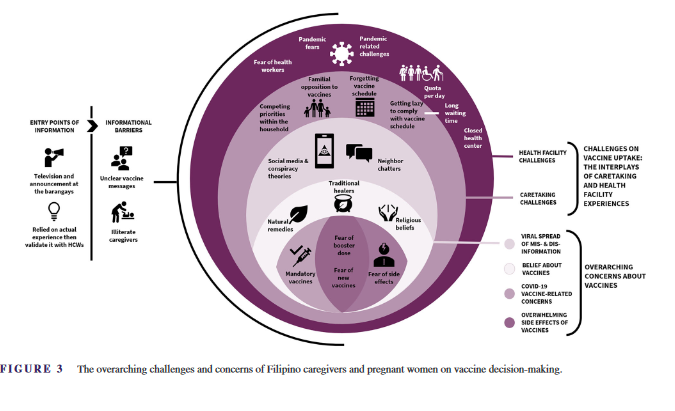
To highlight the complex and volatile nature of vaccination narratives evident in the results, the paper presents a model (see above) that explores the interactions among contextual challenges, respondents' internal beliefs and concerns, and information needs within the framework of social ecological model. The model also illustrates how respondents navigated the challenges of vaccine decision-making and how the larger vaccine narratives are embedded in processes across respondent categories.
Common barriers included the structural challenges faced in healthcare facilities, particularly during the COVID-19 pandemic, and competing household priorities that led caregivers and pregnant mothers to deviate from (delay adherence to) immunisation schedules. Although there were some legitimate concerns about side effects, there were also feelings of sensitivity to these anticipated vaccine adverse events, either due to personal experiences (and/or the experiences of their friends and family members) or to advice and knowledge provided by healthcare workers (HCWs) on how to deal with side effects related to vaccination. Respondents said the long-established maternal and childhood vaccines no longer represent a high-risk concern; instead, their fears and hesitancy seemed to be particularly directed to newer vaccines. (Several scholars have reiterated how the social trauma caused by the dengue vaccine (Dengvaxia) controversy contributes to Filipinos' vaccine hesitancy (VH) toward COVID-19 vaccines.)
All respondents identified COVID-19 pandemic fears and pandemic-related challenges as the primary causes of VH. No matter their age or the number of children they had, respondents voiced worries and skepticism regarding the introduction of COVID-19 vaccines due to the spread of false information in neighbourhood chats, social media, and mainstream media. In particular, the findings highlighted how social media altered communication and stoked widespread anxieties that permeated other contexts. Fear-based narratives are a common source of misinformation on social media, a problem that technology companies have begun to recognise. For example, the Philippines Department of Health's #ChecktheFAQs campaign involved social media companies pledging to support the fight against COVID-19 and vaccine misinformation online. Such efforts may be needed considering that, as the present study found, respondents, especially first-time mothers, can become overwhelmed by vaccine disinformation as they attempt to sort through nuanced vaccine information. Respondents from all groups in the study stressed they rely on expert advice, such as that given by doctors and nurses in the health centres, in the face of the widespread dissemination of false information concerning vaccination.
Several VH studies at national and global levels have emphasised similar health facility challenges and parental concerns as identified in the present study. For example, similar to other findings across LMICs, challenges in public and community engagement appear to be strongly driven by the introduction of new vaccines, such as COVID-19 and dengue vaccines. The present study highlights that risk communication and community engagement are crucial when introducing new vaccines. It also adds to the academic discourse that emphasises the need for health education programmes to not only be educational, interesting, and responsive to the needs of the general public but also to be safeguarded against being used by anti-vaccination movements as a means of deceiving and misinforming the public. Social media analysis should examine how new, trending media applications (e.g., TikTok) are contributing to the proliferation of anti-vaccine sentiments and consequently the decline in vaccine uptake. For example, the researchers urge the devising of multiple strategies to stimulate public interest in simple, empathic, and prosocial messages, as well as integrated nudging techniques, to increase the uptake of COVID-19 boosters.
In conclusion, the study's findings "provide insights into the lived experiences of caregivers and pregnant women on their hesitancies to receive vaccines in rural and urban Philippines." The researchers recommend that programme managers "develop health information materials on vaccines that are adaptive and responsive to the needs and interests of the general public, and designate authorities to enhance transparent, consistent, and coherent public communication to address misinformation. Although some notable challenges are unveiled, it reminds us of what truly matters - that the chances and actions we should take must focus on inclusivity, equity, and responsiveness. These insights could strengthen our shared hope and vision to keep our promise to leave no one behind."
Public Health Challenges 2023;2:e105. https://doi.org/10.1002/puh2.105.
- Log in to post comments