










































Right To Play's Intervention to Reduce Peer Violence among Children in Public Schools in Pakistan: A Cluster-Randomized Controlled Trial
Aga Khan University (Karmaliani, Khuwaja, Somani, Bhamani, Ali, Asad); Texas Woman's University (McFarlane); South Africa Medical Research Council (Chirwa, Jewkes); University of Witwatersrand (Chirwa)
"This research has advanced the small body of evidence on the prevention of peer violence victimization and perpetration in low- and middle-income countries in general, and Pakistan in particular."
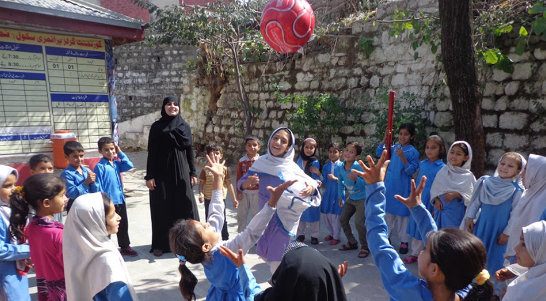
Peer violence is a problem in schools worldwide and is associated with poor school performance, absenteeism, school dropout, and mental health problems. Right To Play is an international non-governmental organisation (NGO) that seeks to use the transformative power of play and sports to educate and empower children to lead healthier and safer lives. The organisation's Positive Child and Youth Development Programme (also called Red Ball Child Play) has been translated and adapted for different settings, including Pakistan. This paper reports on a cluster-randomised controlled trial (RCT) of the intervention on school-based peer violence and depression among schoolchildren in Hyderabad, Pakistan.
The programme draws on social, cognitive, child development, and experiential learning theories, focusing on physical, cognitive, social, and emotional development through sports and games. It is premised on the idea that children learn through processes of exploration and reinforcement of new ideas and behaviour, and that in order to achieve enduring change, interventions must be ongoing. Gender equality is a cross-cutting theme, which is intended to give girls a voice through play and discussion. Behaviour change is viewed as a complex process that is best achieved when new ideas are explored in groups using empowering, participatory methods. The activities seek to develop and build essential life skills, such as confidence, communication, empathy, coping with negative emotions, resilience, cooperation, leadership, critical thinking and conflict resolution in order to reduce intolerance, gender discrimination, and peer violence.
The two-year intervention involved a biweekly structured game led by a coach followed by 30 minutes of critical reflection and discussion. In addition, the NGO organised summer camps and also invited parents to sports tournaments and thematic play days. Right To Play also held quarterly awareness sessions with parents on child rights, gender equality, and positive discipline and provided some training sessions for teachers on positive child and youth development, positive disciplining, gender equity, and child protection.
Forty single-sex public schools were randomised into two study arms (20 per arm 10 of each sex). A total of 1,752 grade 6 students (929 from intervention and 823 from control schools) were enrolled in the trial. The researchers conducted baseline interviews between November and December 2015, after which the intervention commenced. The 12-month assessment was undertaken between December 2016 and January 2017, and the 24-month assessment was undertaken between November 2017 and February 2018. Primary outcomes (exposure to peer violence exhibited through victimisation and perpetration and depression) were evaluated using generalised linear-mixed models.
The RCT found significant decreases in self-reported peer violence victimisation, perpetration, and depression. For peer violence victimisation, the reductions in the intervention and control arms were: 33.3% versus 27.8% for boys and 58.5% versus 21.3% for girls. For peer violence perpetration, the reductions were: 25.3% versus 11.1% for boys and 55.6% versus 27.6% for girls in the intervention and control arms, respectively. The mean depression score in boys dropped by 4.8% in the control versus 7.2% in the intervention arm; in girls, it dropped by 5.6% in the control versus 9.5% in the intervention arm.
In terms of the secondary outcomes, gender attitudes changed significantly for boys and girls, becoming less patriarchal in the intervention arm than the control arm, although the reduction in scores was greater for girls than boys. Corporal punishment was reported significantly less often during the last 4 weeks by both boys and girls in the intervention arm compared to the control arm, with the reduction greater for girls. Physical punishment at home during the last 4 weeks was reported significantly less often in the intervention arm, with a greater reduction for girls than boys. The difference in the proportion promised in marriage for boys and girls showed possible evidence in change in the desired direction but was not statistically significant.
Reflecting on the findings, the researchers note that "evidence shows that school violence has far-reaching effects and that different forms of violence are interconnected....For example, peer violence perpetrators are more likely to engage in dating and partner violence....Using schools as an entry point for reducing violence overall is particularly important in a country like Pakistan which has relatively high levels of culturally sanctioned violence and where oppression of women and girls is widespread."
In conclusion: "Play-based life-skills interventions thus constitute a new dimension in the repertoire of effective approaches to prevent peer violence and should be evaluated in other settings. Further research is needed to determine whether the impact is sustained beyond the 2 years of a study and whether positive impact persists if the intervention is taken to scale."
Global Health Action, 13:1, 1836604, DOI: 10.1080/16549716.2020.1836604. Image credit: © Right to Play Pakistan