










































Scientists Must Not Be Muzzled
SciDev.Net
In this SciDev.Net editorial, David Dickson makes the case that some scientists and those speaking on their behalf are being persecuted for expressing opinions based on their scientific expertise. He argues that the law should not be used to penalise scientists who criticise the views of those who lack scientific credentials, or those whose controversial differences with other scientists spill over into the public domain.
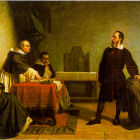
His arguments stem from a reflection on Italian astronomer and physicist Galileo Galilei, who was put on trial in 1633 by the Catholic Church for suggesting that the Earth might not be the centre of the universe. Dickson points to recent cases to show a pattern. Three years ago, for instance, the Nigerian Academy of Science was taken to court by a local doctor after the academy criticised his claim to have developed an HIV/AIDS vaccine. To cite another example, a Peruvian biologist in Peru has received a suspended jail sentence for describing as a "false truth" a claim by another biologist to have detected modified genetic material produced by commercial companies in local maize crops.
Dickson stresses that, in these cases, legal action has been taken (or threatened) primarily over statements made not about a purely scientific dispute, but about scientific disagreements that form part of seminal public debates - such as those around key development issues. In Dickson's words, "[o]f course, academic qualifications do not give scientists the right to say what they like about the behaviour of others....But in any case, the courts should not be the arbiters in disputes over the validity of claims for demonstrated or hypothesised scientific evidence. The peer review process, despite its many shortcomings, is still the best mechanism..."
In Dickson's estimation, all countries should examine their defamation laws and assess whether they discourage informed debate on key issues of social concern. He concludes that scientists "have a responsibility to speak out about topics on which they hold expert knowledge, particularly if this knowledge can better inform a political debate. But society, in turn, has a responsibility to protect scientists when they do."
SciDev.Net Weekly Update (June 1-6 2010).
- Log in to post comments