










































Shifting Norms in Faith Communities to Reduce Intimate Partner Violence: Results from a Cluster Randomized Controlled Trial in Nigeria
Georgetown University (Shaw, Stevanovic-Fenn, Gibson, Davin, Chipanta, Lubin); Tearfund (Martin, Quirke); Tearfund International (Saman, Vandu)
"...findings demonstrate the promise for strategies such as critical reflection and dialogue on existing norms, leading to a cascade of changes at the individual, relationship, and community levels, including reduced IPV and healthy relationships within families and communities."
Programmes aiming to reduce intimate partner violence (IPV) increasingly seek to shift social norms, which are recognised as critical drivers of and/or barriers to behaviour change. In many African countries, including Nigeria, faith leaders are powerholders who hold considerable influence over the emergence or maintenance of a social norm; they can be change agents in support of shifting norms. This study assessed shifts in individual- and couple-level factors, social norms, and IPV from an 18-month community-based trial of the Masculinity, Faith, and Peace (MFP) programme, which was developed and implemented in Plateau state, Nigeria by Tearfund and evaluated by the Institute for Reproductive Health at Georgetown University, with funding from the John Templeton Foundation.
This study was part of a community-based, mixed-methods, 2-arm cluster randomised control trial (cRCT) to evaluate MFP (see Related Summaries, below, for more on the programme). It was implemented in 10 religiously mixed, rural, and peri-urban communities, 5 of which (each with one large Protestant and one Muslim congregation) were randomly selected to receive the MFP intervention; the remaining 5 communities served as the control population.
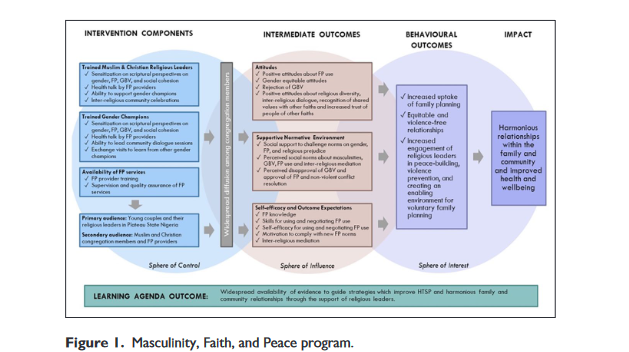
The MFP intervention is an adaptation of the Transforming Masculinities (TM) approach first tested by Tearfund in the eastern Democratic Republic of the Congo. Guided by a theory of change (ToC), the MFP intervention aimed to increase uptake of family planning (FP) methods, promote more gender-equitable roles (e.g., childcare and household chores), and reduce the prevalence of sexual and gender-based violence (SGBV). The intervention also aimed to foster community cohesion and interfaith dialogue in religiously mixed communities. MFP largely focused on shifting social norms to support these outcomes at key transition points in young couples' lives: marriage and early childbearing.
To work toward these objectives, MFP staff collaborated with faith leaders and networks, adapting TM materials to local religious contexts, sensitising leaders, and organising structured, small-group discussions ("community dialogues") delivered by trained gender champions: young adult, partnered males and females in religious congregations selected by local religious leaders as advocates and models for their peers. Community dialogues drew on scriptural reflections on gender equity, SGBV, child spacing, and interreligious relationships and were adapted for both Christian and Muslim congregations. In addition, community-wide activities included supportive talks delivered by religious leaders at congregational meetings, group discussions with congregants led by religious leaders, couple testimonials of change, community mobilisation events focused on key MFP themes, and celebration events for couples completing the community dialogue sessions.
In January 2019, formative work was carried out using the Social Norms Exploration Tool (a participatory guide and set of tools available at Related Summaries, below) to better understand the norms and dynamics of social influence on MFP outcomes. Quantitative baseline surveys were conducted with women 18 to 35 years old and their male partners from April to June 2019; the mixed-methods endline took place from November 2020 to February 2021. In MFP congregations, 335 respondents completed baseline surveys, with 293 (87.5%) retained at baseline. In control congregations, 404 respondents completed baseline surveys, with 338 (83.7%) retained at endline. Social norms were measured based on results from factor analysis. Intent-to-treat analyses assessed intervention effects. Qualitative research in MFP congregations (in-depth interviews (IDIs) and focus group discussions, or FGDs) explored pathways of change.
The cRCT found that all forms of IPV reduced over time among MFP participants. Regression analyses showed a significant 61% reduction in odds of reporting experiencing any IPV among women, a 64% reduction among Christians, and a 44% reduction in MFP congregations, compared to their respective controls. There was a significant intervention effect on reductions in reported experiences of emotional IPV (adjusted odds ratio (aOR) = 0.39; 95% confidence interval (CI) [0.20, 0.77], p < .01), physical IPV (aOR = 0.56; [0.34, 0.93], p < .05), sexual IPV (aOR = 0.44; [0.25, 0.80], p < .01), and any form of IPV (aOR = 0.39; [0.20, 0.74], p < .01) in the previous 12 months, controlling for potential demographic confounders and clustering.
In addition to improvement in norms, the researchers found significant intervention effects on individual attitudes toward IPV and gender roles, relationship quality, and community cohesion. For example:
- Attitudes accepting of gender equity were more similar at baseline, with about one-half of men and women supporting gender equity. At endline, there was marginal improvement among men and significant improvements in change over time for women (aOR = 2.14; [1.27, 3.61], p < .01) compared to controls.
- At endline, there were significant improvements in intention to use nonviolent conflict resolution as an alternative to IPV among both men (aOR = 1.49; 95% CI [1.17, 2.39], p < .05) and women (aOR = 1.57; [1.23, 2.88], p < .01) compared to controls.
- It appears that a larger proportion of MFP participants perceived low community cohesion at baseline, with only about one-third of men and women in MFP congregations perceiving high community cohesion compared to about one-half of respondents in control congregations. At endline, this proportion nearly doubled for MFP respondents while largely staying the same among respondents in control congregations.
Qualitative findings reinforce these pathways, suggesting that critical reflection and dialogue on existing norms and the focus on faith and religious texts were valued by participants and supported IPV reductions. For instance, there was a consensus among informants in most FGDs and IDIs that, in general, IPV was uncommon and unacceptable in their faith communities, with many attributing these perceptions to changes brought about by MFP. Several informants also noted that their perceptions of what is considered IPV have shifted since their involvement in the MFP programme, particularly with coerced sex, which was noted by several informants as previously not being considered as problematic or IPV.
Positive findings were broadly similar for both Muslims and Christians, suggesting that a successful adaptation of MFP activities from their original design in Christian communities, and that norms-shifting interventions can be conducted in multifaith settings.
While perceptions of IPV norms did improve in both MFP and control congregations from baseline to endline, the data did not demonstrate significant differences for perceptions that IPV was typical and/or approved behaviour in respondents' communities comparing intervention participants to controls. The researchers propose various reasons for this finding, such as the fact that, at baseline, a large majority of respondents reported that IPV was neither typical nor approved behaviour in their communities, leading to less variation or room for improvement. "It appears that, despite not shifting...direct normative measures for IPV, the norms-shifting approach of MFP did result in significant improvements in most other individual- and relationship-level intermediate outcomes."
The researchers note that this evaluation of the MFP programme, which reinterpreted religious messaging to highlight gender equity and condemn IPV, demonstrates that "the tremendous influence of religion and faith leaders can be harnessed to improve the health and well-being of faith community members. Further supporting this, in qualitative interviews, most faith leaders testified to their changing attitudes and commitment to MFP messaging and faith community members often explicitly appreciated the faith focus, without which the intervention would be less successful. However, there are still challenges working in faith communities, such as faith leaders and community members simultaneously supporting views that women and men are equals and the need for women to be subordinate to husbands for harmony in the home."
In conclusion: "Findings from this rigorous, mixed-methods, cRCT study demonstrate that programs intentionally designed to shift social norms can substantially reduce the incidence of IPV at the community level in a relatively short time frame. Moreover, this study demonstrates that these decreases can occur, and are perhaps enhanced, through faith-based settings and networks in multifaith communities."
Journal of Interpersonal Violence 1-35. DOI: 10.1177/08862605231176799 - sourced from: Updates from the Global Social Norms Learning Collaborative, July 31 2023.