










































South Asia SBCC Conversation, 7-9 December 2021: Final Report
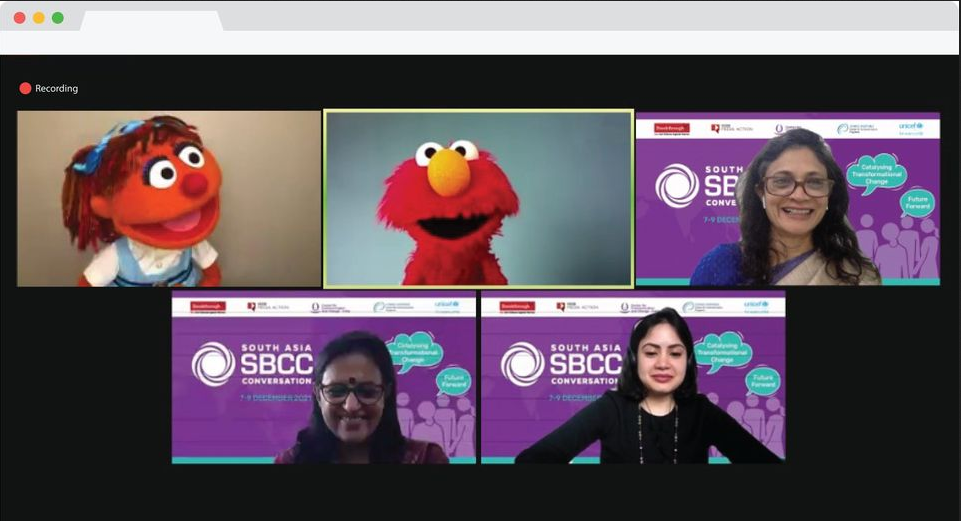
"The virtual regional format has created a sort of equity as it provided an opportunity for people to participate from across the region."
The third International Social and Behavior Change Communication (SBCC) Summit 2020 had to be delayed due to the global coronavirus pandemic. Hoping to keep the SBCC conversation alive and growing until the rescheduled in-person meetup in Marrakech, Morocco, in December 2022, the regional chapter of the Summit for South Asia organised a three-day virtual event in December 2021. This report summarises and provides access to the dialogue and presentations from the event, which brought together SBCC experts, practitioners, researchers, and students working in South Asia to advance dialogue, inspire collaboration, and spark innovation. Specific goals were to:
- Provide a platform to present/share abstracts accepted for 2020 SBCC Summit;
- Build strong momentum in the South Asia region (Afghanistan, Bangladesh, Bhutan, India, Maldives, Nepal, Pakistan, and Sri Lanka) in preparation for the SBCC Summit to be held in December 2022;
- Explore South-Asia-specific issues, initiating a regional dialogue to advance SBCC in the region;
- Engage SBCC experts beyond public health - e.g., those working on humanitarian contexts, the environment, social development, education, public policy, etc.; and
- Share experiences highlighting recent regional SBCC innovation around COVID-19 risk communication and community engagement (RCCE).
The report shares basic information about the gathering, which was hosted on Zoom and also live-streamed on Facebook. The event was guided by a steering committee with representatives from BBC Media Action, Breakthrough, Center for Communication and Change India (CCC-I), Johns Hopkins Center for Communication Programs (CCP), and the United Nations Children's Fund (UNICEF). There was one theme for each day:
- Day 1: SBCC tools & platforms in health & allied sectors - Hosts included: Alka Mahotra, C4D [communication for development] Specialist, UNICEF India; and Sanjeeta Agnihotri, Deputy Director, CCC-I.
- Day 2: SBCC - inclusion, innovation & partnerships - Hosts included: Uttara Bharath Kumar, Senior Technical Advisor, SBC and Capacity Strengthening, CCP; and Urvashi Gandhi, Director, Global Policy and Advocacy, Breakthrough.
- Day 3: COVID-19 RCCE - Hosts included: Sohini Bhattacharya, CEO [chief executive officer], Breakthrough; and Priyanka Dutt, Country Director, BBC Media Action.
Each day began with a common plenary hosted by two emcees from the steering committee. The plenaries featured a section called SBCC Spotlight, which showcased stories of people who have used SBCC to bring about change in themselves and in the community at large. For example, on Day 1, Farheen from Radio Mewat (a community radio station in Haryana, India) talked about her journey from a person who feared stepping outside her house to go to school, to a star radio presenter and an opinion change leader working against domestic violence and for COVID-19 prevention and vaccination. Also that day, Sesame Street India muppets Elmo and Chamki leveraged their funny and endearing qualities to talk about mental health - an issue that has arguably not received the attention it deserves during the pandemic.
Following each plenary were various technical sessions, which covered the following three themes:
- Catalysing transformational change - Topics included: evidence and innovations in SBCC-RCCE; successes and challenges across disciplines such as climate action, gender discrimination and violence, health and well-being, poverty reduction, sustainable consumption, reduced inequality, access to justice; and transformations in leadership at all levels in tackling urgent issues at scale.
- Future forward - Topics included: Mobile technologies; social media; and new partners offering new ways to understand audiences and develop personalised and immersive content across disciplines as mentioned above.
- Connecting the dots - Topics included: interdisciplinary dialogue and collaboration; skills sharing and capacity strengthening for SBCC; creative collective action across different sectors, geographies, disciplines, stakeholder groups, and generations (adults and youth); and engaging non-traditional players/sectors.
Pages 9-22 of the PDF report feature a box with links to each presentation from each day of the Conversation. Also included are the agenda for each day, data from the feedback form, the social media plan, and other details about the event.
The event was dedicated to Vimala Ramakrishnan, one of the founding directors of New Concept Centre for Development Communication and New Concept Information Systems. Vimala, who had acted as a lead advisor for the South Asia SBCC Conversation, passed away on November 27 2021 following a career of more than 4 decades in the social development sector.
Looking forward: "The community engaging in this Conversation can be nurtured if a practice is established for holding this event annually at the South Asia level. Once this practice is set in motion, representatives from the South Asia Conversations can also be included in the SBCC Global Summit 2022, expanding the South Asian presence there, perhaps a South Asia Pavilion can be set up in the offline event. The event successfully created a charged energy amongst all the participants along with creating hope of remaining a united community in the days to come."
Click here to listen to the recordings from December 7 2021. (An example of one video from Day 1 is below.)
Click here to listen to the recordings from December 8 2021.
Click here to listen to the recordings from December 9 2021.
South Asia SBCC Conversation website, February 2 2022.
- Log in to post comments