










































South-South Entrepreneurial Collaboration in Health Biotech
McLaughlin Rotman Centre for Global Health, University of Toronto and University Health Network (Thorsteinsdóttir, Melon, Ray, Chakkalackal, Li, Cooper, Chadder, Daar, Singer); Centre for Sustainable Development, University of Brasilia (Saenz, de Souza Paula), Chinese Academy of Sciences, Beijing (Wen Ke, Lexuan Li); Arid Lands Agricultural Research Institute, Ain Shams University, Cairo (Madkour); Center for Special Studies and Programs, Bibliotheca Alexandrina, Egypt (Aly, El-Nikhely); Research and Information System for Developing Countries, India (Chaturvedi); University of Zambia (Konde)
This article, written by researchers from Canada and five developing countries describes a survey of South-South health biotechnology collaboration. The survey was sent to 469 health biotechnology firms in Brazil, China, Cuba, Egypt, India, and South-Africa, and they were asked about their linkages with all other developing countries. A total of 288 firms responded, reflecting a 62% response rate. It reports that developing countries are turning to each other for affordable and targeted solutions to national health problems, such as "brother-sister" trade relationships between developing countries that allow cheaper drugs and vaccines to reach more economically poor people. It appears in Nature Biotechnology, Volume: 28, Number 5, May 10 2010.
As stated here, there is a growing focus on "science and technology sectors as key areas for encouraging South-South collaboration and ...forging ...bilateral, multilateral and regional agreements....At the same time, analysts have called for increased South-South collaboration to address shared health problems.... Developing countries are increasingly aware of the importance of doing so through joint efforts with one another, and they have set up networks to deal with malaria, tuberculosis, HIV/AIDS and other common diseases."
According to this study, developing countries are establishing mutually beneficial relationships to address health issues they share. Examples include: India and South Africa working together on issues like HIV/AIDS and malaria; Brazil, China, Cuba, Nigeria, Russia, Thailand, and Ukraine networking to promote research and development of diagnostics kits, drugs, and vaccines for HIV/AIDS; and companies collaborating on developing and supplying vaccines, such as Bio-Manguinhos of Rio de Janeiro, Brazil, and the Finlay Institute in Havana, Cuba, producing a meningitis vaccine for the African continent.
Collaboration may offer a conduit to new and foreign markets or enhanced access to strategic knowledge or specific technical skills. "If developing countries can cultivate ways to work effectively together, they may be able to harness a more relevant model of promoting innovation than the traditional model of relying on linkages with developed countries. By pooling their expertise and resources, they could strengthen their capability to address shared problems - problems that may not affect the developed world nor capture the interest of companies there. If successful, South-South collaboration could increase capacity in science-intensive fields by allowing participants to learn from each other, improve the ability of developing countries to address their own problems, and contribute to economic development and quality of life in developing countries."
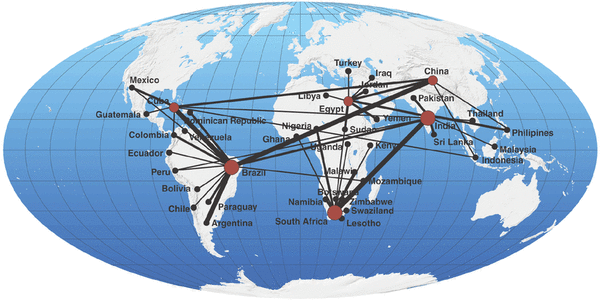
Of the developing world bio-technology firms surveyed for the study, 27 percent were involved in South-South partnerships, though South-North collaborations occurred in 53 percent of firms reporting such relationships. The study also found that "the firms themselves typically initiated the collaborations", though they find it challenging to identify partners in other countries. Due to the challenges of finding information on potential trade partners and building trust with them, according to the study, "...there ...is scope for governments and other third parties to take a more proactive role in initiating collaborations...." Of the countries surveyed, "Chinese companies collaborate mainly with those in Brazil and India, Indian companies have close linkages with those in South Africa, and Brazilian companies have close linkages with firms in Cuba. The only other pairs of countries where companies are involved in a similar level of South-South collaboration are Brazil and Argentina, and South Africa and Botswana."
The survey shows that South-South firm collaborations in health biotech, though widespread, rarely involve innovation - most are end-stage commercial collaborations, but by leveraging their individual strengths and increasing the pool of resources to address their shared problems using an innovation focus, these countries could increase bidirectional knowledge flow. The authors recommend government attention to government policy supporting joint innovation, especially by making cross-border regulatory processes smoother. They further recommend that governments in developing countries and the international community pay attention to the fact that when "health biotech firms in developing countries pool their respective strengths, there is potential for such collaborative efforts to be more cost effective and relevant than the work of health biotech companies in developed countries."
SciDev.Net Weekly Update website, May 10-16 2010. Image courtesy of Nature Biotechnology website
- Log in to post comments