










































A Structural Equation Modelling Approach to Understanding the Determinants of Childhood Vaccination in Nigeria, Uganda and Guinea
Affiliation
Ipsos Healthcare (Bell, Lartey, Fernandez, Darrell, Exton-Smith, Gardner, Richards, West, Sharma); Ipsos Nigeria (Akilo); Ipsos Uganda (Odongo, Ssenkungu); Ciblage Senegal (Kouadio); Ciblage Tuinea (Cissé); Ciblage Ivory Coast (Rérambyah, Adou); Boston University School of Public Health (West)
Date
Summary
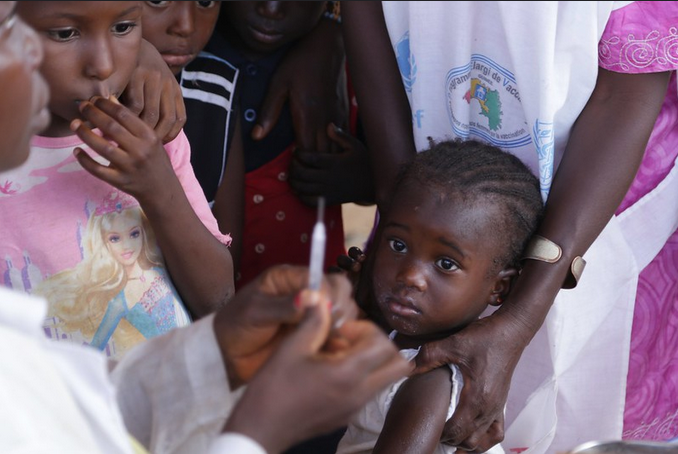
"[V]accination uptake is not determined solely by the attitudes and behaviours of the child's primary caregiver, but by a range of intersecting familial, community and social influences. This suggests that 'whole family' or 'whole community' intervention approaches could be impactful in these contexts."
Low demand for vaccination among caregivers of young children contributes to stagnating coverage rates across Africa. The research on vaccine demand to date suggests that many inter-dependent and context-specific factors contribute to uptake of vaccination services. This study aimed to construct and test a model to explain the determinants of vaccination uptake. The research was conducted in Nigeria, Uganda and Guinea, which were chosen to represent African countries with a range of cultural and religious backgrounds, as well as differing vaccination coverage rates.
Data were collected using a questionnaire, designed using the results of a literature review and a formative qualitative study (see Related Summaries, below), which found that family relationships, social connections, attitudes to healthcare and governmental institutions, and interaction with social and cultural norms around health and child development informed vaccination behaviour. These themes informed the contents of the questionnaire, which was distributed to 3,318 primary caregivers of children aged 1-3 in Nigeria and Uganda between November and December 2020 and in Guinea between July and August 2021. Vaccination status of the sample varied by country, with Uganda reporting 60.4% of children fully vaccinated, and lower percentages in Nigeria and Guinea (36.1% and 40.0%, respectively).
Application of a structural equation model showed that:
Notably, when the analysis is done separately by country, some differences by geography are noted. Thus, interventions should ensure that local contexts are taken into account when designing strategies to encourage adoption of vaccination.
With regard to methodology, this study "moved beyond the standard approach in many explorations of predictors of childhood vaccination demand, which may rely on observed variables only as model inputs." For instance, the analysis was explicitly based on themes identified through prior qualitative research. "A research-based approach, and the choice of structural equation modelling as the analytical tool, ensured that the hypothesised relationships between the explanatory factors had an empirical basis and were stated explicitly rather than assumed. This may result in models that reflect more closely how decisions around vaccination play out in the real world, which may make resulting interventions more appropriate."
In conclusion: "vaccination uptake...is informed by family and community relationships, service delivery experience and attitudes and beliefs towards vaccination. The work has implications for intervention design and suggests that approaches that include entire families and communities in interventions may be beneficial."
Low demand for vaccination among caregivers of young children contributes to stagnating coverage rates across Africa. The research on vaccine demand to date suggests that many inter-dependent and context-specific factors contribute to uptake of vaccination services. This study aimed to construct and test a model to explain the determinants of vaccination uptake. The research was conducted in Nigeria, Uganda and Guinea, which were chosen to represent African countries with a range of cultural and religious backgrounds, as well as differing vaccination coverage rates.
Data were collected using a questionnaire, designed using the results of a literature review and a formative qualitative study (see Related Summaries, below), which found that family relationships, social connections, attitudes to healthcare and governmental institutions, and interaction with social and cultural norms around health and child development informed vaccination behaviour. These themes informed the contents of the questionnaire, which was distributed to 3,318 primary caregivers of children aged 1-3 in Nigeria and Uganda between November and December 2020 and in Guinea between July and August 2021. Vaccination status of the sample varied by country, with Uganda reporting 60.4% of children fully vaccinated, and lower percentages in Nigeria and Guinea (36.1% and 40.0%, respectively).
Application of a structural equation model showed that:
- The probability that a child is fully vaccinated increases if a caregiver has support from others to vaccinate them (B = 0.33, β = 0.21, p<0.001) and if caregivers had poor experiences with the healthcare system (B = 0.09, β = 0.09, p = 0.007).
- Conversely, the probability of full vaccination decreases if the caregiver's husband exerts control over her decision-making ability (B = -0.29, β = -0.20, p<0.001) or if the caregiver perceives vaccines to be of low importance (B = -0.37, β = -0.27, p<0.001).
- Belief in religious protection (B = -0.07, β = -0.05, p = 0.118) and a belief that vaccines are harmful (B = -0.12, β = -0.04, p = 0.320) did not have an observed effect on vaccination status.
- In a comparison of the standardised coefficients (β), the factor with the strongest positive observed impact on vaccination was having support from others to vaccinate. The strongest negative impacts were observed for those who expressed high degrees of control of decisions by the husband and those with stronger beliefs that vaccinations were not important or necessary.
Notably, when the analysis is done separately by country, some differences by geography are noted. Thus, interventions should ensure that local contexts are taken into account when designing strategies to encourage adoption of vaccination.
With regard to methodology, this study "moved beyond the standard approach in many explorations of predictors of childhood vaccination demand, which may rely on observed variables only as model inputs." For instance, the analysis was explicitly based on themes identified through prior qualitative research. "A research-based approach, and the choice of structural equation modelling as the analytical tool, ensured that the hypothesised relationships between the explanatory factors had an empirical basis and were stated explicitly rather than assumed. This may result in models that reflect more closely how decisions around vaccination play out in the real world, which may make resulting interventions more appropriate."
In conclusion: "vaccination uptake...is informed by family and community relationships, service delivery experience and attitudes and beliefs towards vaccination. The work has implications for intervention design and suggests that approaches that include entire families and communities in interventions may be beneficial."
Source
Global Public Health 3(3): e0001289. https://doi.org/10.1371/journal.pgph.0001289. Image credit: ©Nick Loomis for ALIMA/ECHO via Flickr (CC BY-NC-ND 2.0)
- Log in to post comments