










































Structuring a Communication Framework to Address the Challenges of Vulnerable Communities for Building Trust and Ensuring Access to Emergency Health Messages for Compliance during COVID-19
Access Alliance Multicultural Health and Community Services (Alamgir, Usmani, Janczur); University of Toronto (Bhuiyan); Ryerson University (Bhuiyan)
"The World Health Organization...suggested an equity approach framework to prioritize such vulnerable populations for access to resources....Creating a framework for information sharing and dissemination, after analyzing these barriers, is an important strategy during the COVID-19 pandemic to contain the outbreak and mitigate the impact."
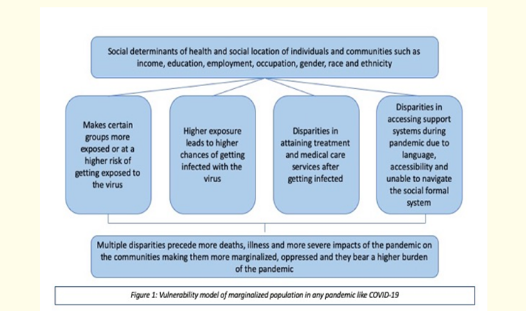
During health emergencies such as the COVID-19 pandemic, authorities seek to build timely awareness and trust in the system by providing credible information to inform and instruct, by promoting protective behaviour, and by dismantling rumours. However, access to and utility of COVID-19 communication materials have been limited for vulnerable populations in Canada due to social determinants of health such as linguistic or technology barriers and by mistrust owing to a history of oppression, colonialism, and racism. This review seeks to: (i) explore the communication resources available in Canada around COVID-19 that are geared to different subsets of the vulnerable population; (ii) identify the social determinants of health that impact accessing and practicing communicated preventive measures; and (iii) develop an equity-informed framework to enhance communication with vulnerable populations during the pandemic.
From June-September 2020, the researchers conducted a systematic review, inclusive of responses to past epidemics. They adopted a scoping review framework and the Preferred Reporting Items for Systematic Review and Meta-analysis for Scoping Review (PRISMA-ScR) model. Then, they consulted five relevant service providers and policy planners to learn about their experiences with programming for vulnerable people during the COVID-19 pandemic.
Selective findings:
- Communication resources available in Canada during COVID-19 for different subsets of population: For example, interventions have been adapted for the specific needs of diverse resident groups and community organisations. As Canada has a pluralistic population, translation services are also available online, including a language repository for the materials in almost 120 languages. Efforts have been made to create digital platforms and technical support for individuals to access information, such as a QR code on documents that people can scan with their cell phone; their preferred language translation comes up on the phone. In addition, Access Alliance, a multicultural community health organisation, has developed a multilingual health library online that is accessible to all with the help of an app; anyone can download the entire interface and navigate the library in their language.
- Importance of information and critical health literacy: Pandemic communications ideally require people's participation and make them major stakeholders who act as partners in the processes of pandemic prevention, control, and recovery. However, responses to any such information are affected by socioeconomic, cultural, and health factors that affect the individual's capacity to interpret the information and act accordingly.
- The most vulnerable - experiencing major barriers to accessing and using health information: Contributing factors to vulnerability are existing health discrepancies experienced by certain groups and populations such as new immigrants and refugees. Other determinants are poor living conditions, low educational level, and language barriers. With regard to information, for example, accessing online and toll-free information helpline support available in English and French may create barriers for those who are not fluent in the official languages and/or who have limited or no access to a phone or the internet.
Findings from the study informed the design of an equity-informed communication preparedness and strategy framework, which is build on a participatory and inclusive process of planning and implementing emergency risk communication materials. The preparedness plan anticipates the limitations of communication materials from an end-user perspective and aims at reducing the barriers and in turn the vulnerability of subgroups. It involves:
- Assessment of the phase of the pandemic for communication: The focus is on providing adequate information, in a timely manner, for prevention, treatment, and support to cope with the pandemic. The message needs to be inclusive, accessible, and understandable by high-risk audiences. Delayed, partial, or incomplete messages can create panic and distrust among people. Therefore, assessment of whom to reach, how to reach them, and what to be communicated at what stage are important considerations for a risk communication process.
- Ongoing communication strategy: Communication during a pandemic needs to be consistent and continuous to reinforce the correct information. In a pandemic situation, communication items may change rapidly; therefore, agencies and social institutions can play a vital role in reaching vulnerable communities. Agencies and social institutions that interact directly with vulnerable people, such as schools, workplaces, service providers, and religious organisations, work as support systems for people at high risk and can be platforms for ongoing communication.
- Medium of communication: Choosing the right medium for communication with vulnerable people is strategic during a pandemic. There are multiple channels of communication such as print, social media, and broadcasting, but they are not accessible equally by everyone. Thus, multiple channels of communication can be used in combination to disseminate consistent and accurate information. Preventing overload of information involves making it simple, offering it in multiple languages, using infographics, and ensuring that it is issue-based and culturally suited for the diverse population.
- People's participation: The effectiveness of any communication strategy is determined by the level of participation of the priority population. Participation empowers people, such as by helping to identify trusted community leaders and resources to be used effectively for emergency risk communication. Social relationships and connections build social and emotional resilience for vulnerable communities to cope with the pandemic and practice safe behaviour.
In conclusion: "With government and civil society taking multiple efforts to reach out to a diverse population, they face challenges around adequate availability of communication resources on one hand and technological hitches with an overload of information on the other. Navigating such information with limited language and digital skills turns out to be challenging for service users in general to seek information. Therefore, a communication preparedness and strategy framework...[can] make the communication process more effective, appropriate and inclusive to reach out to large and diverse audiences."
EC Emergency Medicine and Critical Care 5.2 (2021): 07-16.