










































Target Tuberculosis

Through its projects, Target TB draws centrally on interpersonal communication to equip local people with the skills and knowledge to encourage their fellow community members to seek TB and HIV/AIDS care/services. In many efforts, the involvement of volunteers is a central strategy, and organisers note that involvement of the community in the selection of these volunteers has ensured local participation and ownership of various projects.
The following illustrations of Target TB's work illuminate the core communication strategies (for additional details, visit the Target TB website):
- India:
- Target TB is working in partnership with Alternative for India's Development (AID) to bring TB healthcare and awareness to remote and marginalised tribal communities in Jharkhand and Orissa. AID has strong established relationships with communities in these regions having previously carried out sexual health and HIV control programmes for many years. Building on their community-based and -led experience, AID is integrating TB into their existing programmes. For instance: healthcare workers and community representatives are given training in TB control to improve their knowledge and awareness of TB, reduce stigma and encourage people with, or at risk of, TB to go for testing; mobile clinics provide testing and treatment services to isolated tribal communities where no other facilities are available; activities such as street drama, rallies, advocacy workshops, and regular health newsletters are used to help strengthen community participation in the campaign against TB; and advocacy workshops and regular coordination meetings are held in order to strengthen government TB control efforts and improve the quality of TB services to meet the needs of tribal communities.
- Target TB is working with a network of 6 local Indian NGOs in Theni district, including 1 association of HIV-positive people. With Network Theni, Target TB is: mobilising and coordinating field workers and community volunteers to carry out TB control activities; carrying out TB awareness campaigns to improve the general public's understanding of TB; working in partnership with government health services to ensure best practices for TB treatment and improving access to basic healthcare facilities; strengthening the local support network for people affected by both TB and HIV; and working in collaboration with the Maharashtra Association for Anthropological Science to carry out studies into the impact of community-based TB control programmes and civil society groups' impact. (Study findings will be used to advocate for improvements at local, national, and international levels.)
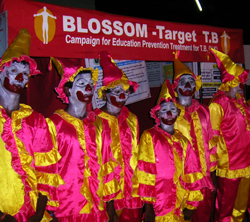
- Target TB has been working in partnership with Blossom Trust, a local NGO based in Virudhunugar District, Tamil Nadu, since 2007. Together, they are: mobilising and training volunteers and members of community groups in TB control and helping them coordinate TB control activities in their local communities; helping TB patients access healthcare services and provide them with home-based care and support treatment in line with Direct Observed Therapy Short course (DOTS); and conducting education campaigns to raise awareness about TB using a range of methods, such as street theatre with "edu-clowns", cable TV programmes, mobile TB exhibitions, and World TB Day activities.
- Target TB is working in partnership with Raphael Ryder-Cheshire International Centre for the Relief of Suffering to provide what they describe as high-quality TB testing services, comprehensive TB treatment support, and a specialised in-patient facility to TB patients.
- Target TB is partnering with AKS Hope, a small community-based organisation working to reduce the burden of TB in the Madrasi slums. As part of this collaboration, awareness raising camps are held in urban slum areas of Dehradun to inform people about the causes, symptoms, treatment, and prevention of TB. Also, volunteers are trained to: identify people with, or at risk of, TB, to refer people with symptoms for testing, and to provide DOTS. Finally, advice, information, and support are provided to TB patients with HIV or drug-resistant TB.
- Malawi: Target TB is collaborating with the Sue Ryder Foundation (SRFIM) on a 3-year effort to provide information and education about TB to people in remote rural areas. During the pilot phase, Government District TB Officers provided 2 information, education, and communication (IEC) officers with training designed to foster their capacity to spread health information messages to the rural communities of Bwanje valley. The IEC officers linked up with SRFIM mobile clinics in remote rural areas where health services are limited, giving health talks at the clinics. These talks sought to educate people on the signs and symptoms of TB, to indicate where to go for testing, and to explain how TB can be treated. The IEC officers also carried out community visits which involved speaking with community leaders, as well as patients and their families. (According to Target TB, because traditional practices often provide the basis for health making decisions in Malawi, it is crucial to involve community leaders and traditional healers). The project also trained 455 volunteers to spread information about TB within their own communities by giving health talks at community meetings. The volunteers also identified people displaying TB symptoms (e.g., coughing for more than 3 weeks) and referred them to the nearest government health centre for testing.
- Pakistan: Target TB is working in low-income areas of Faisalabad with Tamir Welfare Organisation, a local non-governmental organisation (NGO), to promote awareness about TB and to help address the human resource shortages and knowledge gaps within the existing National TB Programme. Organisers are training 500 health workers and volunteers from 50 private and public health institutions in TB management to increase TB identification and provision of DOTS treatment support. As part of this effort, lady health workers are introduced to the use of drama as a means of spreading information about TB. Health education workshops are being held in schools and amongst village leaders, supplemented by informational materials in local languages. Audio-visual equipment is also used to show films about TB and HIV.
- Tanzania: In the Central and Southern Highland Zones, Target TB is working with the Tanzanian Network of Organizations of People Living with HIV/AIDS (TANOPHA) to strengthen HIV positive people's participation in the national response to TB and HIV/AIDS and improve the management of TB and HIV co-infection. Representatives from HIV-positive people's groups are trained on TB prevention and treatment and the relationship between TB and HIV. These representatives then disseminate this knowledge to members of their groups. They also conduct community outreach activities such as public meetings, discussions, drama, and role play to increase awareness, reduce stigma, and encourage people to access health services relating to TB and HIV. Posters and leaflets with TB messages are being produced and distributed by the HIV-positive people's groups to increase awareness of HIV and TB and encourage people to go for TB testing in their local communities.
- Timor-Leste: Target TB is working with a local NGO, Klibur Domin, to implement a TB Outreach Programme in 3 remote rural districts (Bazartete, Liquica, and Maubara). In order to strengthen existing community and health frameworks to support national TB control efforts, organisers are: training local community volunteers on the symptoms, diagnosis, treatment, and prevention of TB; building the capacity of volunteers to help refer people in their own communities for tests and to support TB patients throughout their treatment; and training and mentoring government nurses. The project is overseen by 2 health professionals: a TB resource nurse and a TB health promoter who are responsible for developing and distributing health promotion materials to community members, local leaders, and schools.
- Uganda: Working with the International Medical Foundation (IMF), Target TB is focusing on people living with HIV in the slum areas of Namuwongo district in Kampala. The project aims to investigate the effectiveness of a new technique, microscopic observation technique (MOT), for TB diagnosis in low-resource, HIV-prevalent settings. After a 3-month trial phase, MOT will then be used to test HIV-positive people for TB in the Namuwongo district. Community volunteer workers will be trained to provide TB outreach and support services, including health education. The volunteers will work with local community leaders to educate people living in Namuwongo district about TB.
- Zambia
- Target TB has been working in partnership with Zambian NGO Bwafwano Home Based Care Organisation (Bwafwano) in the Mkushi district since 2003; a grant from Comic Relief awarded in 2007 is supporting a 5-year integrated TB-HIV programme to raise awareness of TB and HIV/AIDS and improve access to health care services for over 55,000 people. Activities include: provision of direct support to people affected by TB and HIV, including home-based care and support services, basic medicines, nutritional supplements, transport to medical facilities and opportunities for income-generating activities; training local volunteers and peer educators, ensuring they are able to respond effectively to the needs of people affected by TB and HIV in their communities; conducting health talks, street dramas, mass awareness raising events, and establishing patient support groups; and establishing sustainable community networks to highlight and respond to the needs of people affected by TB and/or HIV, through collaboration with government health staff, other NGOs, and community-based organisations.
- Since 2001, Target TB has been working with the Zambian NGO Zatulet; in 2007, Target TB was awarded a grant from The Big Lottery Fund to implement a 5-year project with Zatulet. The project involves highly motivated and committed volunteers who work from 8 branches, across 4 provinces of Zambia. Key goals include empowering communities with the knowledge and skills to prevent and treat the disease, increasing people's access to TB testing and treatment services, improving the welfare of people affected by TB, and raising awareness in the wider population. Outreach activities in the local communities identify people with TB symptoms and refer them to the nearest testing and treatment centre. Also, organisers are providing home-based care and support for people affected by TB, including monitoring treatment adherence, providing psychosocial counselling, helping with household chores, and establishing TB/HIV support clubs. Trained volunteers inform the public about TB and HIV through activities such as health talks, street drama, one-to-one counselling, and large-scale awareness raising events.
The Target TB website provides information and resources such as a resource pack for teachers to use primarily with pupils aged 13 years or older. Target TB believes that it is particularly useful for the Citizenship programme of study. It features a lesson plan complete with a choice of suggested activities and resources, as well as comprehensive teachers' notes, follow-up ideas, and online resources about TB in the Global South.
Tuberculosis.
AID, AKS Hope, Blossom Trust, IMF, Klibur Domin, Network Theni, Raphael Ryder-Cheshire International Centre, SRFIM, Tamir Welfare Organisation, TANOPHA, and Zatulet.
Target Tuberculosis website on May 4 2006, March 16 2007, and December 7 2009.

- Log in to post comments