










































Together We Can
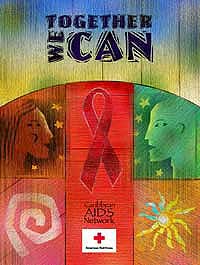
Launched in 1993 in Jamaica as a joint effort between the American Red Cross and the Jamaican Red Cross, Together We Can is a Red Cross/Red Crescent methodology for working with youth that uses a peer-to-peer approach to raise awareness about HIV and AIDS.
The initial programme inspired the creation of the Red Cross Caribbean AIDS Network, which took the lead in key regional youth prevention initiatives. This network then provided the tools for Red Cross leaders throughout the region - and beyond - to replicate Together We Can in their own cultural context. By the end of 2002, Together We Can was being implemented in 10 countries in the Caribbean. In 2003, the materials were revised and translated into English, Spanish, French, Creole, and Papiamento. In November of the same year, having recognised the importance of the communication approach developed with the methodology, Red Cross health staff introduced the peer education methodology underpinning Together We Can in Central America. As of 2008, Together We Can is being implemented in 7 countries in Central America, including the Dominican Republic, and 3 countries in South America.
"It is not only appropriate for raising awareness about HIV and AIDS but also a way to educate our youth about sexually transmitted infections (STIs), teenage pregnancies, child abuse and life choices that young people face in relation to their reproductive and sexual rights".
Recently, a Regional Faculty was set up with support of the International Federation of Red Cross and Red Crescent Societies to ensure the quality of the methodology and guarantee its adequate update.
Recognising that young people feel more at ease when talking to their peers, Together We Can places an emphasis during peer educator training on helping young people (aged 13 and 19 years) develop the necessary skills to conduct different learning techniques. These are meant to be dynamic interactive educational techniques such as: role-playing, group discussions, quizzes, etc. using a non-judgmental approach. Participants are encouraged (and supervised) to act as information disseminators and behavioural change agents.
The core areas of training include knowledge (e.g., identifying family planning clinics, STI clinics, health centres, and pharmacies as places to get condoms), attitudes (e.g., expressing a willingness to interact in everyday situations with people living with HIV and AIDS), and skills (e.g., demonstrating the ability to tell others how HIV is transmitted and prevented).
An interactive online forum was set up to act as a place where young Together We Can participants can exchange experiences, discuss issues, continue friendships, and engage in moderated sessions. The use of the internet here is a tool for - it is hoped - reducing the numbers of young people being infected with HIV while promoting care and support to those who have been infected and affected.
HIV/AIDS, Children, Youth.
The following statistics are drawn from the Joint United Nations Programme on HIV/AIDS (UNAIDS) in the report titled "2008 Report on the Global AIDS Epidemic":
Caribbean:
- An estimated 230,000 [210,000-270,000] people were living with HIV in the Caribbean in 2007 (about three-quarters of them in the Dominican Republic and Haiti).
- An estimated 20,000 [16,000-25,000] people were newly infected with HIV in this region.
- Some 14,000 [11,000-16,000] people died of AIDS in 2007.
Latin America:
- There were an estimated 140,000 [88,000-190,000] new HIV infections in this region in 2007.
- The number of people living with HIV in this region is approximately 1.7 million [1.5 million-2.1 million].
- An estimated 63,000 [49,000-98,000] people died of AIDS in 2007.
In 2004, a consultancy firm (Itaca Assesorias) was hired to develop a monitoring and evaluation Together We Can toolkit to be implemented in all National Societies in the Caribbean and Central America in 2005. This toolkit is designed to measure impact in Together We Can programmes in the region.
In Suriname, where the programme was launched in 2007, by the end of that year approximately 4,000 young people were reached, most of whom are between the ages of 15 and 25 years. Sahida Leerdam (age 21), a public administration student in Suriname who participates in Together We Can, says, "We use the same vocabulary as our peers. When trainers and trainees use the same language, you get this relaxed atmosphere where everybody feels on the same level....In my circle of friends and fellow students, I notice that HIV/STI only becomes a topic when they are somehow involved in working for an organization like Red Cross, or another voluntary job. That's why I think the educational materials we produce should be made in such a way that they have a strong impact. Is a brochure colourful, does it lead to action? I like the infomercials the region shows on television, as a young woman I feel connected, right then and there. A line like: 'Make your next date special. Get tested.' I love it!..."
Jamaica Red Cross, the Norwegian Red Cross, Netherlands Red Cross, the Norwegian Agency for Development (NORAD), the United Nations Children's Fund (UNICEF).
Tabiki Productions' "Young in the Caribbean: The Caribbean Children & Youth Development Bulletin" [Vol. 5 (2007), No. 2 (December)] - forwarded from Marieke Visser to The Communication Initiative on January 9 2008; Together We Can: The Methodology - Youth Peer Education [PDF]; Caribbean Red Cross website; and emails from Mrs. Norma García de Paredes and Marie Louise Belanger to The Communication Initiative on May 2 2008 and November 10 2008, respectively.
- Log in to post comments