
























Health action with informed and engaged societies
After nearly 28 years, The Communication Initiative (The CI) Global is entering a new chapter. Following a period of transition, the global website has been transferred to the University of the Witwatersrand (Wits) in South Africa, where it will be administered by the Social and Behaviour Change Communication Division. Wits' commitment to social change and justice makes it a trusted steward for The CI's legacy and future.
 
Co-founder Victoria Martin is pleased to see this work continue under Wits' leadership. Victoria knows that co-founder Warren Feek (1953–2024) would have felt deep pride in The CI Global's Africa-led direction.
 
We honour the team and partners who sustained The CI for decades. Meanwhile, La Iniciativa de Comunicación (CILA) continues independently at cila.comminitcila.com and is linked with The CI Global site.
Time to read
less than
1 minute
Read so far

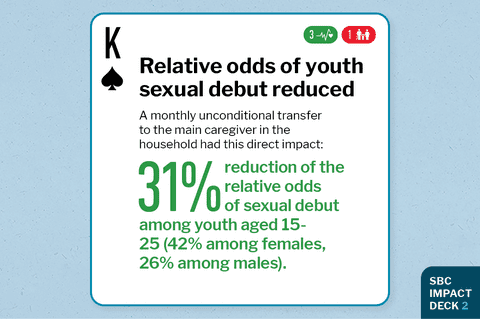
Unconditional Cash Transfer - Reduced Relative Odds of Sexual Debut among People Ages 15-25 by 31%
0 comments

Strategy researched

An unconditional transfer of US$20 per month directly to the main caregiver in the household

Impact achieved

The programme reduces the relative odds of sexual debut among young people ages 15-25 by 31%, with larger impacts among females (42%) relative to males (26%). In relation to the mean, this implies a 23% reduction in the likelihood of sexual debut among the full sample, and 35% and 18% for females and males, respectively.

Country of study

Kenya

Research methodology

RCT

Journal

PLOS ONE; 2014

Journal paper title and link

The Government of Kenya's Cash Transfer Program Reduces the Risk of Sexual Debut among Young People Age 15-25

Excerpt from Abstract

"The aim of this study is to assess whether the Government of Kenya's Cash Transfer for Orphans and Vulnerable Children (Kenya CT-OVC) can reduce the risk of HIV among young people by postponing sexual debut....[R]esults...show that the program reduced the odds of sexual debut by 31 percent. There were no statistically significant effects on secondary outcomes of behavioral risk such as condom use, number of partners and transactional sex. Since the CT-OVC provides cash to the caregiver and not to the child, and there are no explicit conditions associated with receipt, these impacts are indirect, and may have been achieved by keeping young people in school. Our results suggest that large-scale national social cash transfer programs with poverty alleviation objectives may have potential positive spillover benefits in terms of reducing HIV risk among young people in Eastern and Southern Africa."

Summary at this link