










































Using Farming Families' Perspectives to Inform Recommended Priority Practices
"Regardless of specific practices being promoted, UPAVAN videos should model good decision-making and positive communication styles. Additional opportunities to help farming families build communication, planning, and joint decision-making skills should also be explored."
As an adaptable, participatory approach, community video has been described as a promising intervention to increase nutrition sensitivity within agricultural programmes by delivering both nutrition-sensitive agriculture and nutrition-specific maternal, infant, and young child nutrition (MIYCN) and hygiene content. By combining the power of traditional storytelling with low-cost technology, the Strengthening Partnerships, Results, and Innovations in Nutrition Globally (SPRING) project and Digital Green (DG) have developed a community video social and behaviour change (SBC) approach to improve maternal and child health and nutrition outcomes in Keonjhar District, Odisha State, India. In 2016, a group of partners led by the London School of Hygiene and Tropical Medicine (LSHTM) began a randomised control trial (RCT) to assess the impact and cost-effectiveness of this intervention on maternal and child nutritional status. The LSHTM-led RCT, formally called Upscaling Participatory Action and Videos for Agriculture and Nutrition (UPAVAN), is exploring the effect of community video on nutrition outcomes. LSHTM is implementing the RCT with partners DG, the Voluntary Association for Rural Reconstruction and Appropriate Technology (VARRAT), JSI Research and Training Institute (JSI), SPRING, and Ekjut, with funding provided by the Bill and Melinda Gates Foundation. This report describes the results of formative research conducted in September and October 2016, during the first year of UPAVAN.
The report provides context for the intervention in the rural Keonjhar District, Odisha State, India, where seasonal food insecurity, as well as sub-optimal diet, health care, and water, sanitation, and hygiene (WASH) practices, contributes to high rates of undernutrition. In the community video model, partners train and support agriculture and health workers to promote improved agriculture and nutrition practices by producing and discussing community-made videos at monthly women's group meetings.
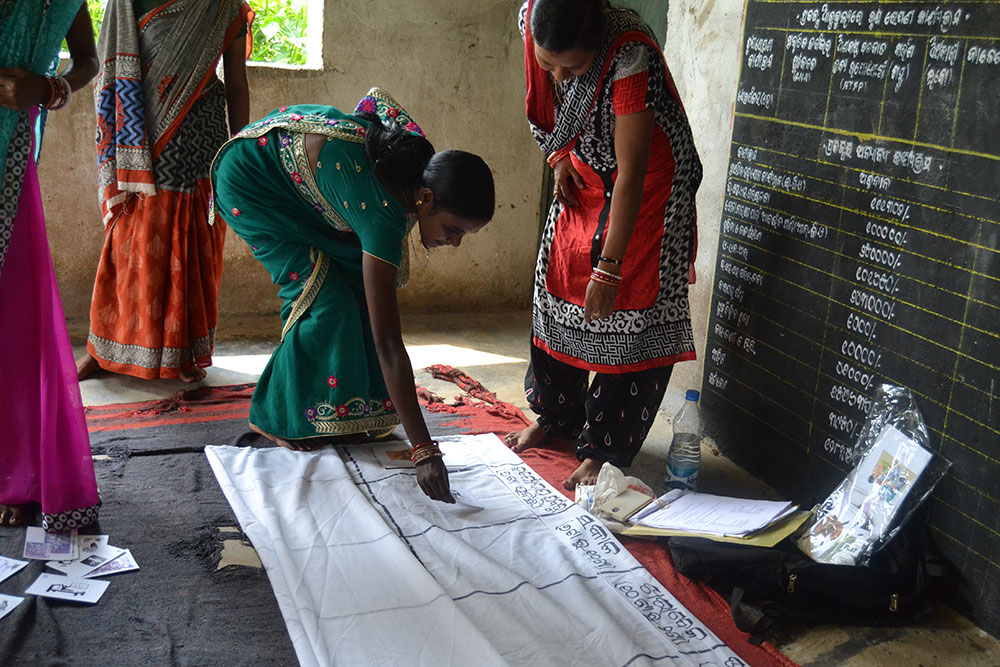
The UPAVAN formative research prioritised exploring current nutrition-sensitive agriculture practices, knowledge, and beliefs, as well as addressing gaps and remaining questions from research carried out in 2012 around MIYCN and hygiene practices, knowledge, and beliefs. The objective of the formative research was to gain a deeper understanding of current nutrition-sensitive agriculture and nutrition-specific MIYCN and hygiene practices, priorities, and preferences of primary and influencing groups or audiences, and other barriers and facilitators of key practices in the study area. Focus group discussions included open-ended questions, a participatory food ranking using pile sorts, and an exercise to fill out daily activity charts for participants themselves and for their family members. The team conducted 32 such focus group discussions in eight villages over a seven-day period, as well as observational transect walks in all eight villages.
Behavioural models, including the COM-B model, the socio-ecological model, and cognitive models, informed the design of the research protocol and instruments. These models indicate that to create an effective programme, UPAVAN will need to:
- promote practices in local terms (for example, what do respondents value in food?)
- link improved practices to short-term risks and benefits
- develop messages that get people's attention and engage their emotions as well as their minds
- leverage existing social identities and gender roles (where possible) to enable, rather than constrain, participants to act on messages
- think about whether the enabling environment will support adoption of the practices UPAVAN promotes.
UPAVAN partners used this behavioural lens to refine the project theory of change, which can be found in Annex 3 of the report.
In brief, SPRING learned which foods communities perceived positively, and which foods were considered expensive or harmful. There was broad consensus with slight variation based on market access and very localised food taboos. SPRING and project implementers used these findings to determine priority crops/livestock to promote for production, consumption, and sale, as well as priority foods to promote for consumption. Relevant context-appropriate nutrition-sensitive agriculture interventions include, for example, safely intensifying production, improving post-harvest processing and storage, and prioritising purchase of desirable and healthful foods.
The researchers also learned how respondents think about gender roles, what their decision-making about health care or money looks like, and what their ideals are about successful farming or good family relationships. For example, the ideal of a "good relationship" between a mother-in-law and a daughter-in-law and between a husband and wife includes "friendly" communication, task sharing for food preparation and childcare, and joint decision-making about finances, agriculture, and festival observations (a year-round issue affecting spending and diet decisions).
Findings related to women's empowerment were key to designing interventions promoting additional rest and less heavy work for pregnant women and increasing women's participation in farm and household decision-making. As these practices fit well within existing norms and family roles, they are more likely to be adopted, and thus more likely to contribute to nutrition. For example, respondents stated that husbands and grandmothers have important roles in caring for pregnant women and that pregnant women should work less and refrain from heavy tasks.
Concrete data from direct observations and secondary data about nutritional content of local foods complemented the more abstract data about respondents' behavioural ideals, which allowed SPRING and partners to set priorities on which MIYCN, agriculture, and nutrition-sensitive agriculture practices to promote. Specifically, the findings of the formative research informed three key outcomes:
- Recommendations for nutrition-specific MIYCN/hygiene and nutrition-sensitive agriculture practices to promote in community videos. Social and behaviour change (SBC) interventions such as this are thought to be more effective if they promote a limited number of practices. SPRING and its partners used formative research findings to identify a limited number of priority crops and livestock to promote throughout the intervention, as well as appropriate nutrition-sensitive agriculture and nutrition-specific MIYCN practices.
- Recommendations of key crops and foods to feature in community videos and to promote for cultivation and sale or consumption, based on nutrient content and community members' perceptions of availability, affordability, tastiness, and healthfulness.
- Revisions to an existing MIYCN/hygiene training package and the creation of a nutrition-sensitive agriculture training for community-level video production teams and extension workers. These training packages were adapted to the findings of the formative research and prioritised practices, and aimed to provide sufficient technical background for UPAVAN teams to produce videos and effectively mediate community video disseminations throughout the intervention.
The next step for SPRING will be to update the MIYCN/Hygiene and hygiene training package, develop the nutrition-sensitive agriculture training package, and support the training of trainers and rollout of these trainings to community workers. These packages will include general technical background as well as some of the specific recommended practices, along with a discussion of barriers and enablers identified in this formative research. The next step for all UPAVAN partners will be to decide on the number and sequencing of videos and to then create the package of practices (POPs) and storyboards for those videos.
SPRING website Image caption/credit: "During a mothers' focus group, women complete a daily activity chart exercise." SPRING
- Log in to post comments