










































Using Human-Centered Design to Co-Design Dedicated Menstrual Health Spaces with People Who Menstruate in Bidi Bidi Refugee Settlement, Uganda: Learnings for Further Adaptation and Scale in Humanitarian Settings
Affiliation
Youth Development Labs (YLabs)
Date
Summary
"[T]here is an urgent need to actively involve people who menstruate during the design, development, and testing of MH [menstrual health] innovations to ensure their needs and preferences are met."
Many people who menstruate in low- and middle-income countries (LMICs) struggle to manage their menstruation safely, hygienically, and with dignity. This problem is exacerbated in humanitarian settings, where there is a need to tailor programmes to the specific contextual nuances. To address these challenges, Youth Development Labs (YLabs) used a human-centred design (HCD) approach to co-design the Cocoon Mini, a safe, physical structure for managing menstruation in the Bidi Bidi Refugee Settlement in Uganda. This paper describes the 5-phase HCD approach that guided the building of 20 Minis during the summer of 2021, including the 3-month pilot that was conducted to assess its desirability, acceptability, and feasibility.
HCD is a creative, iterative, and participatory process that seeks to engage participants in co-designing, developing, and testing potential solutions. Co-design empowers participants to tailor interventions to their specific health and cultural needs, making MH interventions more acceptable to users and, therefore, more likely to be adopted and sustained. The approach relies on real-world prototyping and rapid iteration of potential solution ideas based on participant feedback. Each research phase informs the final design by selecting and refining low-fidelity prototypes until one final high-fidelity intervention is implemented and evaluated during a pilot phase.
As outlined in the paper, this project engaged a total of 340 people, including people who menstruate, male community members, and community stakeholders, participated in interviews, focus groups, and co-design sessions. Highlights from the 5 phases include:
Furthermore, by creating a safe, dedicated household space for menstruation, participants reported speaking more openly about MH after observing and actively participating in MH best practices. In total, 47% of people who menstruate reported having more discussions about MH with men and boys since the creation of the Mini space. Having a physical space for men and boys to ask about, and for people who menstruate to directly refer to, made them feel more comfortable and confident talking about MH to other community members. They reportedly liked explaining the importance of the Mini features. However, some people who menstruate reported feelings of fear, shame, and embarrassment when using the Mini around boys and men; there was also a rumour that sexually transmitted infections (STIs) could be contracted from using the communal Mini space.
In that vein, "Potential software solutions to accompany implementation of hardware solutions like the Cocoon Mini include social and behavioral interventions that foster dialog and challenge traditional beliefs. To ensure long-term, lasting change, targeted sensitization forums where comprehensive sexual/reproductive health issues can be openly discussed by men and women alike are necessary....With open dialogue and sensitization training, men and boys can understand menstruation and, ideally, gradually become advocates for the well-being of the women and girls in their community..."
In conclusion: "The Cocoon Mini has the potential to expand far beyond the bounds of the Bidi Bidi Settlement with the scalability of the physical spaces interlinked with the sustainability of the solution itself. Using HCD to understand each community's specific needs would allow for nuanced customization of the Minis based on cultural beliefs and available infrastructure....[T]he iterative, creative, and user-centered nature of the HCD process allowed the team to work in partnership with both people who menstruate and key community stakeholders to prototype and develop solutions which integrate people who menstruate's priority needs for safety, privacy, hygiene, and disposal. Furthermore, local ownership of Mini construction and maintenance allowed for agency and decision-making power to be concentrated within the community....Therefore, MH facilities like the Cocoon Mini should be considered a high-priority intervention in humanitarian settings."
Many people who menstruate in low- and middle-income countries (LMICs) struggle to manage their menstruation safely, hygienically, and with dignity. This problem is exacerbated in humanitarian settings, where there is a need to tailor programmes to the specific contextual nuances. To address these challenges, Youth Development Labs (YLabs) used a human-centred design (HCD) approach to co-design the Cocoon Mini, a safe, physical structure for managing menstruation in the Bidi Bidi Refugee Settlement in Uganda. This paper describes the 5-phase HCD approach that guided the building of 20 Minis during the summer of 2021, including the 3-month pilot that was conducted to assess its desirability, acceptability, and feasibility.
HCD is a creative, iterative, and participatory process that seeks to engage participants in co-designing, developing, and testing potential solutions. Co-design empowers participants to tailor interventions to their specific health and cultural needs, making MH interventions more acceptable to users and, therefore, more likely to be adopted and sustained. The approach relies on real-world prototyping and rapid iteration of potential solution ideas based on participant feedback. Each research phase informs the final design by selecting and refining low-fidelity prototypes until one final high-fidelity intervention is implemented and evaluated during a pilot phase.
As outlined in the paper, this project engaged a total of 340 people, including people who menstruate, male community members, and community stakeholders, participated in interviews, focus groups, and co-design sessions. Highlights from the 5 phases include:
- Background research: Stakeholders within the settlement spoke of exposed, crowded toilet and bathing facilities in schools and in the community. Using these facilities, especially at night, often left girls and women vulnerable to sexual and gender-based violence.
- Design research: Among the insights that emerged: Participants explained that sexual education focused predominantly on abstaining from sex to avoid pregnancy, leaving little room for discussion on menstruation, puberty, and bodily autonomy. Men and boys shared that they are largely excluded from conversations on MH, which fuels rumours and narratives around menstruation being "dirty", and that those who are currently menstruating should not participate in certain activities. In terms of process, during this phase, research team members living in the community started actively engaging with community leaders and members by hosting sensitisation and education meetings about MH to incentivise community buy-in for the project and to build trust.
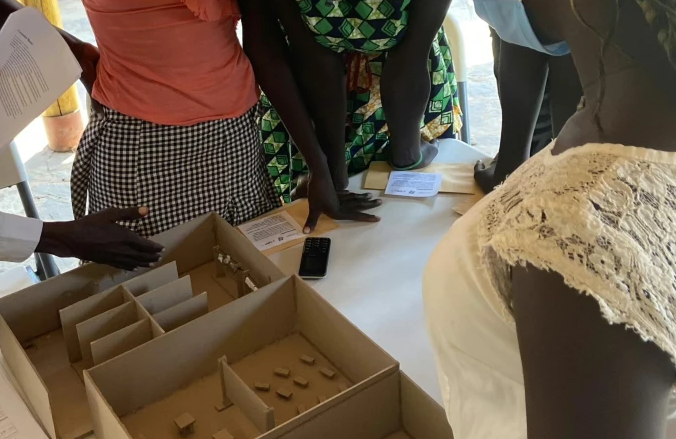
- Rough prototyping: Four prototypes were developed to address challenges related to education, menstrual products, and supportive infrastructure. For example, to generate conversation and increase education about menstruation, the researchers tested the idea of a monthly community storytelling event. During the event, young women and girls would share their experiences with menstruation and sexual health, along with educational content and sanitary product demonstrations. Ultimately, it was not possible to take this idea forward due to COVID-19 restrictions limiting community gatherings at that time.
- Live prototyping: Researchers invited 86 new individuals, which included 58 people who menstruate, 13 boys, and 15 health and humanitarian workers, to engage with high-resolution prototypes, to use them over several weeks, and to give feedback to the design team for further improvement. The researchers then tested the Cocoon Mini in a live setting. (Each structure was built alongside a preexisting pit latrine by attaching a bathing structure made out of iron sheets for privacy. See the full paper for a details and an illustration.) Participants articulated the importance of local ownership in the construction and maintenance of the site in order to foster a sense of communal responsibility.
- 3-month pilot: The Mini was evaluated qualitatively for feasibility and acceptability during the 3-month pilot using structured interviews with 109 people who menstruate utilising Mini structures, 64 other community members, and 20 Mini supervisors.
Furthermore, by creating a safe, dedicated household space for menstruation, participants reported speaking more openly about MH after observing and actively participating in MH best practices. In total, 47% of people who menstruate reported having more discussions about MH with men and boys since the creation of the Mini space. Having a physical space for men and boys to ask about, and for people who menstruate to directly refer to, made them feel more comfortable and confident talking about MH to other community members. They reportedly liked explaining the importance of the Mini features. However, some people who menstruate reported feelings of fear, shame, and embarrassment when using the Mini around boys and men; there was also a rumour that sexually transmitted infections (STIs) could be contracted from using the communal Mini space.
In that vein, "Potential software solutions to accompany implementation of hardware solutions like the Cocoon Mini include social and behavioral interventions that foster dialog and challenge traditional beliefs. To ensure long-term, lasting change, targeted sensitization forums where comprehensive sexual/reproductive health issues can be openly discussed by men and women alike are necessary....With open dialogue and sensitization training, men and boys can understand menstruation and, ideally, gradually become advocates for the well-being of the women and girls in their community..."
In conclusion: "The Cocoon Mini has the potential to expand far beyond the bounds of the Bidi Bidi Settlement with the scalability of the physical spaces interlinked with the sustainability of the solution itself. Using HCD to understand each community's specific needs would allow for nuanced customization of the Minis based on cultural beliefs and available infrastructure....[T]he iterative, creative, and user-centered nature of the HCD process allowed the team to work in partnership with both people who menstruate and key community stakeholders to prototype and develop solutions which integrate people who menstruate's priority needs for safety, privacy, hygiene, and disposal. Furthermore, local ownership of Mini construction and maintenance allowed for agency and decision-making power to be concentrated within the community....Therefore, MH facilities like the Cocoon Mini should be considered a high-priority intervention in humanitarian settings."
Source
BMC Women's Health (2023) 23:319. https://doi.org/10.1186/s12905-023-02421-0. Image credit: YLabs
- Log in to post comments