










































Using Immersive Virtual Reality to Improve the Beliefs and Intentions of Influenza Vaccine Avoidant 18- to 49-Year-Olds: Considerations, Effects, and Lessons Learned
University of Georgia (Nowak, Evans, Wojdynski, Ahn, Len-Rios); Oak Ridge Associated Universities (Carera, Hale, McFalls)
"By increasing the ability to convey key vaccine and immunization concepts, immersive VR could help address vaccination hesitancy and acceptance challenges."
According to the United States (US) Centers for Disease Control and Prevention (CDC), during the 2017-18 flu season, only 26.9% of US 18- to 49-year-olds received a recommended annual influenza vaccination. This low acceptance of flu vaccination has mobilised researchers to seek out more persuasive ways to educate and motivate US adults to accept flu vaccination. The findings from this study suggest that immersive virtual reality (VR) can be an effective vaccination communication tool by showing people how flu spreads, its impact on others, and the possible effects of their decisions, such as not getting a flu vaccine.
The 171 participants in this study self-identified as those who had not received a flu shot in the last year and did not plan to receive one during the 2017-18 influenza season. Participants were randomly assigned to one of four groups: (i) a 5-minute VR experience; (ii) a 5-minute video that was identical to the VR experience but without the 3-dimensional and interactive elements; (iii) an e-pamphlet that used text and pictures from the video presented on a tablet computer; and (iv) a control condition that only viewed the CDC's influenza Vaccination Information Statement (VIS), which is often provided before a flu vaccine is given and describes benefits and risks. Participants in the VR, video, and e-pamphlet conditions also viewed the CDC VIS before answering a series of questions regarding flu vaccination, including whether they would get a flu vaccine.
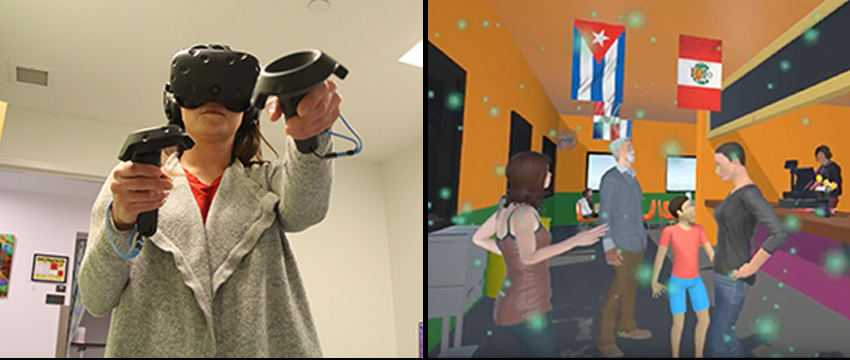
In the VR condition, participants were provided headsets that enabled them to vividly experience the information and events being shown as if they were in the story, which begins with the participant in a restaurant enjoying a dinner with friends. Someone sneezes, spreading the influenza virus to the people around him. The participants were shown that two people, a child and an older man, were taken to the hospital. Then the user, equipped with a video game controller, was taken inside the body of someone infected with flu and prompted to actively participate in the story by trying to fight the virus with antibodies. However, if the person in the VR simulation wasn't vaccinated, there weren't enough antibodies to "fire at" the virus; if they were vaccinated, participants saw what a difference it makes to fight the flu.
Compared to video or the e-pamphlet, the VR condition created a stronger perception of presence - that is, a feeling of "being there" in the story. The idea is that this subjective perception that one is genuinely experiencing what is depicted in the mediated world can enable the future positive or negative consequences of health behaviours to be experienced as if they were presently happening. This presence, in turn, increased participants' concern about transmitting flu to others and had significant positive effects on perceptions of one's flu susceptibility, influenza severity (on both self and others), vaccination confidence, confidence that one's vaccination would protect others, and flu vaccination intention. Neither the e-pamphlet nor the video was able to elicit a sense of presence, nor were they able to improve the impact of the VIS on the confidence, belief, and intention measures.
Thus, the success of the immersive VR experience is that it gave participants a sense of "being there", or engagement in the story. The investigations of underlying mechanisms revealed that "it was not the mere use of VR technology driving the positive effects, but VR's ability to positively influence key psychological variables, such as the perception of presence or indirectly, the concern for others' well-being. Prior studies have found that immersion, or the breadth of sensory cues provided by the media modality or platform, is a key predictor of presence..."
All that said, "one should not equate elicitation of presence with persuasion effectiveness nor view it as the only mediating variable that matters. Presence may be viewed as a necessary but insufficient outcome when it comes to fostering vaccination acceptance. In this study, presence mattered because it directly affected concern about spreading flu to others and fostered indirect effects on beliefs, confdence, and intention. Intuitively it would seem that presence would increase empathy, but the story in this study did not emphasize the symptoms of the infected individuals and most participants appeared to have high existing empathy for those sick with flu."
The researchers cite studies demonstrating the possibility of using other media modalities, such as short videos and e-pamphlets, to deliver narratives intended to elicit high levels of presence. This may be useful for organisations with limited time and funds to develop and pre-test immersive and interactive VR-based education materials.
The researchers plan to conduct the VR study with a larger number of people. Among other areas to investigate: using VR to educating adults and parents about vaccination recommendations, including the identification of topics that facilitate vaccination acceptance.
Click here to listen to Glen Nowak and Karen Carera discuss the research further in the "Further Together" podcast.
Vaccine https://doi.org/10.1016/j.vaccine.2019.11.009 - sourced from "How VR can encourage more adults to get their flu shots", by Michael Walter, January 6 2020; "Could immersive virtual reality provide a path to increased flu vaccination rates?"; "Virtual reality could help flu vaccination rates", by Sarah Freeman, December 2 2019; and "Encouraging young adults who don't get a flu vaccination to get one: Study finds virtual reality may provide a path to increased acceptance" - all accessed on January 9 2020. Image credit: Sarah Freeman