










































"Vaccinating Your Child during an Emergency Is More Important than Ever": A Randomised Controlled Trial on Message Framing among Ukrainian Refugees in Poland, 2023
European Centre for Disease Prevention and Control - ECDC (Winters); United Nations Children's Fund (UNICEF) Refugee Response Office in Poland (Sochoń-Latuszek, Nurzhynska) - plus see below for full authors' affiliations
"[T]his online, randomised controlled trial...found that a short message focussing on risk aversion (while also highlighting the vulnerable situation refugees are in) increased vaccination intention and clicks on a vaccination scheduler among refugee mothers from Ukraine currently residing in Poland."
The full-scale war in Ukraine, which began in February 2022, caused millions of women and children to flee to places such as neighbouring Poland. A multitude of barriers, including communication barriers, often prevent migrants and refugees from accessing healthcare and vaccination services. Vaccination uptake among Ukrainian refugee children in Poland remained suboptimal in 2023. In order to inform interventions meant to reach this population, this study sought to test the effect of various message frames on the intention of Ukrainian refugee mothers to get their child vaccinated in Poland.
As outlined here, deciding to get vaccinated is a complex behaviour that is influenced by multiple factors. The Behavioural and Social Drivers of Vaccination framework (BeSD) suggests that 'thinking and feeling', 'social processes', and 'practical issues' can be important determinants of vaccination motivation and vaccination behaviour. 'Thinking and feeling' refers to the cognitive and emotional processes around both vaccination and vaccine-preventable diseases. 'Social processes' include vaccination recommendations as well as perceived social norms around vaccination. How pro-vaccine messages are framed may influence not only these elements but also the perception of practical issues. This framing in turn may affect vaccination motivation.
The researchers conducted an online survey with an embedded randomised controlled experiment. Using a questionnaire partially based on the published BeSD questionnaire, they tested 3 pro-vaccine messages and compared their effectiveness on increasing the intention to vaccinate a child as well as the likelihood of clicking on a vaccination scheduling link. Briefly, the messages were based on insights from a previous survey among Ukrainian refugee mothers living in Poland, showing a relatively high trust in Polish health workers, a perceived difficulty to access health services in Poland, and the tendency to delay childhood vaccination. All intervention messages started with a first sentence that encouraged the mothers to have their children vaccinated in Poland. The next sentence varied per group, which highlighted confidence in Poland's healthcare system (Group 1: trust), emphasised the accessibility of vaccinations (Group 2: access), or underscored the importance of immunisation to mitigate risks while in a vulnerable state as a migrant (Group 3: risk aversion).
Data were collected between June 27 and July 18 2023. A total of 1,910 Ukrainian mothers living in Poland with at least one child under the age of 7 years completed the study. Before exposure to the intervention or control messages, 49% of participants said they intended to get their child vaccinated in Poland in the next 6 months. After reading the intervention message, this figure increased to 53% for the mothers randomised to the risk aversion group, which resulted in an adjusted odds ratio (AOR) of 2.35 (95% confidence interval (CI): 1.25-4.42) compared with the control group. The message around trust in the Polish health system significantly increased vaccination intentions in the crude analysis (odds ratio (OR): 1.85; 95% CI: 1.01-3.40), but was no longer significant after adjusting (AOR: 1.64; 95% CI: 0.86-3.14). Similarly, the message focusing on ease of access to vaccination had no statistically significant effect on the intention to vaccinate (AOR: 1.35; 95% CI: 0.72-2.54).
For the second primary outcome, clicking on a vaccination scheduling link, 31% of the participants in the risk aversion intervention group clicked on the link, compared with 25% in the control group, which translated into an AOR of 1.53 (95% CI: 1.12-2.09). The messages around trust in the Polish health system and ease of access did not translate into an increased clicking rate compared with the control group (trust AOR: 1.07; 95% CI: 0.78-1.48, access AOR: 1.28; 95% CI: 0.94-1.75).
When looking at the determinants of intention to get a child vaccinated in Poland in the next 6 months, in the thinking and feeling block, only the perceived importance of vaccination was significantly associated with the intention to get a child vaccinated in Poland (AOR: 1.12; 95% CI: 1.01-1.25). Trust was also an important determinant of vaccination intention: Trusting social media and official health institutes to obtain vaccination information was associated with increased intention. In addition, analysis of the determinant factors suggested that the perceived importance of vaccination and trust in healthcare providers played a role in vaccination intention.
Reflecting on the study's findings, the researchers note: "It can be argued that the message around risk aversion performed well...because it acknowledges the difficult situation the refugees are in: feeling seen and being approached with empathy has been shown to work in other settings....Furthermore, it may speak to the message being perceived as relevant and timely..." Therefore: "Health workers who interact with refugees from Ukraine should empathise with the vulnerable situation the refugees and their children are in, and they may want to consider encouraging them to get vaccinated from that perspective."
Notably, the study's messages did not have a clear author or 'messenger'; they were simply presented as blocks of text. It has been shown that the messenger can play a key role in how a message is received, so it would be important to work with sources who are trusted among refugees from Ukraine and to co-create pro-vaccine messages with them. Social media, as a trusted source among refugees, could be used for such messaging campaigns, being mindful that such campaigns may not translate into actual vaccination behaviour and that social media can also be a fertile ground for vaccine misinformation. "Providing trustworthy information through trusted sources is therefore of utmost importance."
In conclusion, this study "demonstrates that message framing in vaccination communication can play a role in enhancing vaccination intention. Vaccination is often not the first priority for refugee parents and caregivers, and efforts are needed to encourage them to vaccinate refugee children."
Full list of authors, with institutional affiliations: Maike Winters, European Centre for Disease Prevention and Control (ECDC); Agnieszka Sochoń-Latuszek, United Nations Children's Fund (UNICEF) Refugee Response Office in Poland; Anastasiia Nurzhynska, UNICEF Refugee Response Office in Poland; Kseniia Yoruk, UNICEF Refugee Response Office in Poland; Katarzyna Kukuła, UNICEF Refugee Response Office in Poland; Mutribjon Bahruddinov, UNICEF Refugee Response Office in Poland, Aleksandra Kusek, UNICEF Refugee Response Office in Poland; Dorota Kleszczewska, Institute of Mother and Child Foundation; Anna Dzielska, Institute of Mother and Child Foundation; Tomasz Maciejewski, Institute of Mother and Child Foundation; Joanna Mazur, University of Zielona Góra; Hannah Melchinger, University of Texas Southwestern; John Kinsman, ECDC; Piotr Kramarz, ECDC; Sarah Christie, Yale University; Saad B Omer, University of Texas Southwestern
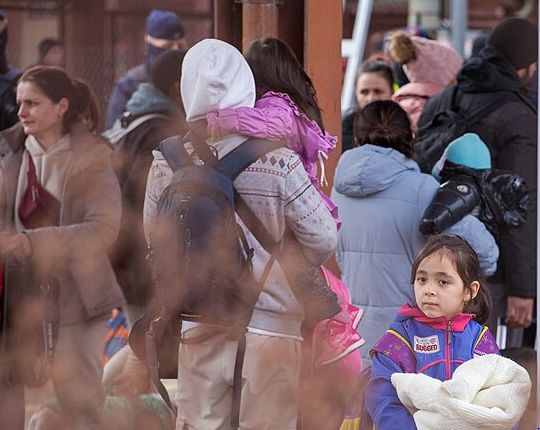
Eurosurveillance. 2024;29(39):pii=2400159. https://doi.org/10.2807/1560-7917.ES.2024.29.39.2400159. Image credit: Mirek Pruchnicki via Wikimedia (CC BY 2.0)