










































What Interventions Are Effective to Prevent or Respond to Female Genital Mutilation? A Review of Existing Evidence from 2008-2020
Affiliation
Population Council (Matanda); University of Antwerp (Van Eekert); What Works Association (Croce-Galis, Gay, Hardee); Right to Rise (Middelburg)
Date
Summary
"As the final decade of acceleration towards zero new cases of Female Genital Mutilation (FGM, SDG Target 5.3) by 2030 has begun, increasing the rigour, relevance, and utility of research for programming, policy development and resource allocation is critical."
In 2020 alone, an estimated 4.1 million girls were at risk of undergoing female genital mutilation (FGM), with the number of girls undergoing FGM each year projected to rise to 4.6 million by 2030. Knowledge of what works to stop the harmful practice has remained elusive. In contrast to previous research, the current review: considered qualitative, quantitative, and mixed-methods studies; included literature in three languages; and assessed both the quality of studies and the strength of the evidence to inform the discourse on what works to end FGM and to guide programming.
The study drew on a Rapid Evidence Assessment (REA) of literature on FGM interventions published between 2008 and 2020. The quality of primary studies was assessed based on United Kingdom Department for International Development (DfID) guidelines; the strength of evidence was assessed using a modified Gray scale developed by the What Works Association. Of the 7,698 records retrieved, 115 studies met the inclusion criteria. Of the 115 studies, 106 were of high and moderate quality and were included in the final analysis.
The highest number of studies was published in 2019 and 2020 (n=26). The studies were mostly carried out in Africa (n=82), Europe (n=15); and Asia (n=3); the remaining studies were inter-regional. Notably, none of the studies published in Arabic met the inclusion criteria, while the studies published in French were duplicates of studies published in English.
The UNFPA-UNICEF Joint Programme on the Elimination of Female Genital Mutilation: Accelerating Change global theory of change and the compendium of indicators for measuring the effectiveness of FGM interventions were drawn on to classify the various intervention approaches. Both the global theory of change and the compendium of indicators embrace a holistic and multisectoral approach to ending FGM. Most studies that were considered moderate and high quality were conducted at community level (41%), followed by system level (28%), individual level (20%), and service level (10%). Six successful interventions with supporting evidence were identified: four at community level, one at individual level, and one at service level. Two identified interventions, one at the community and one at the system level, were shown to be promising, and four identified interventions, with one at each level, were considered not to be effective.
The review explores strategies at each of these levels:
Key takeaways:
In 2020 alone, an estimated 4.1 million girls were at risk of undergoing female genital mutilation (FGM), with the number of girls undergoing FGM each year projected to rise to 4.6 million by 2030. Knowledge of what works to stop the harmful practice has remained elusive. In contrast to previous research, the current review: considered qualitative, quantitative, and mixed-methods studies; included literature in three languages; and assessed both the quality of studies and the strength of the evidence to inform the discourse on what works to end FGM and to guide programming.
The study drew on a Rapid Evidence Assessment (REA) of literature on FGM interventions published between 2008 and 2020. The quality of primary studies was assessed based on United Kingdom Department for International Development (DfID) guidelines; the strength of evidence was assessed using a modified Gray scale developed by the What Works Association. Of the 7,698 records retrieved, 115 studies met the inclusion criteria. Of the 115 studies, 106 were of high and moderate quality and were included in the final analysis.
The highest number of studies was published in 2019 and 2020 (n=26). The studies were mostly carried out in Africa (n=82), Europe (n=15); and Asia (n=3); the remaining studies were inter-regional. Notably, none of the studies published in Arabic met the inclusion criteria, while the studies published in French were duplicates of studies published in English.
The UNFPA-UNICEF Joint Programme on the Elimination of Female Genital Mutilation: Accelerating Change global theory of change and the compendium of indicators for measuring the effectiveness of FGM interventions were drawn on to classify the various intervention approaches. Both the global theory of change and the compendium of indicators embrace a holistic and multisectoral approach to ending FGM. Most studies that were considered moderate and high quality were conducted at community level (41%), followed by system level (28%), individual level (20%), and service level (10%). Six successful interventions with supporting evidence were identified: four at community level, one at individual level, and one at service level. Two identified interventions, one at the community and one at the system level, were shown to be promising, and four identified interventions, with one at each level, were considered not to be effective.
The review explores strategies at each of these levels:
- System-level interventions include those implemented at a macro level to provide an enabling environment for ending FGM. The system-level studies included in this review focused on assessing the effectiveness of national anti-FGM legislation in ending the practice. The review finds that legislation-related interventions must be multifaceted to be effective. In fact, legislation enacted without consideration of the local context may be counterproductive and even harmful, as it can lead to transformation rather than the elimination of the practice, such as: increased medicalisation and/or changes in the type of cut, cutting at younger ages, and/or the practice continuing in secret.
- Service-level interventions aim to protect girls and women at risk of FGM, prevent FGM, and provide care to women and girls who have undergone FGM. Interventions assessed for effectiveness in this review include training healthcare providers and capacity-building of the health system, as well as the use of rescue centres. While all levels would benefit from more research, for the service level especially, more research is needed into how the health system can effectively prevent and respond to FGM.
- Community-level interventions are implemented in communities with the aim of challenging existing gender inequalities and social norms associated with FGM, such as health education, comprehensive community engagement, media/social marketing campaigns/communication initiatives, public declarations/statements, work with religious/cultural leaders, and conversion of traditional practitioners. The review found that community-level interventions are effective for changing attitudes towards FGM, but more must be done to innovate with these interventions so they move beyond affecting attitudes alone to creating behaviour change. For instance, evidence shows that interventions that only supply information, education, and communication (IEC) to increase FGM awareness are not sufficient to change behaviour. Advocacy and awareness-raising efforts that take a holistic, multisectoral approach constitute best practices that should be sustained in order to maintain their impact for future generations.
- Interventions at the individual level include those that aim to empower girls and women to make their own informed decisions regarding their sexual and reproductive rights. Interventions assessed for effectiveness under this category were (i) formal education for women in terms of educational attainment and (ii) approaches that used alternative rites of passage to encourage abandonment. The former strategy (i) was found to be effective in reducing FGM prevalence among girls. However, the returns of formal education in ending FGM may take many years to be realised. For alternative rites of passage (ii) to be effective, especially in dealing with the issue of stigma, they should be implemented in combination with other intervention approaches (e.g., community awareness-raising initiatives, intensive community mobilisation, and sensitisation about FGM, combined with a public declaration ceremony that is fully integrated into a girls' empowerment program). More broadly, interventions targeting intermediate outcomes, such as improvement in knowledge and change in attitudes and beliefs towards FGM, are equally needed at the individual level.
Key takeaways:
- Health education, community dialogues with parents and religious leaders, the use of media and social marketing efforts, and formal education for women and girls are examples of interventions that have a strong enough body of evidence to justify wider implementation as part of comprehensive efforts to eliminate FGM.
- Legislation accompanied by political will in combination with additional interventions, creating FGM-free communities through public declarations, and training health providers are promising interventions, with further evidence needed.
- Providing traditional practitioners with alternative sources of income and alternative rites of passage, with a focus on public ceremonial passage of girls, is not effective in ending FGM.
- Adequately addressing FGM requires a holistic approach bringing together interventions that are sensitive to the complexity of FGM.
Source
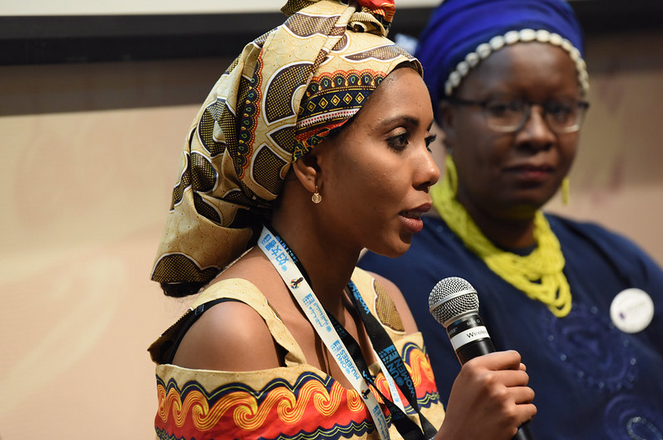
PLOS Global Public Health 3(5): e0001855. https://doi.org/10.1371/journal.pgph.0001855. Image caption/credit: From the March 2014 side event It's Time! A Collaboration to End Child Early and Forced Marriage and Female Genital Mutilation (FGM). Photo: UN Women/Susan Markisz via Flickr (CC BY-NC-ND 2.0)
- Log in to post comments