










































What Quantitative and Qualitative Methods Have Been Developed to Measure Community Empowerment at a National Level?
University of Trento (Laverack); WHO Regional Office for the Americas (Pratley)
Community empowerment in the health arena involves people collectively gaining greater control over the influences on their health, including access to health care and preventive services. Empowerment is multilevel and multidimensional, and standard quantitative indicators may not be sufficient to measure the complexity of the concept, especially at a national level. This report from the Health Evidence Network (HEN), an information service for public health decision-makers in the World Health Organization (WHO) European Region, summarises quantitative and qualitative methods for measuring community empowerment that can support monitoring at national or local level.
The report begins by providing background on community empowerment, which can be supported by policies that help communities to develop skills, to have equal access to information and resources, and to have opportunities to participate and to influence the factors affecting their health and well-being. Often, roadblocks hamper such participation, such as those caused by discrimination; community empowerment can remove social barriers but requires the support of government policy. For example, the United Nations Entity for Gender Equality and the Empowerment of Women (UN Women) works to uphold standards to create an environment in which women and girls can exercise their human rights to make strategic life choices.
Measuring community empowerment has been studied at subnational and individual levels, and the report examines some of those approaches. The concept is challenging to study in part because "[c]hanges in empowerment are not single-event outcomes: they are dynamic and often involve a long-term process of capacity-building and achievement of control over factors influencing the lives of individuals, groups and communities." This is particularly true at the national level, when attributing causality can be difficult.
To assess what is known about national-level measurement of community empowerment, the researchers used rapid review methodology to synthesise the academic and grey literature in English and Russian published from January 2000 to September 2017, with a focus on the WHO European Region but also considering worldwide literature and recommendations from key experts in the field. Ultimately, they included 42 documents in the analysis.
The findings of this report are subdivided into the following key areas:
- data from household surveys;
- data from measurement of women's empowerment;
- data from existing databases;
- a mixed-methods approach integrating qualitative and quantitative information;
- the development of empowerment indexes, variables, and indicators;
- visualisation tools;
- scaling up from community measurements; and
- measurement of governance initiatives.
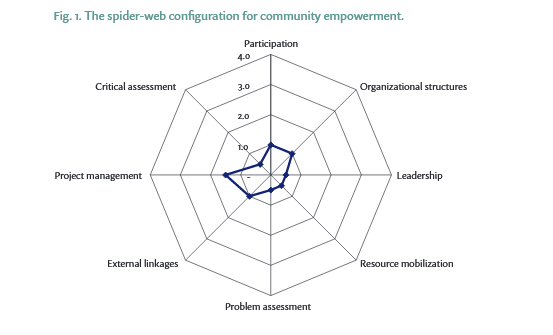
The review found that the most common approaches for tracking changes in empowerment used household survey instruments such as Demographic and Health Surveys (DHS) and the aggregation of variables such as legal, economic, and political measures. Case studies and examples throughout the text illustrate various approaches to measurement. For example, in Mexico, a wheel of empowerment framework was used to demonstrate how the level of empowerment/disempowerment could be measured in five dimensions: economic, psychological, social, political, and environmental. Indicators to measure the level of empowerment for each dimension were developed in a three-stage measurement process commencing with semi-structured interviews with key stakeholders, followed by focus groups with community members. The visual representation of community empowerment has also been implemented in a number of countries, including in Fiji and Kyrgyzstan, using a spider's web format that incorporates nine domains or indicators (see image, above).
Based on the effectiveness of the approaches discussed in this report, several policy considerations are identified:
When resources are limited or there is no current practice of measurement: Combine a limited set of easily accessible quantitative indicators taken from government and/or statistical databases. Such indicators include:
- the percentage of communities (defined at a geographical or administrative level through census clusters) with access to a functioning paved road (or percentage of communities with access to sufficiently developed infrastructure);
- the percentage of single-headed households;
- the percentage of women in political office or senior management positions;
- the percentage of communities in which all adult members have completed at least the minimum legal required level of education;
- the percentage of total government budget transferred to community-based organisations; and
- the average social network density - for example, the number of formally registered non-governmental organisations (NGOs) per capita.
When resources can be allocated for a more comprehensive measurement strategy: Use a mixed methods approach that combines the accessible quantitative variables and indicators with some form of rapid qualitative assessment. This more systematic approach would use:
- quantitative data from accessible government statistics offices that are updated regularly (e.g., DHS and similar surveys);
- quantitative data from internationally comparable databases such as those of Transparency International, CIVICUS's Civil Society Index (CSI), the Gender Empowerment Measure (GEM), the Gender-related Development Index (GDI), and the World Bank governance database;
- quantitative data from national or regional civil society organisations (e.g., access to social networks and the opportunities created by government for civic spaces);
- qualitative data from a specific number of key stakeholders (e.g., a sampling strategy that identifies participants to allow for a range of perspectives or accesses a marginalised population); and
- qualitative data collected by a relevant government department or a contracted private sector agency (e.g., via interviewing at individual, group, and community levels).
When a national monitoring and evaluation system is feasible: Use a comprehensive and systematic mixed methods approach that uses clearly defined methodology and responsibility for data collection and analysis. Indicators would be derived from both quantitative and qualitative data in regard to the social, governance, economic, and civil participation dimensions of community empowerment - for example:
- quantitative data for key variables and indicators from government statistics offices and through DHS or similar surveys;
- qualitative data from key stakeholders, including policymakers and community leaders, through interviewing using rapid, semi-structured techniques; and
- elements of internationally comparable databases such as those mentioned above.
Posting from Glenn Laverack to The CI's Social Change Network on July 8 2019; and WHO Regional Office for Europe website, October 21 2019.
- Log in to post comments