










































Promoting Change in Reproductive Behavior in Bihar (PRACHAR)
PRACHAR sought to arm young couples with information and skills related to the "true concept" of "planning a family" - molding their own lives by working together to build a strong spousal bond and partnership at the beginning, planning their families, and building a financial base before taking on the responsibilities of childbearing. On this line of thinking, information about reproductive health (RH)/family planning (FP) and compelling reasons for delaying and spacing their children could help prepare these couples to withstand social and family pressures and take advantage of resources to prevent pregnancy.
Organisers reasoned that, to achieve substantial cultural and behavioural change along these lines, a wide spectrum of the community - especially parents of young couples and influential community members - had to be actively engaged in the conversation. A key focus was placed on galvanising broad-based community commitment to maternal and child health through the delivery of messages and information in culturally sensitive forms - and in language appropriate to local levels of education - delivered by trusted and respected members of the local community. To this end, a large ceremonial community meeting launched the project in each village to provide information about the project and its goals, and to seek community acceptance and involvement. District and village government officials, teachers, landlords, medical providers, and others with community stature - including religious leaders - were invited.
To sustain this process, Pathfinder used a "learning by doing" approach to equip 30 local non-governmental organisations (NGOs) in Bihar with training, supervision, and resources to attain new levels of capacity and sustainability, particularly in maintaining and developing programmes in RH/FP. Through this group of 30 implementing partners, Pathfinder conducted trainings, community group meetings, and events to provide information (e.g., on preventing sexually transmitted infections (STIs) and HIV/AIDS, as well as the importance of delaying childbirth and spacing subsequent children). The particular type of information was geared toward the needs of specific populations within the communities, including: girls between 12-14 years of age, girls and boys between 15-19 years of age, newlywed couples who had not yet had a child, young couples with only one child, families of young couples (especially the mothers-in-law), and respected elders and community leaders with influence.
Face-to-face training was also used as a tool for enhancing the quality of basic maternal and child care and RH/FP services delivered by community-based traditional birth attendants (dais) and informal rural medical practitioners (RMPs). To elaborate on training of the dais, groups of 15-20 women (selected by implementing partners) attended 5-day residential programmes led by teams of two female government auxiliary nurse midwives (ANMs), who had been trained as trainers by Pathfinder. Training objectives included increasing knowledge and skills in the process of childbirth, providing aid and advice to pregnant women and their families, teaching about immediate and exclusive breastfeeding, and prevention of infection during and after delivery. Dais were also taught to promote post-partum contraception for birth spacing, and to track and report on births and contraceptive preferences in their communities. Trained dais were expected to share much of their new knowledge with other dais.
Following intensive training in community resource mapping, change agents surveyed the 25-30 villages of their districts covering a population of approximately 35,000 people. Through door-to-door canvassing, they introduced themselves and the project to the community and gathered the names, ages, and other specifics about adolescents, about-to-be-married young people, newlyweds, and young couples with one child. They started an ongoing database of births, deaths, marriages, and other significant community events, meeting weekly to consolidate and verify their data with others. In addition, Cultural Teams visited villages once every 6 weeks. These teams (formed through a rigorous application and training process) were charged with writing their own scripts for - and then performing - songs, plays, and puppet shows dramatising the hazards of early childbearing and promoting the advantages of FP and child spacing.
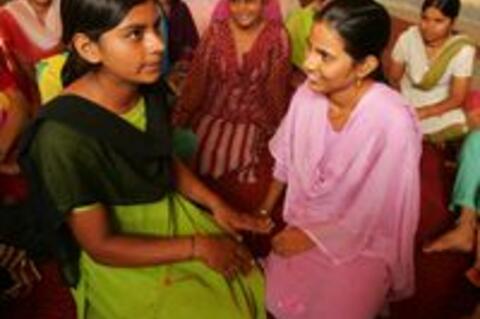
Several such edutainment-oriented interpersonal activities were designed to reach specific populations. For example, taking advantage of the celebratory arrival of the new bride to the family and to the village, newly married couples were invited to a felicitation ceremony called "Nav Dampati Swagat Samaroh" (NDSS), or "Newly-Married Couples' Welcome Ceremony". Activities attempted to generate new emotional connections. Short plays, games, and couple activities led to discussions of RH/FP, the elements of happy family life, the economics of raising children, and sharing in decision-making. Skits illustrated how to negotiate with parents or in-laws who pressure them on child-bearing. Finally, couples received a small lunch-box containing condoms and birth control pills, along with explanations of the different kinds of contraceptives and their use.
Maternal and Child Health, Youth, Reproductive Health and Family Planning.
According to Pathfinder, Bihar's extreme poverty and high levels of illiteracy and unemployment reinforce a deeply conservative social system. Pathfinder indicates that, in traditional Hindu and Muslim villages of Bihar, the median age at first marriage for women aged 20-49 is 16.9 in urban areas and 14.93 in rural areas. Among all women in India between 15 and 19, 16% already have a child (and 50% of those in this age group who are married already have a child). Infant mortality in children born to adolescent mothers is 92.7% compared to 67.6% across all age groups. India's maternal mortality rate is 540 per 100,000 births. In rural India, more than 80% of babies are delivered at home; of these, 35% are assisted by a dai (typically, a woman of a lower caste who is illiterate and learns the skills of the trade on the job). In Bihar, 66% have the aid of a dai, but only 9% receive assistance from a formal provider. Only 10% of pregnant women receive at least three antenatal check-ups.
Pathfinder indicates that, though for more than 4 decades, the Government of India has actively promoted FP and contraception, those efforts have sought to motivate women who have completed their families to end childbearing altogether. In contrast, PRACHAR focuses on young couples in their peak reproductive years. In addition, FP programmes have historically addressed women exclusively, whereas PRACHAR attends to the role that men play in decision-making about having children.
The Packard Foundation has extended funding for a second phase of PRACHAR. In the new phase, interventions will continue in 6 of the 19 Phase I areas, and efforts will be made to determine whether changes that began in Phase I intensify or taper off. These sites will serve as demonstration sites where visitors can observe and learn from project approaches. PRACHAR will also introduce youth RH programmes in two new districts.
Pathfinder International, with funding from David and Lucile Packard Foundation.
Email from Pathfinder International to The Communication Initiative on February 15 2006; and Promoting Change in the Reproductive Behavior of Youth: Pathfinder International's PRACHAR Project, Bihar, India [PDF], by Jennifer Wilder, Rekha Masilamani & Dr. E. E. Daniel, Pathfinder International, August 2005.
Comments

- Log in to post comments