










































Using Gossips to Spread Information: Theory and Evidence from Two Randomized Controlled Trials
Massachusetts Institute of Technology, or MIT (Banerjee, Duflo); National Bureau of Economic Research, or NBER (Banerjee, Chandrasekhar, Duflo); Abdul Latif Jameel Poverty Action Lab, or J-PAL (Banerjee, Chandrasekhar, Duflo); Stanford University (Chandrasekhar, Jackson); Santa Fe Institute (Jackson)
"Can we identify highly central individuals in a network without collecting network data, simply by asking community members? Can seeding information via such nominated individuals lead to significantly wider diffusion than choosing randomly chosen people, or even respected ones?"
Theoretical and empirical research in sociology, marketing, economic theory, and computer science studies the problem of identifying opinion leaders and key individuals in diffusing products and information. A key takeaway from these studies is that if the goal is to diffuse information by word of mouth, then the optimal seeds are those who are "central", according to specific measures. (Studies have shown that superficially obvious proxies for individuals who are central in the network sense - such as people with leadership or special status, or who are geographically central, or even those with many friends - can fail when it comes to diffusing information.) By detailing two separate large randomised controlled trials (RCTs) in India, the researchers suggest a process by which, by keeping count of how often they hear about someone, individuals learn the correct ranking of community members in terms of how effectively they can spread information. This matters because understanding how information exchange takes place in social networks is critical to designing effective information campaigns.
Study 1: The cell phone and cash raffle RCT
The researchers conducted an RCT in 213 villages in Karnataka (India) with 196.5 households on average to investigate if people who are nominated by others as being good "gossips" (good seeds for circulating information) are more effective than other people at transmitting a simple piece of information. The question that was asked to 15 households to identify the gossip nominees was: "If we want to spread information to everyone in the village about tickets to a music event, drama, or fair that we would like to organize in your village or a new loan product, to whom should we speak?" The researchers then compared seeding of information with gossips (nominees) to 2 benchmarks: (i) village elders, who are traditionally respected as social and political leaders - one might presume they would be effective seeds; and (ii) randomly selected households. In each treatment, the seeded individuals were encouraged to inform others in their community about a promotion that gave villagers a chance to win a new mobile phone or a cash prize. The key experimental result: Gossip nominees are significantly better than random seeds for diffusing a piece of information. Gossip seeds also lead to much more diffusion than elder seeds. In fact, the reduced-form effect of seeding with an elder is negative, although not significantly. This could be due to the fact that elders may have thought that this raffle was a frivolous undertaking and did not feel they should circulate the information, whereas they might have circulated a more important piece of news. Thus, the next policy question is whether gossip nominees are also good at circulating information on something more vital - leading to Study 2.
Study 2: The Haryana immunisation RCT
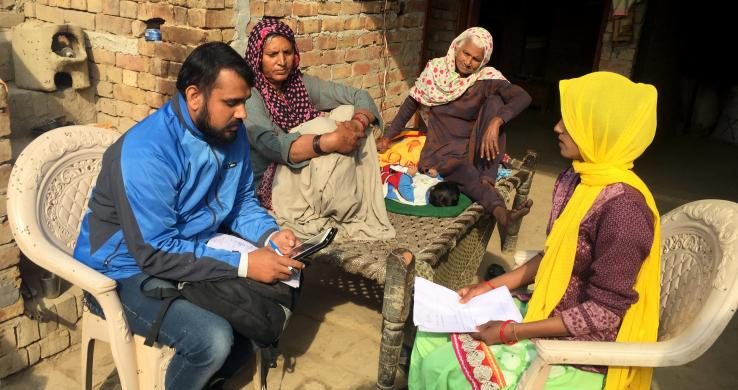
This RCT was carried out in the context of a collaboration with the Government of Haryana (India), which took place in 7 low-performing districts where full immunisation rates were around 40% or less at baseline. (See Related Summaries, below.) Of the participating villages, the researchers identified 521 of them for the "seed" intervention. Each of those villages was randomly assigned to one of four groups. In the first group ("gossip"), 17 randomly selected households were asked to identify who would be good diffusers of information; in the second group ("trust"), these 17 randomly selected households were asked whom people in the village tend to trust; in the third one ("trusted gossip"), the 17 randomly selected households were asked who is both good at diffusing information and trusted; and in the fourth group, no nominations were elicited. The researchers then visited the 6 individuals in each village with the most nominations in the first 3 groups, and the head of 6 randomly selected households in the fourth group, and asked them to become the programme's ambassadors. Throughout the year, they received regular SMSs (text messages) and phone calls reminding them to spread information about monthly immunisation camps, and the researchers tracked immunisation with administrative data over one year. The results of this RCT are consistent with those of the Study 1. In the average monthly camp with random seeds, 18.11 children attended and received at least one immunisation. In villages with gossip seeds, the number was 23, or 27% higher. The other seeding strategies are in between: neither statistically different from random seeding (for most vaccines), nor statistically different from gossip seeding.
Furthermore, some villages in Study 2 were randomised to be in one of two reminder groups. In those villages, either 33% or 66% of all households whose children had previously attended at least one vaccination camp were randomly selected to receive targeted reminders of the next vaccine their children were due for. This allowed the researchers to study whether essentially adding many more seeds (here considering those reminded individuals as seeds) generates much more diffusion than, say, gossip-based seeding. They found that the SMS blasts did not lead to greater adoption as compared to seeding information with just a few seeds (i.e., 6 gossips). This is despite the fact that, on average, at least 34 (68) people for whom the information was potentially relevant were directly informed; even in the absence of any information diffusion, these individuals should be affected. Going from a blast that reached 33% to one that reached 66% also generated no extra take up. Thus, providing information to many more households, even to households for whom the information is directly relevant, does not significantly lead to more diffusion.
In light of the findings from Study 1 and Study, in Section 3 of the paper, the researchers develop a model of diffusion and present the theoretical results relating network gossip to diffusion centrality. In brief, they show that people's knowledge of who are highly central individuals and good seeds can be explained by a model in which community members simply track how often they hear gossip about others. This model illustrates that it should be easy for people, simply by counting, to have an idea of who is central in their community. Indeed, when asked for nominations, villagers do not simply name locally central individuals (the most central among those they know), but actually name people who are globally central within the village. This suggests that people can use simple observations to learn about the complex social systems within which they are embedded, and that researchers and others who are interested in diffusing information have an easy and direct method of identifying highly central seeds.
To provide more support for their interpretation, the researchers test some more specific predictions of the theory. For instance, in 33 villages in which they had previously collected detailed network data, they collected gossip nomination data and found that individuals nominate highly diffusion-central people. The nominations were not simply based on the nominee's leadership status, degree, or geographic position in the village, but were significantly correlated with diffusion centrality even after controlling for these characteristics.
The researchers outline some of the practical implications of these findings. In many settings, identifying central members in a social network and seeding information to them can accelerate the diffusion of information. But collecting network data is expensive and not always practical, and it is therefore important to find cheaper ways to identify the central people. Since nominations of seeds are easy to collect, they can be used in a variety of contexts, either on their own or combined with other data, to identify effective seeds for information diffusion. Thus, using this sort of protocol may be a cost-effective way to improve diffusion and outreach, as demonstrated in the Haryana immunisation RCT (Study 2).
Beyond these applications, per the researchers, the work presented here suggests possibilities for further study to understand which other aspects of agents' social environments can be learned in simple ways. "Given the fact that people seem to know little about the network around them, how do they navigate it in their daily decisions? That is, how do people decide whom to ask to find important information, and whom to tell in order to help spread information to others?....This has important policy implications, as people's knowledge of their networks determines the efficiency of such active social learning, and any distortions that it may exhibit."
Review of Economic Studies (2019), vol. 86, no. 6, pps. 2453-90. doi:10.1093/restud/rdz008 - sourced from: International Initiative For Impact Evaluation (3Ie) website, July 27 2020. Image credit: Kyle Murphy/J-Pal
- Log in to post comments