










































Effect of Nutrition-Sensitive Agriculture Interventions with Participatory Videos and Women's Group Meetings on Maternal and Child Nutritional Outcomes in Rural Odisha, India (UPAVAN Trial): A Four-Arm, Observer-Blind, Cluster-Randomised Controlled Trial
London School of Hygiene & Tropical Medicine (Kadiyala, Harris-Fry); Digital Green (Pradhan) - plus see below for full authors' affiliations
"These results show that making agriculture interventions nutrition-sensitive can improve diets."
The second Sustainable Development Goal (SDG) of zero hunger includes a target that aims to double agricultural productivity and incomes of subsistence farmers, particularly women. In India, 21% of children are wasted, and almost a quarter of women are underweight. Many Indians depend on subsistence farming; for instance, in Keonjhar district, Odisha, 86% of the population engage in agriculture. In this context, the Upscaling Participatory Action and Videos for Agriculture and Nutrition (UPAVAN) trial tested the effects of three nutrition-sensitive agriculture (NSA) interventions on maternal and child nutrition in Keonjhar, where 57% of the population belong to Scheduled Castes and Scheduled Tribes, which are historically disadvantaged groups.
The approaches tested in this cluster-randomised trial (see also Related Summaries, as well as the video, below) included:
- Agricultural extension, which provides services to improve farmers' technical knowledge, livelihoods, and food security;
- The use of participatory videos, which typically involving an iterative process in which community groups view and discuss videos developed based on local needs, try practices described in the videos, and give feedback to shape the content of subsequent videos to make agricultural and nutrition interventions relevant and demand-driven; and
- Women's groups using participatory learning and action (PLA), whereby groups meet to identify and prioritise health problems, identify feasible strategies, implement these strategies with help from the wider community, and informally evaluate the process.
Following a feasibility study in 2013 and a pilot trial in 2014, the researchers developed three NSA interventions for testing in Keonjhar district of Odisha, India, drawing on the above approaches. They set up a nutrition-sensitive participatory video-based agricultural extension service delivered through women's groups that integrated nutrition-specific videos and incorporated PLA.
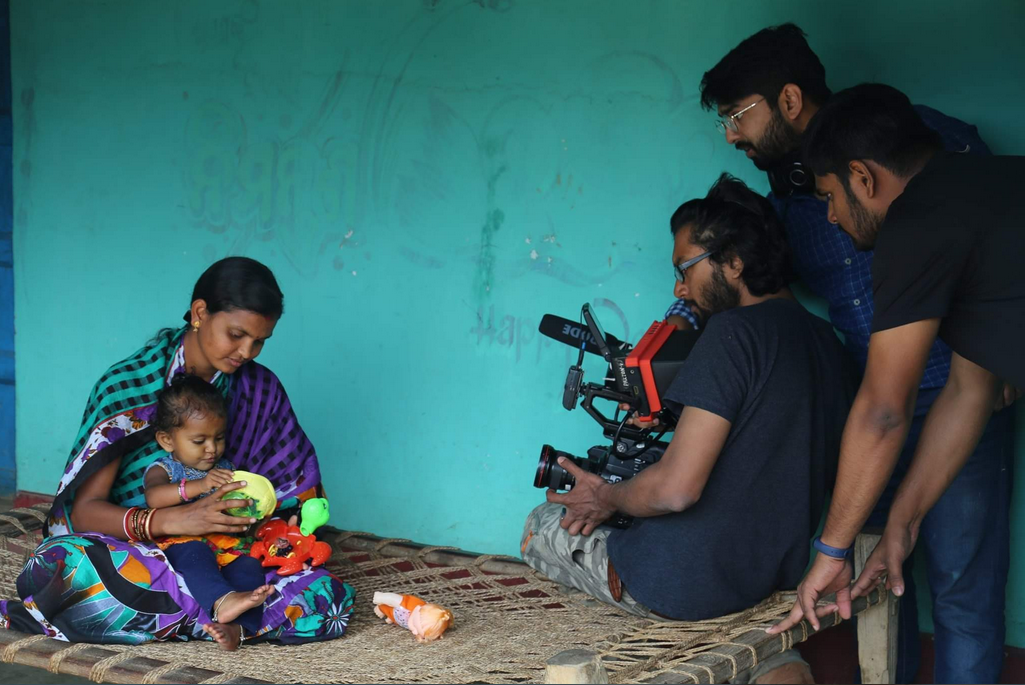
The participatory video approach used in all interventions began with community members initially identifying appropriate topics and developing packages of practices - key actions to improve agricultural practices - to discuss in the videos. Other community members, often including government frontline workers, were filmed demonstrating and discussing these practices. Local, trained, salaried facilitators then showed these videos to community groups, using low-cost, battery-operated projectors and pausing the video at specified points to facilitate discussion of the promoted practices. Facilitators visited group members at their homes or farms to ask whether they adopted the practices and could recall the messages. Local implementers used information from a monitoring system, as well as qualitative feedback athered during facilitators' review meetings, to identify future video content. Iterations of this basic approach were as follows:
- The AGRI group received an agricultural extension intervention with fortnightly women's groups (self-help groups, an existing platform of women's groups involved in savings and lending activities usually consisting of 20-25 members each) that viewed and discussed participatory videos on NSA. NSA videos focused on practices related to at least one of four NSA pathways in the Theory of Change: increasing availability of nutritious foods (e.g., growing spinach); increasing income (e.g., reducing goat mortality); improving women's decision making in agriculture (e.g., planning crops); and reducing workload for women who are pregnant and breastfeeding (e.g., using manually operated weeding machines). Group participants who were pregnant or had a child (aged under 2 years) received follow-up visits at home.
- The AGRI-NUT group had fortnightly women's groups that viewed and discussed participatory NSA videos and nutrition-specific videos on maternal and child nutrition, with follow-up visits. On average, groups had one NSA and one nutrition-specific video per month. Nutrition-specific videos focused on age-appropriate child feeding practices, care during child illness, and maternal diets and rest.
- The AGRI-NUT+PLA group had fortnightly women's group that viewed and discussed participatory NSA videos combined with PLA meetings, with follow-up visits. The PLA meeting cycle comprised four phases: First, group members identified and prioritised nutrition problems. Second, they explored the causes and effects of prioritised problems, planned locally feasible strategies to address these, decided on roles and responsibilities for implementing the strategies, and shared their learning with the wider community. Third, groups implemented their strategies. Fourth, groups evaluated the process. The videos in this group arose from the PLA meetings and were different from the nutrition-specific videos in AGRI-NUT. On average, groups had one NSA video and one PLA meeting (discussion-based or nutrition-specific video) per month.
- The control group participants did not receive UPAVAN interventions.
Interventions, which lasted for 32 months, began with launch events to gain community support and invite women to participate, particularly to include younger women and self-help group strengthening activities. UPAVAN facilitators worked with women's groups to plan video dissemination schedules, invite women to meetings, disseminate and discuss videos in groups, conduct follow-up visits, monitor participation, and devise ways to improve coverage.
As part of UPAVAN's Theory of Change, researchers used the transtheoretical model of behaviour change to reinforce and encourage adoption and maintenance of selected practices. They aimed to address women's individual-level barriers to adopting practices by increasing their knowledge, confidence, skills, and motivations, and they addressed community-level barriers by strengthening group cohesion, collective problem-solving, community support, and diffusion of knowledge.
For the parallel, four-arm, observer-blind, cluster-randomised trial, a cluster was defined as one or more villages with a combined minimum population of 800 residents. The clusters were allocated 1:1:1:1 to a control group or one of the intervention groups: 148 of 162 clusters assessed for eligibility were enrolled and randomly allocated (37 clusters per group). Primary outcomes were the proportion of children aged 6-23 months consuming at least four of seven food groups the previous day and mean maternal body-mass index (BMI). Secondary outcomes were proportion of mothers consuming at least five of ten food groups and child wasting (proportion of children with weight-for-height Z score below minus 2 (‑2.0) standard deviations (SD) below the mean on the WHO Child Growth Standards). Outcomes were assessed in children and mothers through cross-sectional surveys at baseline (November 24 2016 to January 24 2017) and at endline, 36 months later (November 19 2019 to January 12 2020). Of the 5,427 households assessed for eligibility at baseline, 4,480 mothers and 4,473 spouses provided data. At endline, of 4,792 households assessed for eligibility, 4,291 mothers and 4,287 spouses provided data
The study found an increase in the proportion of children consuming at least four of seven food groups in the AGRI-NUT (adjusted relative risk [RR] 1.19, 95% confidence interval (CI) 1.03 to 1.37, p=0.02) and AGRI-NUT+PLA (1.27, 1.11 to 1.46, p=0.001) groups, but not AGRI (1.06, 0.91 to 1.23, p=0.44), compared with the control group. An increase in the proportion of mothers consuming at least five of ten food groups was seen in the AGRI (adjusted RR 1.21, 1.01 to 1.45) and AGRI-NUT+PLA (1.30, 1.10 to 1.53) groups compared with the control group, but not in AGRI-NUT (1.16, 0.98 to 1.38). None of the interventions affected maternal BMI or child wasting.
In other words, the study found positive effects of AGRI-NUT and AGRI-NUT+PLA on child minimum dietary diversity (AGRI-NUT and AGRI-NUT+PLA groups: 19% and 27% relative increase in the chance of children meeting minimum dietary diversity than control, respectively), in addition to secular relative improvement of 33% from baseline to endline. Women had a relative increase of 21% (AGRI), 16% (AGRI-NUT), and 30% (AGRI-NUT+PLA) in the chance of meeting minimum dietary diversity than control, albeit borderline statistical significance in AGRI-NUT.
Reflecting on the experience, the researchers point to the way in which UPAVAN was conducted through "equitable partnerships" and featured:
- High implementation fidelity: Indicators of fidelity and exposure suggest high-quality implementation in all intervention groups.
- A focus on problem solving and capacity building: Government frontline nutrition and health workers (Anganwadi workers and Accredited Social Health Activists) in all groups, including the control, received a 2-day training course in maternal and child nutrition. Training improved group facilitators' and video producers' knowledge before the start of interventions, with mean knowledge scores for 82 facilitators and video producers increasing from 14.4 to 22.6 out of 23 (SD 0.6) for NSA and from 12.7 to 18.9 out of 20 (SD 0.2) for maternal and child nutrition.
- Intergenerational participation: Grandparents and adolescents were engaged in the intervention(s).
- Strong feedback loops: These were established in an effort to ensure the interventions remained demand-driven and relevant.
- Potential for scale-up: Intervention packages were derived from prevailing policy interventions, and the components have been implemented separately in several low-income settings; effects could be increased by scaling up them up together. "Scaling up such approaches is, however, unlikely to be sufficient to improve child wasting. Prevention of child wasting is likely to require long-term investments in equitable, intergenerational, and convergent nutrition-sensitive multisectoral approaches..."
Although the study was not designed to detect differences between interventions, the largest observed effect sizes for dietary diversity were found in the AGRI-NUT+PLA group versus control. "This result suggests that enhancing participatory components using a PLA cycle could accelerate NSA intervention improvements in diet quality. The participatory nature of interventions might have created an enabling environment for women to adopt new dietary practices through peer support, building women's confidence, problem solving, and collective action."
In conclusion: "Participatory interventions of women's groups using combinations of NSA videos, nutrition-specific videos, and a nutrition-specific PLA cycle can improve maternal and child diet quality in rural settings in India."
Full list of authors, with institutional affiliations: Suneetha Kadiyala, London School of Hygiene & Tropical Medicine (LSHTM); Helen Harris-Fry, LSHTM; Ronali Pradhan, Digital Green; Satyanarayan Mohanty, DCOR Consulting; Shibanath Padhan, Voluntary Association for Rural Reconstruction and Appropriate Technology; Suchitra Rath, Ekjut; Philip James, LSHTM; Emily Fivian, LSHTM; Peggy Koniz-Booher, JSI Research & Training Institute; Nirmala Nair, Ekjut; Hassan Haghparast-Bidgoli, University College London; Naba Kishor Mishra, Voluntary Association for Rural Reconstruction and Appropriate Technology; Shibanand Rath, Ekjut; Emma Beaumont, LSHTM; Heather Danton, JSI Research & Training Institute; Sneha Krishnan, Environment, Technology and Community Health Consultancy Service and Jindal Global University; Manoj Parida, DCOR Consulting; Meghan O'Hearn, Tufts University; Abhinav Kumar, Digital Green; Avinash Upadhyay, Digital Green; Prasanta Tripathy, Ekjut; Jolene Skordis, University College London; Joanna Sturgess, LSHTM; Diana Elbourne, LSHTM; Audrey Prost, University College London; Elizabeth Allen, LSHTM
Lancet Planetary Health 2021;5: e263-76. https://doi.org/10.1016/S2542-5196(21)00001-2. Image credit: Digital Green via Facebook
- Log in to post comments