










































Study of the Effects of the Husbands' School Intervention on Gender Dynamics to Improve Reproductive Health in Niger
Institute for Reproductive Health (IRH)
"If these husbands succeed in changing their behavior and supporting a change in gender roles in their households as well as to other households in their communities, a profound social norms shift sought in communities is possible."
Commissioned by the United States Agency for International Development (USAID)-funded Passages Project, this exploratory study was designed to understand how power-sharing was taking place between men in Niger who were members of Husbands' Schools (HS) and their wives and the broader community. The study aimed to understand better the change pathways (of programme theories of change) leading to the expected outcome of HS activities: increased use of antenatal, delivery, postnatal, and family planning (FP) services at a community level.
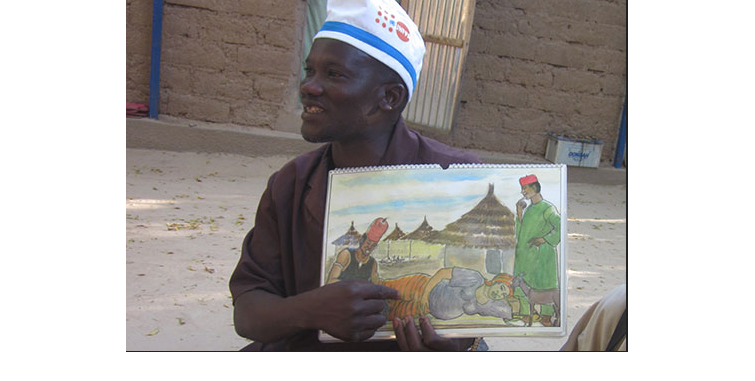
As the report outlines, HS activities were designed to address the barrier of men not allowing their wives to access health services, in the context of a patriarchal society where women have minimal personal decision-making power and financial resources. (See more details at Related Summaries, below.) The idea was that engaging men in understanding the importance of reproductive health (RH) and services use for their couple and families - and empowering them to play roles as community promoters, service linkers, and modelers of supportive spouse behaviours - would lead to more wives using RH services. Anecdotal evidence indicated that gender effects were positive, but HS organisers - the United Nations Population Fund (UNFPA) and the non-governmental organisation (NGO) SongES - sought a better understanding of the gender effects of HS.
Carried out in 3 regions (Dosso, Tahoua, and Zinder), the qualitative, exploratory study entailed 35 individual interviews and 25 focus groups conducted with respondents who were directly and indirectly exposed to the HS intervention. Questions focused on present-day perceptions and often elicited before-after reflections on HS and their impact on couples and the larger community. Some questions aimed to understand how diffusion of new ideas occurred, which would contribute to norms shifting at community level. Data collection occurred from June 9 to July 9 2018.
Study results showed that the HS intervention was accepted and supported by the community. Model husbands, a name given to men who are HS members, were listened to and seen as credible resources for RH by their wives, peers, and community members, enhancing the value of women's RH and use of services. Rooted in the community, they were considered specialists, and respondents often put on the same level of esteem as health workers. Model husbands had a positive perception of their role to sensitise their peers and felt they have a mission to bring about positive behaviour change in their household and the community. The model husbands' actions went beyond RH to work to meet other community needs, such as child health and community hygiene.
The study revealed change in what is considered appropriate men's roles. Before the implementation of HS, maternity issues were considered to be women's issues; men's roles were limited to the management of medical emergencies. The evaluation found that men's attitudes were more favourable to their expanded involvement in RH-related actions. Men got involved in care issues during pregnancy and also during and after delivery, for postnatal care. "The normative environment has shifted both in perceptions about what others are doing (descriptive norms) and what others should be doing (injunctive norms)..."
In that vein, the study found that gender role shifting and power-sharing were prominent in visited sites, yet these effects were manifested differently at different levels of decision-making and power-sharing. At one level, patriarchy and the view of men's social position did not seem to be changing: Men retained ultimate decision-making power on services use. However, men came to understand the importance of RH service use and male engagement, "a marked departure from earlier times when men did not understand, trust, or allow their wives to use services". At another level, significant and widespread changes were seen in how women and men view each other and interact as couples. Couple communication, which had come to be initiated by both women and by men, was assessed to be occurring around FP, as well as around antenatal and delivery care and services use - a clear transition from earlier. Women likewise expressed newfound freedoms and actions to seek and use services independently and to engage with their husbands in discussions on RH. This change was observed in both model and non-model husbands and their spouses, indicating a diffusion effect leading to wider community acceptance of improved couple communication. Participants also indicated that the HS messages were reaching surrounding villages and health areas with no HS through exchanges between communities, indicated by increased discussions on RH and men's involvement in RH in those settings, as well.
The study found that HS helped reinforce husbands' and their wives' knowledge of the importance of using RH services, and there was much more gender-equal access to RH information. A comparison of the level of knowledge before and after the intervention indicates that HS filled a gap.
The intervention focuses on shared decision-making in the couple on RH issues. However, the nature of the intervention strategy, which highlights husbands as catalysts for change, has led to respondents (generally men and women who are non-members of HS) noting effects that may be detrimental to gender transformation. For example, the perception that a husband's involvement in HS increases his responsibilities in the RH of his wife and the couple led some men to impose RH-related decisions on their wives, rather than to see these decisions as shared.
The sustainability of the gains of the HS is demonstrated through: the speed with which the messages are conveyed within couples in HS communities and beyond the HS' intervention areas, which indicates community interest in the topic and subsequent idea diffusion; community acceptance of the intervention; and the willingness of the model husbands and their wives to not abandon the new behaviours and acquired knowledge - that is, to not revert to how they were "before". That said, evaluators noted a significant reduction in HS activities over the prior year due to a lapse in UNFPA funding.
In conclusion, despite "notable attitudinal and behavioral changes in gender relations, especially within couples whose husbands are members of HS, but also visible in the community at large", the evaluators note that "significant efforts are still needed for a greater change towards gender equity in RH decision-making across the different-level decisions relating to antenatal care, delivery, postpartum care, and FP services. Hence, the recommendation to intensify existing schools' training activities to deepen members' gender reflections vis-à-vis reproductive health, and to scale up HS activities in new areas to continue sowing seeds of gender norm shifting across communities in Niger."
Institute for Reproductive Health (IRH) website, March 31 2022. Image credit: IRH
- Log in to post comments