










































A Health Promotion Approach to Emergency Management: Effective Community Engagement Strategies from Five Cases
Western Washington University (Corbin); World Health Organization (Oyene, Bayugo, Huda, Moran, Omoleke, Spencer-Walters); New York University (Manoncourt); Paris School of International Affairs, Sciences Po (Manoncourt); University of Limpopo (Onya); African Institute for Health and Development (Kwamboka, Amuyunzu-Nyamongo); Global Health Literacy Academy (Sørensen); University of Zambia (Mweemba); National University of Ireland (Barry); Midlands State University (Munodawafa); Thammasat University (Munodawafa); Université catholique de Louvain (Van den Broucke)
"While it is increasingly recognized that communities must be engaged throughout the full cycle of emergency preparedness, readiness, response and recovery, the question remains how community engagement can be ensured."
Community engagement in emergencies is known to be critical, as empowering people to help themselves can save lives. However, the imperative to take swift action during a crisis can be problematic for community engagement. This study aims to add to the existing understanding of community engagement in the context of addressing emergency situations by presenting five case studies and analysing the strategies used to develop or enhance community engagement in a systematic way, in accordance with health promotion principles, which prioritise participation, empowerment, and community action.
The cases presented in this study come from two sources. Three cases were drawn from the World Health Organization (WHO) Community Engagement Package database. Cases 4 and 5 are drawn from the International Union for Health Promotion and Education (IUHPE) COVID-19 Response for African Region project, focusing on implemented actions in communities in Kenya and South Africa. Two matrixes were created as analytical tools for data analysis. One was informed by social-ecological theory; the other was developed from the Bergen Model of Collaborative Functioning to ascertain information on the process of implementation with special attention to collaboration among stakeholders.
Case studies include, in brief:
- Engaging the community in a chemical disaster recovery, Graniteville, South Carolina, United States - From the outset, the research team engaged key stakeholders from academic, civil society, private organisations, and residents in efforts to identify and address locally identified health and environmental concerns. Trust was crucial, and the engagement through town hall meetings facilitated the building of relationships between the community and the external responders. The community advisory board fostered local ownership, which catalysed local resource mobilisation and increased community members' sense of agency. One lesson: Listening to affected people is essential in planning successfully for emergencies.
- Community-led Ebola management and eradication, Sierra Leone - During the 2014-2015 Ebola outbreak, Action Contre la Faim International (ACF) collaborated with health authorities and district partners in Moyamba and Kambia. The ACF's Community-Led Ebola Management and Eradication (CLEME) approach employed a five-phase process that entailed: selecting communities and assessing them on the Ebola outbreak and dangers; applying a participatory rural appraisal methodology; developing a community-guided action plan; and ensuring long-term safety by following up on the CLEME approach. The programme's success factors included a continuous analysis of the situation and adaptation of messages and strategies to align with the prevailing situation context. It also incorporated tools and strategies that addressed women's, men's, boys', and girls' unique and evolving needs. Also important was integration with existing community-based initiatives and programmes.
- Community engagement for migrant workers' response to COVID-19, Singapore - A local non-governmental organisation called My Brother SG and the National University of Singapore initiated a risk communication and community engagement (RCCE) project to address the specific communication and engagement needs of the migrant worker population in the context of the pandemic (see Related Summaries, below). Culturally sensitive communication and engagement strategies were deployed, and engaged workers practiced the recommended behaviours to keep workers safe from COVID-19 while quarantined. The participatory approaches such as storytelling theater and film discussions created opportunities for reinforcing relational connections, and migrant worker social media influencers co-hosted webinars on their online platforms to promote dialogue, address concerns, and promote trusted health advice. The project's adoption of a people-centred strategy prioritised a bottom-up participatory approach and included a wide range of stakeholders. It is necessary to build a relationship early with the affected population in order to enhance their sense of empowerment and ownership.
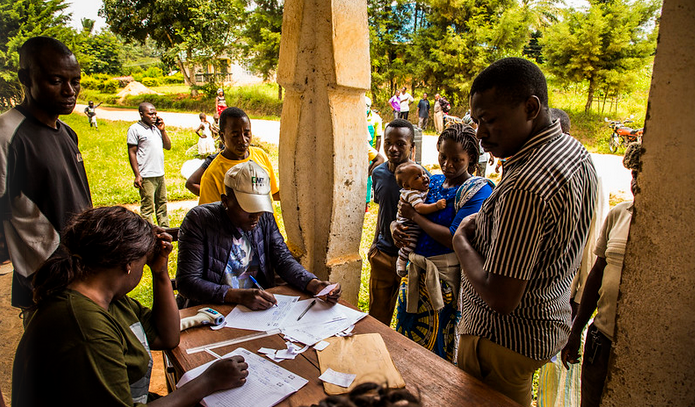
- COVID-19 response for the African Region project, Kenya - A health promotion project was undertaken in the Ruai and Njiru wards, Kasarani sub-county, Nairobi county, by the African Institute for Health and Development and IUHPE/Vital Strategies in collaboration with the Nairobi Metropolitan Services, the Ministry of Health at the national and county levels, and key stakeholders. Working in collaboration with national and local agencies and partners, health promotion officers were employed to implement intervention activities at the community level and help train Community Own Resource Persons (CORPs), who included religious and traditional leaders, community health workers and volunteers, and women and youth leaders in the project area. The CORPS received training, were commissioned as change agents, and encouraged to continue community conversations at individual, family, community, and workplace levels and within other social spaces. They were equipped with information and skills that would allow them to provide correct information, clarify myths, challenge misconceptions and misinformation on COVID-19, and address other health-related concerns. The project incorporated the deaf and physically disabled as CORPs to disseminate information to their social groups, this fostered inclusion and acceptability by their social groups. A key success factor was the intervention's multi-strategy approach through advocacy, community engagement, social mobilisation, and media communication.
- IUHPE COVID-19 response for African Region project, South Africa - This intervention by IUHPE/Vital Strategies focused on resource-limited rural and urban settings within three districts (Waterberg, Vhembe, and Sekhukhune) in the Limpopo Province of South Africa with poor access to COVID-19 diagnosis and healthcare facilities. Given that the main aim of the intervention was to enable members of the community to take behavioural actions to prevent COVID-19 infection, emphasis was placed on decision-makers within households. The work began with translating risk communication messages into local languages and engaging local people to bring those messages to community members. Efforts were made to tap into existing networks, including traditional leaders, healers, religious leaders, artists, teachers, and school staff. This group formed a coalition that used SMS (text) messages to communicate on mobile devices and local radio to send health messages. Following the interventions, data were collected to trace the effectiveness of the strategy. Among the key success factors was the partnership between global and local health promotion experts. One lesson learned: Although there was a positive significant shift in knowledge of community members and positive change in perception regarding all the myths and misconceptions/misinformation measured at follow-up, these changes were minimally translated into practice. Thus, strategies such as RCCE that apply health promotion principles and methods, such as developing personal skills to not only make informed behaviour change decisions but to maintain them, are key in the fight against COVID-19.
Based on these cases, and in line with WHO guidance, the researchers argue that "future emergency responses must involve the community members for project ownership and sustainability....[T]hey must allow for community members' agency and active involvement. These efforts should build on existing assets and make use of ongoing relationships, local expertise, existing infrastructure and community leaders. The best responses combine diverse forms of expertise: cultural, technical, logistical and relational. Ideally, community engagement should also happen early. The best way to achieve that, as seen in the case examples, is to build and maintain community engagement and emergency infrastructure before disaster hits." Some specific suggestions include:
- Ensure that education and communication strategies are relevant and grounded in a health promotion approach. For example, the incorporation of artistic modes of dissemination enables co-creation, relevance, and uptake within communities.
- Enlist a diverse cadre of trusted community leaders in the effort.
- Recognise the unifying power of shared goals.
- Adapt to changing contexts and to the specific needs of vulnerable groups and sub-groups in ways that are "relentless" and community-led.
- Acknowledge historic and current realities, such as profound distrust in Western/Northern biomedical advice that can be traced back to legacies of colonialism in many parts of the world.
- Conduct more research to develop more readily available and sustainable solutions for the future, to identify the specific health promotion skills that are needed in emergency situations, and to specify how this capacity can be strengthened.
The researchers indicate that the community engagement strategies presented here might inform practices in other settings. Replicating these approaches requires analyses/scanning of: the socio-economic, political set-up, and operating environment; the community's governance and function; and existing public/community engagement approaches/tools, including platforms, communication formats, and trusted groups and channels and feedback mechanisms. Once these analyses are done, strategies could be adapted to fit into the new setting(s).
In conclusion: "The global scope of the paper shows that empowerment is an asset that can be applied across the world to harness people's health and safety. Adapting health promotion approaches to local needs can enhance the communities' power to act quickly when emergencies occur. The lessons learned illustrate the high capacity of people and communities to collaborate, communicate, and confront challenges despite being in vulnerable situations. However,...further empirical studies are needed, as well as the development of more integrative theoretical frameworks to guide health promotion practice in this important area."
Health Promotion International, Volume 36, Issue Supplement_1, December 2021, Pages i24–i38, https://doi.org/10.1093/heapro/daab152. Image credit: World Bank / Vincent Tremeau via Flickr (CC BY-NC-ND 2.0)