










































Research Participation Influences Willingness to Reduce Zoonotic Exposure in Uganda
Stanford University (Bloomfield, Randolph); George Washington University (Tracey); Kibale National Park (Mbabazi); University of Georgia (Schultz); University of Florida (Henderson); University of Washington (Bardosh); University of Wisconsin-Madison (Paige)
"...results support the potential for participant-led interventions, as part of a long-term research engagement, to have sustained impact on community willingness to engage in protective behaviors for preventing the spillover of zoonotic diseases."
Nearly 75% of emerging infectious diseases are zoonotic in origin. The literature on behaviour and behaviour change during epidemics points to demographic, psychological, social, and environmental features that influence behaviours exposing individuals to potential zoonotic infections and determining the progression of an epidemic over time. Participatory, community-led behavioural interventions aimed at addressing priorities defined by the community, such as human-centred design (HCD), have been found to be the most effective at disease prevention. This study hypothesised that enrollment in an HCD intervention would increase knowledge retention, influence attitudes, and change behaviours aimed at avoiding exposure to zoonoses in Kibale National Park, Uganda, which hosts some of the highest mammal biodiversity and the highest nonhuman primate densities in the world.
People living around the periphery of Kibale National Park have participated in foreign-led research investigating the influence of anthropogenic ecosystem changes on human, livestock and wildlife health since the 1970s. One such research initiative, the Kibale EcoHealth Project https://kibaleecohealth.wisc.edu/index.html, led studies on: the factors influencing the transmission of retroviruses between non-human primates and humans; livestock-wildlife interactions contributing to livestock health and productivity; ecological influences on animal and human microbiome; and pathogen discovery.
Between February and April 2016, the researchers collected qualitative data - focus group discussions (n = 9), guided walks (n = 11), and key informant interviews (n = 9) with influential community members (e.g., local council leaders, informal leaders, herbalists) - from 3 communities located less than 1 km from the border of Kibale National Park. They identified techniques that people used to protect themselves from livestock and wild animal zoonotic exposure, which were used to populate a knowledge, attitude, and practices (KAP) survey that was administered at 2 time points: KAP T1 (April-July 2016) and KAP T2 (February-May 2018).
Prior to KAP T1, in 1 of the 3 communities (an intervention group), the researchers used HCD, a participatory action research framework, to reframe zoonotic infection exposure risks and rapidly test multiple locally suited protective behaviours. Following the HCD intervention, the researchers administered KAP T1 to n = 240 people; later, they administered to all reachable original participants a revised version of the survey KAP T2 focusing on willingness and engagement in protective behaviours. Participants in the intervention group represented 33% (61/186) of the final sample, while the comparison group included participants from the other 2 communities (28% and 38% of the sample, respectively).
Participants reported what information they had learned during the HCD intervention and other sources of knowledge about zoonotic infections. Radio health campaigns were the most common source of knowledge about protective practices to avoid zoonotic exposures. Interactions with researchers and educational seminars were also common sources of knowledge.
Qualitative results pointed to continued tensions between growing population density near protected areas, conservation objectives, and public health. Namely, participants expressed they should avoid animal contact to protect themselves from zoonotic exposure; however, they stated that animal contact was unavoidable - forced by economic and political constraints. Participants described an increasingly untenable situation in which wild animals regularly left the park boundary to raid farms, destroy crops, and harm property, while they were reprimanded by park staff for hunting or using forest resources.
The researchers measured the difference in willingness to engage in protective behaviours around zoonotic exposure between the intervention group (n = 61) and comparison group (n = 125). Quantitative results showed that sustained willingness to engage in protective practices was significantly influenced by participant engagement in zoonotic research.
Specifically, at KAP T1, comparison group participants had a significantly lower (p < 0.05) level of willingness to engage in behaviours that increase exposure to zoonoses from domestic animals; intervention group participants had a significantly higher (p < 0.01) level of willingness to engage in behaviours that increase exposure to zoonoses from wild animals. At KAP T2, the treatment effect was significant (p < 0.01) for sustained willingness to engage in protective behaviours for domestic animal exposure in the intervention group. There were no significant differences in practices to avoid domestic and wild animal zoonotic exposure between the intervention and comparison groups. The lack of observed behavioural changes may be due to factors such as the short duration of the intervention or economic constraints of participants.
Community affiliation was a significant predictor of change to willingness to engage in protective behaviours from KAP T1 to KAP T2. Although the HCD intervention was only rolled out in Community 3, Community 2 also had significantly higher levels of willingness to engage in behaviours at KAP T2 compared to Community 1. Variables describing willingness to engage in protective behaviours were also significantly associated with distance of household to forest. Sustained willingness to engage and practice of protective behaviours were not significantly associated with level of education, frequency of forest use, wealth, or social status.
Reflecting on the findings, the researchers note that "Understanding the prolonged effects of research engagement on participants - both the positive and negative - is an important area to further examine the ramifications of international health research..., along with opportunities to leverage those experiences into sustained positive outcomes. Community-based research design and participatory rural appraisals are research approaches that have the potential both protect participants from harm and orient the research approach to support community priorities..."
In conclusion: "Though this study highlights that long-term engagement by researchers in communities can create a context in which local individuals are more aware of the risks of zoonotic disease, it also points to the need for economic support or alternative options to decrease risky behaviors because reductions in zoonotic risk are not, and cannot be, the priority for many individuals. Short, low-cost interventions may have a lasting effect in reinforcing knowledge and increasing willingness of participants to engage in these practices."
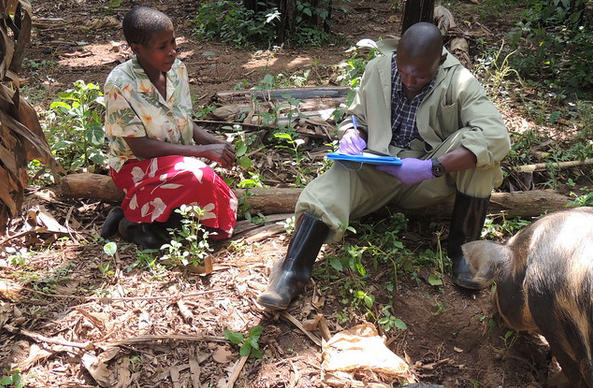
Ecohealth 2022 Jun;19(2):299-314. doi: 10.1007/s10393-022-01589-5. Image credit: ILRI/Elisabeth Kilian via Flickr (CC BY-NC-ND 2.0 Deed)
- Log in to post comments