










































Programme Communication for Early Child Development

UNICEF
This booklet from the United Nations Children's Fund (UNICEF) explains how principles of programme communication are part of a holistic approach to early child development (ECD). It is designed for programme planners, designers, artists, and communicators to improve their ability to use programme communication for holistic ECD. Parts of this booklet are in the larger document Programming Experiences in Early Child Development [PDF format].
The term "holistic approach to early child development" refers to policies and programming that ensure that child rights to health, nutrition, cognitive and psychosocial development, and protection are all met. As advocated by this document, all interventions should reach the same children, including the most marginalised. Principles outlined in this booklet have also been applied to communication for older children and adults. They have been adapted to behaviour change communication (BCC) related to HIV/ AIDS and other child protection issues, child-to-child communication, girls’ education, safety and child injury prevention, and a variety of other topics.
The document supports a combination of advocacy, policy, services, social mobilisation, programme communication, and quality media for, about, and with children to ensure the rights of children and caregivers. It calls for the production of "developmentally and culturally appropriate media for and with, as well as about young children. Research indicates that the more language, through songs, stories, books and rhymes, that young children are exposed to in their first years of life, the more prepared children will be for entry to school...Developing quality media for and with young children is important for many reasons:
- It is a direct response to the rights of children expressed in the Convention on the Rights of the Child.
- It can help build the self-confidence of children, caregivers and nations. It can promote healthy habits and practices and pro-social behaviours as well as encourage literacy and cognitive development.
- It can be as powerful a message to caregivers and other adults as to the young children at whom it is aimed (print media for young children is often readable for people with lower literacy skills). It can be a safe haven, especially for children in difficult circumstances (sick, traumatized, grieving, etc.).
- It can effectively address sensitive topics (HIV, gender discrimination, disability, death, etc.)."
Research and experience on BCC offer principles and guidelines that can assist caregivers of children in making critical programmes and media for, about, and with children as effective as possible. Five guidelines include:
- Build a "Culture of Media" - multiply impact through collaboration, coordination, convergence, or integration. For example, the ECD Project in Maldives: focused on reaching directly into the household; focused on building the self-confidence of caregivers as well as of children; created special features for caregivers such as adolescents; and combined creative talents of the technical stakeholders working on the project. It eventually encompassed the Ministry of Health, Ministry of Education, Ministry of Culture and Information, Ministry of Child Protection, Ministry of Tourism, and Ministry of Atoll Administration, as well as parents, preschool teachers, curriculum developers, health care workers, and therapists. Stakeholder contributions include: "The Ministry of Tourism offered the use of hotels on tourist islands to train 'working fathers' who lived and stayed away from their families for months at a time. Those responsible for preserving Maldivian culture began to look at and promote traditional stories and songs that best enhanced holistic development." Messages (listed on page 11 of the document) included the importance of fathers, non-discrimination based on gender, listening and talking to children, and expressing love and praise.
- Less is More and Simple is Best - Literacy Works for ALL - As stated here, for both literate and non- or neo-literate audiences, "[i]t is the role of communicators to make oral, written and visual media 'stick' or be memorable." For example, "The Uganda Community and Home Initiatives for Long-term Development (CHILD), in association with the World Bank, developed a low-literacy booklet entitled 'Caring for Children in Uganda'. Simply but clearly illustrated, it covered healthy mothers, feeding children, preventing illness, responding to sickness, learning with things and people. Only the most basic intersectoral and holistic information was included in a very user-friendly style."
- Finding Good Practices within Local Communities (“Positive Deviance”) - "In every community, there are people who share the same resources as their neighbours or colleagues, yet they successfully solve problems or overcome barriers (do something positive) through uncommon or special behaviours or practices (deviance from normal practices)." For example, two public service announcements (PSAs) in South Africa showed fathers, including a Zulu warrior, carrying infants and talking to them as models of positive fathering behaviours.
- Communication Exemplifying Best Caregiving Practices as Routine - Messages for BBC can focus not only "what" to do, but "why" and "how" messages that tend to increase effectiveness and give clear, practical explanations and simple, doable actions. For example, a programme can include examples such as a song to sing while washing children’s hands before eating, a rhyme to say when they are afraid of an immunisation, or an educational game to play while walking to the rice fields.
- Solution-Oriented Communication to Model Positive and Pro-Social Actions and Words - "Research and experience shows that for children as well as for non-literate or neo-literate adults, 'not' or 'don’t' messages are not easily understood. Instead, the positive behaviour or action to be practised should be modelled." For example, instead of describing the negative impact of parents' fighting, "show problem solving, techniques parents can use to calm down, positive reinforcements, and ways young children emulate words and actions of beloved adults in their lives."
The document adds practical exercises to get started with communication for ECD. It includes examples of communication media such as posters (including photos of behaviour with children); PSAs; training of child caregivers and training of trainers (TOT); use of keywords on care; books for children and adults; physical contact; games like singing "The ABC’s of Holistic Caregiving" (including birth registration, hand washing, iodized salt, reading, vitamin A, etc.); and brainstorming appropriate interventions by age group to make a holistic ECD programme.
The booklet concludes that ECDcommunication is an investment for young children and can be a vehicle to effectively reach caregivers, policy makers, and older children.
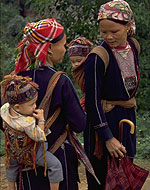
UNICEF website, January 27 2010. Image credit: UNICEF/LeMoyne
- Log in to post comments