










































Neighbors Radio Drama
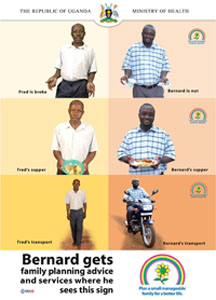
The drama used an edutainment approach drawing on Albert Bandura's theory of social learning and positive role modelling to influence behaviour change. The drama revolved around 2 key characters: Bernard, who has planned his family and has few children, and Fred, who has not planned his large family. At the core of the storyline are messages about the problems of having a large family and the advantages of a small planned family. The drama's episodes are carefully designed to demonstrate the effects of population pressures on family economics and access to resources and services, as well as the benefits of family planning and couple communication.
As a first step in the development process, HCP carried out formative research about family planning in Uganda. This was used in a strategic design workshop involving key stakeholders from the Ministry of Health, family planning partners, an advertising agency, satisfied users of family planning, and people who do not use family planning. The workshop was designed to develop communication objectives, identify primary and secondary audiences, and explore the approach to best reach and appeal to the primary audience. The resulting communication strategy was designed to engage rural married men who do not use modern family planning methods, and, secondarily, their wives.
After developing the characters and writing scripts, actors were identified and an initial pre-test of the first episode was done before a live audience. Feedback received from this pre-test was incorporated to produce the final scripts. The resulting audio was again pre-tested, initially in English in conjunction with partners and was later translated into 5 local languages and pre-tested again. Input was incorporated and the dramas modified accordingly. The producers said that, because the episodes were short, the Ministry of Health was able to re-broadcast them for wider reach.
In addition to the radio drama, the characters of Bernard and Fred were also featured in 45-second radio spots broadcast during the same period as the radio drama, and on posters, billboards, and booklets in 5 languages, which were distributed across 5 regions of the country.
Family planning partners also organised men-only seminars and challenges that involved men in sports, games, and interactive sessions; these sessions included a live dramatisation of the Fred and Bernard story. Interactive sessions focused on family size, population growth, its impact on family and community resources and development, and an overview of the modern family planning methods and how to access family planning providers for personal advice and counselling. Each man participating in these sessions received a booklet about family size and its effects on resources and development and was encouraged to share it with their spouse and at least one friend. The campaign also supported a series of live call-in radio talk shows about the issues in 5 languages on 13 radio stations. All communication directed men and women to family planning services that the Ministry of Health and its partners labelled with the national family planning logo. The campaign also provided newsletters about modern family planning methods in 5 languages to all family planning service delivery points.
Family Planning
In July 2009, HCP conducted a sample survey among 3,082 men and women in 14 of Uganda's 82 districts to evaluate the campaign. According to HCP, the drama had, at that time, reached an estimated 1.6 million men, changed the attitudes of nearly 1 million Ugandans about ideal family size, and resulted in almost 500,000 visits to family planning clinics for contraceptive methods. Research findings showed that men and women who had heard the messages were significantly more likely to want a small family and to have discussed family planning with their spouses than those who had not heard the messages. More than 60% of men who had heard the campaign materials stated that they had decided to have a small family as a result; 40% of women and 20% of men stated that they had discussed family planning with their spouse as a result; 21% of women and 7% of men said they had visited a clinic for family planning methods as a result of the campaign.
In 2009, Neighbors was awarded a Global Media Award for Best Serial Drama by the Population Institute.
HCP is a project managed by the Center for Communication Programs of the Johns Hopkins Bloomberg School of Public Health, with funding from the United States Agency for International Development (USAID).
Uganda Ministry of Health, Reproductive Health Division & Health Promotion & Education Division, Family Planning Revitalization Working Group - Uganda, Johns Hopkins Bloomberg School of Public Health Centre for Communication Programmes, and Lowe Scanad Ltd.
Email from Judy Heck to Soul Beat Africa on February 23 2010; and Johns Hopkins website on February 24 2010.
- Log in to post comments