










































Baseline Assessment of the Readiness of Health Facilities to Respond to Gender-Based Violence in Guinea
This assessment, organised by the RESPOND Project, partnering with the Ministry of Social Affairs and the Promotion of Women and Children and the Ministry of Public Health and Hygiene of Guinea, is written to provide a baseline for a project on gender-based violence (GBV) funded by the United States Agency for International Development (USAID)/Guinea. The project intends to provide support and services to survivors of September 28 2009 sexual violence (SV) which occureed amidst political violence in Guinea and to implement a broader strategy for a comprehensive response to GBV in 3 regions of Guinea (Conakry, Kissidougou, and Labé). Project work began in January 2011 and is being implemented in collaboration with two local nongovernmental partners: the Coalition Nationale de Guinée pour les Droits et la Citoyenneté des Femmes (CONAGDCF) and the Association Guinéene des Assistantes Sociales (AGUIAS).
In addition to providing services - ongoing medical care, psychosocial services, and social and economic reintegration support to survivors - capacity building for prevention and for improving the health sector's response to SV are among the objectives. To achieve this, RESPOND intends "to conduct a series of SV trainings for health providers and other health facility staff. The training curriculum will cover medical and psychosocial services for SV survivors, as well as the ethical management of client data. The training curriculum is informed by the results of this baseline assessment, which gauged the readiness of 21 health centers to respond to SV in terms of services, equipment, supplies, standard operating procedures (SOPs), and provider knowledge, attitudes, and skills."
The assessment team conducted interviews with facility managers and health care providers, who identified doctors, nurses, midwives, and health technicians likely to treat SV survivors. Among the recommendations are the following:
For the development of a provider SV training programme -
- Include all four cadres of health care providers
- Invite providers to attend even if they have received some prior SV training; ask those recently trained providers to serve as assistant trainers.
- Train and support providers to conduct an SV orientation for other staff at their facilities.
- Cover the laws that relate to GBV, and legal reporting. If feasible, train providers to carry out forensic examinations and fill out medico-legal certificates.
- Invite providers to use a template to develop SV SOPs with the managers of their facilities. Include job aids for SV response in the training and test providers' use of them through role play.
- Discuss attitudes of providers on SV, treatment, and provider responses to disclosure, as well as confidentiality and consent.
- Train providers to provide information on clients’ rights and services, and to conduct safety planning with the survivors through role plays and develop lists of services for referrals available to SV survivors in each of the three regions, and share these lists with providers during the training.
- Include samples of forms for registration, referral, and consent.
- Do an evaluation visit to facilities at 3-6 moths post training.
For the Ministry of Health and partner organisations:
- Scale up SV training through in-service training in other regions of Guinea and/or pre-service training.
- Ensure that the Ministry of Health’s guidelines for responding to SV are available at every health facility.
- Develop and distribute simple job aids (such as an SV response flow chart and a listing of other services available to SV survivors) for response to SV.
- Disseminate registers, referral forms, consent forms, and other tools to assist providers in the management of SV cases.
- Invest in infrastructure and equipment, such as private examination rooms and lockable file cabinets, to improve SV response.
- Increase efforts to secure the supply chain for treatment-related commodities.
- Invest in GBV prevention efforts at the national, regional, facility, and community levels.
- Institute and enforce sexual harassment and assault policies in health services.
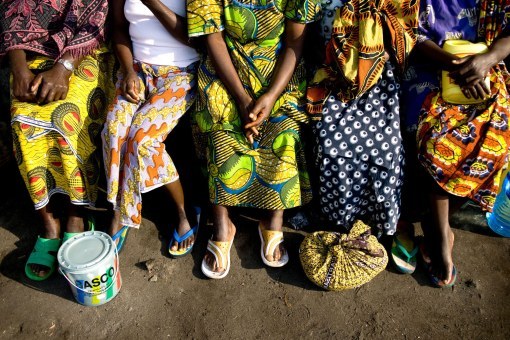
Email from The RESPOND Project to The Communication Initiative on March 2 2012. Image courtesy of Photo: Aubrey Graham/IRIN
- Log in to post comments