










































Monitoring & Evaluation of Community Engagement...KEMRI Community Representatives (KCR)
The KEMRI-Wellcome Trust Research Programme
Delivered at the Wellcome Fourth International Public Engagement Workshop, October 3 2012, this presentation explores strategies for monitoring and evaluating community engagement (CE) in action research work as undertaken through a collaboration between the Kenya Medical Research Institute (KEMRI) and the Wellcome Trust (WT). Specifically, it focuses on how the KEMRI-Wellcome Trust Research Programme (KWTRP) has monitored and evaluated a network of community representatives elected by residents of Kilifi, a poorly resourced and semi-arid district of Kenya. KWTRP research falls into 5 major disciplines: clinical sciences, epidemiology and demography, pathogen biology, public health policy and health systems, and social and behavioural research.
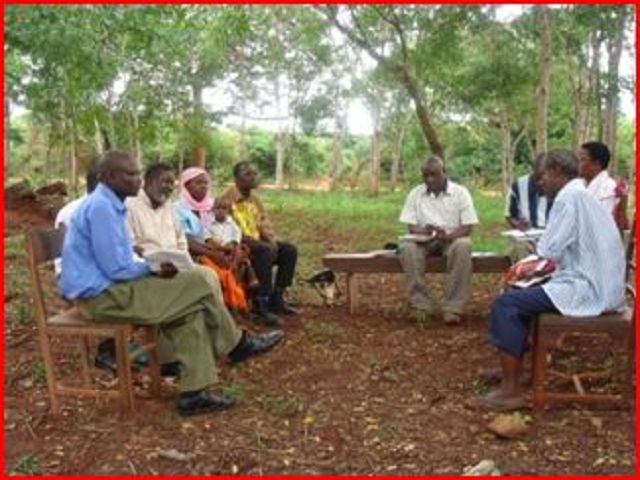
It is this group - KEMRI Community Representatives (KCR) - that KWTRP consults for ongoing and planned research studies in the programme. The goal of this CE effort is to strengthen general awareness about research, address some concerns and rumours, consult on KWTRP research activities, build appropriate levels of trust, and show respect and cultural humility. At the study-specific level, organisers hope to develop appropriate study-specific activities and ensure freedom of choice, highlight the hidden costs and benefits of research, and ensure validity of the proposed science.
A range of activities that are designed to engage area residents include regular meetings with the KCR network, open days, outreach activities, training of the KCR, and meetings with provincial administration and local health stakeholders. KCR comprises about 220 typical community volunteers elected in large public meetings at a sub-locational level. They are typical in terms of their representation: gender mix, age mix, education levels. The local leaders (chiefs and the assistant) are co-opted members. KCR are first given training on programme activities. KWTRP ensures that they are independent so that they are not compromised on the information they give. "We do not expect them to pro-actively mobilize for research activities." The study-specific CE deals with development and implementation of a CE plan for new studies. All CE activities are coordinated by a community liaison group.
The motivation for evaluating KCR is based on curiosity as to how they support consultation and how they interact with KWTRP staff. Approaches include: ongoing action research; documentation of questions, issues, suggestions, etc.; and social science studies such as household surveys and focus group discussions (FGDs). "We carefully document and review material during our engagement with them. This is cyclic as expected the learning we draw are fed back into practice."
Email from Salim Mwalukore to The Communication Initiative on October 30 2012; and KEMRI-Wellcome Trust Research Programme (KWTRP) website, October 31 2012.