










































Sabitra Dhakal - CARE International - DFID Girl Summit 2014
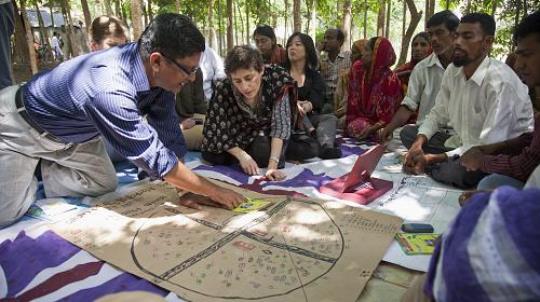
"In Southern Nepal, it is not just girls who are forced to marry young but boys too. Both boys and girls marry between the ages of 5 and 7 years, and girls move to live with the boy and his family in their early teens." Sabitra Dhakal
Panel Discussion: Spotlight on Progress - "All Aboard: Strategies to Engage Girls, Boys, Men, Women and Whole Communities for Change"
Context: This is one of the 14 "Spotlights on Progress" video-recorded sessions from the Girl Summit 2014, London, United Kingdom (UK). The sessions were organised to share best practice between practitioners, grassroots activists, and ministers of governements across the issues of female genital mutilation (FGM) and child, early, and forced marriage (CEFM). Girl Summit is a project of the Department for International Development (DFID), UK.
A featured panelist of this Spotlight session was Sabitra Dhakal, who is Project Manager of the Tipping Point Initiative of CARE International.
Profile of speaker: Sabitra Dhakal works in Nepal for this multi-country project led by CARE-USA (United States), working to address the root causes of CEFM through the challenging of social norms.
Strategy overview: Since August 2013, the Tipping Point initiative has been addressing CEFM through: innovation, insight (analysis and learning), and influence through advocacy. Dhakal highlighted the importance of working not only with women and girls, but with men and boys to break down cultural norms around early marriage in Nepal. She cites the father of the family as a central figure, as well as the centrality of religious leaders and of wives - three main actors in CEFM decisions. Because of the early commitment to marriage, she states that working with boys at a very young age is critical - reflecting on how they are forced to "be a man" early on. She illustrates how men are changing through stories of reflection on how couples' lives would be different if allowed to, for example, continue their education.
"The project focuses on facilitating and learning from innovative strategies to influence change-makers and root causes of child marriage in Nepal and Bangladesh, two child marriage hotspots....It is important to engage with boys and men in Nepal. Women cannot fully exercise agency without engaging men. Not only girls are affected by early marriage. In Nepal, both girls and boys are married at age 5, 6, 7. Neither boys nor girls have a choice. We work with boys and men to empower women. Boys and men are under pressure to dominate women and girls and they are relieved to discuss the impact of child marriage on girls and boys. Things are changing. Men are saying things like 'if only we had not been forced to marry, and had been allowed to go to school, our lives would have been different' or 'We decided we will not need anything in dowry from a daughter-in-law’s family. The newly married couple will be able to have a life without it Dowry leads to many bad things. My poverty is transferring to my children. I will take responsibility to delay their marriage.'"
CARE describes its focus on innovation as working locally - each community has "complex and particular reasons for child marriage, and any solution for child marriage must come from local solutions." Thus, partnering with local organisations is critical. Funders and partners include: The Kendeda Fund, and in partnership with Siddhartha Samudayik Samaj (SSS), the Dalit Social Development Center (DSDC), JASHIS, and the Association for Slum Dwellers (ASD).
Strategies that are being documented include:
- "Address the economic links between dowry and early marriage;
- De-link norms of sexual “purity” and family honor;
- Build a supportive environment through multiple and diverse partnerships; and
- Directly engage men and boys as advocates for change."
Monitoring, evaluation, and learning (MEL) take place through using a Developmental Evaluation (DE) approach, which encourages local development of strategies through creating theories of action, baseline testing and situational analysis, modification through feedback loops, capacity building, reflection, adaptation, documentation, and generation of innovation.
Tipping point key learning questions (Click here to access a full list.) include, for example:
- "Can intentional and thoughtful dialogues on adolescent sexuality and masculinity (what it means to be a male) make a difference in child marriage practices?
- How can sexual and reproductive health education or dialogues on sexuality affect communication between parents and adolescents on bodily integrity and rights?
- How can they help to delink chastity and family honor, or the burden of shame that gets laid on girls when boys and men sexually harass them?
- How can transformative work with men and boys through dialogues on masculinity affect expectations of girls and women, roles and responsibilities of girls and women, the quality of relationships, and decision making about marriage?"
Overview of this Summit Session: From the Girl Summit summary document: "This session recognises the importance and power of community members and the structures to drive social change for girls – including the importance of engaging men and boys. Here we explore a range of different strategies for working with whole communities to promote abandonment of FGM and child, early and forced marriage. We learn more about the role of championing from within, bringing men and boys into the picture, the power of working through pre-existing structures to promote conversation and commitment to change and exploring the role of the disparate communities in the form of diaspora groups.
The session is opened by Ziauddin Yousafzai Honorary Chairman, The Malala Fund.
The speakers, in order of appearance, are:
Rugiatu Neneh Turay Founder of the Amazonian Initiative Movement
Nasheima Sheikh Assistant CEO, Birmingham & Solihull Women’s Aid
Sana Uqba Campaigns and Publicity Manager, Middle East and North Africa Regional Consulting
Sabitra Dhakal Project Manager, CARE International
Agnes Pareyio Founder of the Tasaru Ntomonok Initiative
The session is moderated by Eric Levine, CEO, Stars Foundation."
Footage of this (available below) and other "Spotlights" are available on DFID’s YouTube channel.
The Girl Summit is a project of DFID. Click here and scroll down to see the full list of committed individuals and organisations working on girls' issues, as well as a list of Girl Summit Charter signatories.
DFID Girls Summit Outcomes website and the CARE website, August 3 2015.
- Log in to post comments