










































Professor Gamal Serour, International Islamic Center for Population Studies and Research - DFID Girl Summit 2014
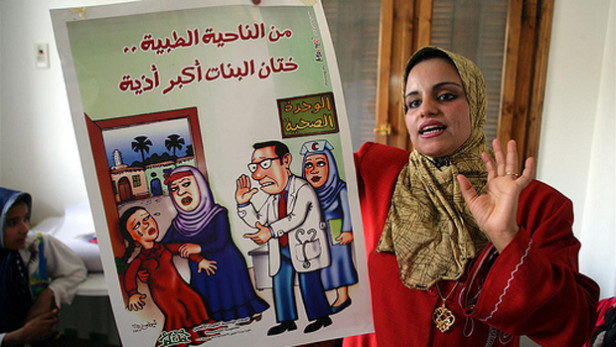
"There is no religious basis whatsoever in Islam for FGM - either Type 1, Type 2 or Type 3..." - Professor Gamal Serour
Panel Discussion: Spotlight on Progress A3 - Faith Forward: the Role of Faith Communities and Leaders in Addressing FGM and CEFM
Context
This is one of the 14 "Spotlights on Progress" video-recorded sessions that took place at the Girl Summit 2014 in London on 22nd July. The sessions were organised to spark conversations and share best practice between practitioners from around the world, between grassroots activists and ministers, and across all the issues of female genital mutilation (FGM) and child, early, and forced marriage (CEFM). Girl Summit is a project of the Department for International Development (DFID), UK.
A featured panelist of this Spotlight session was Professor Gamal Serour, who talked about how religious leaders and community advocators are at the forefront of combating FGM in Egypt.
Profile of Speaker
Professor Gamal Serour is Professor and Director of the International Islamic Center for Population Studies and Research at Al-Azhar University. He is a professor Of Obstetrics and Gynaecology. FRCOG, FRCS, FACOG, FSOGC, FJSOG (Hon.)
Project strategy and key points made in the presentation:
Professor Gamal Serour talks about "how the al Azhar University and the Al Azhar Mosque in Egypt have worked together to help faith leaders across the world understand how science and medical evidence relate to ideology and doctrine." He highlights the importance of combining professional medical advice from obstetricians and gynaecologists with credible religious scholars to dispel misinterpretations of Islam around FGM and other harmful practices. He talks about their work with religious leaders and their role in taking these messages out to the wider community with the help of publications and training.
Professor Gamal Serour explains that the International Islamic Center for Population Studies and Research has been working with faith-based organisations since 1975. They initially started working with religious leaders to create awareness of the consequences of FGM on the sexual and reproductive health of girls, and out of this collaboration came the recommendation and recognition that FGM is against religious direction, and that the Holy Koran does not refer explicitly or implicitly to any form of FGM. None of the Prophet's daughters were circumcised, and there are no authenticated Hadith (collected sayings of the Prophet Muhammad) which support FGM. Based on this work, as well as work with other faith groups,such as the Coptic Church, various documents were developed which dispelled misconceptions about religion and other harmful practices.
Based on these publications, they then conducted seminars and training programmes for religious leaders from remote areas in Egypt. A third party evaluation showed a marked improvement in the attitudes of religious leaders when talking about harmful practices including FGM.
To take this work a step further, they then decided to train the trainers, and involved higher level religious leaders and trained them on how to change their Friday prayer addresses to include contemporary issues like FGM. These religious leaders then conducted the same courses with their peers. Professor Gamal views the fact that the training was coming from religious leaders themselves and not an outside party as important for success, and believes this played a major role in changing the attitude and position of society towards FGM. The project provided this training not just for Egypt, but also for the region and the Islamic world - in Africa, Asia and Europe. They also encouraged top religious leaders to issue statements and fatwas against FGM and harmful practices. Professor Gamal Serour stresses again that it is important that these come from top religious leaders, as it is more effective than when it comes from those who claim to be talking for Islam.
He concludes by saying that Egypt has seen a decline in FGM practices over the last decade. The last DHS showed a decline of FGM among schoolgirls from 91% to 75% (public schools) and 50% (private schools).
The following are two publications developed by the International Islamic Center for Population Studies and Research in partnership with UNICEF:
"Female Circumcision - Between the Misconception of Science and the Misunderstood Doctrine" [2013].
"Children and Islam" [2005].
Overview of the "Faith Forward: the Role of Faith Communities and Leaders in Addressing FGM and CEFM" Summit Session:
"This Spotlight discusses initiatives with faith and community leaders who support efforts to end FGM and child, early and forced marriage. Lessons are shared from inter-faith dialogue and from coalition building with wider non-faith groups to outline areas for future action including joint statements, campaigns and by connecting local and international faith communities. The discussion covers:
- building coalitions with faith and community leaders at the grass roots;
- working with faith and community leaders in challenging contexts;
- using traditional networks and new media to engage audiences;
- engaging a global community of faith leaders."
The speakers, in order of appearance, are:
Rebecca Mahlunge Programme Manager, Hivos
Shahin Ashraf Muslim Chaplain and National Network Coordinator for the Muslim Women’s Network UK
Reverend Dr Medad Birungi Zinomuhangi President and Founder, World Shine Ministries
Professor Gamal Serour Professor and Director of the International Islamic Center for Population Studies and Research at Al-Azhar University
Dr Ann-Marie Wilson Executive Director, 28 Too Many
The session was chaired by human rights journalist Saroja Coelho, formerly Environment Editor and Radio Presenter at Deutsche Welle.
Footage of this (available below) and other "Spotlight Sessions" are available on DFID’s YouTube channel.
Outlines of the 14 Girl Summit Spotlight Sessions and Summaries of the 14 Girl Summit Spotlight sessions and Youtube Girls Summit 2014 webpage, August 7 2015.
Image credit: UNICEF, Australia
- Log in to post comments