










































Evaluation of the Behaviour Change Communication and Community Mobilization Activities in Myanmar Artemisinin Resistance Containment Zones
Department of Medical Research, Yangon
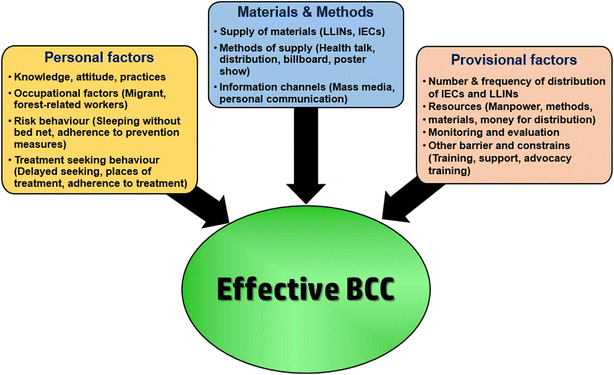
This study aimed to evaluate the effectiveness of the behaviour change communication and community mobilisation activities carried out under the rubric of the fifth objective of the Myanmar Artemisinin Resistance Containment (MARC) programme zones in Myanmar. Noting that provision of the diagnosis, treatment and preventive tools are not enough to combat the disease without proper information to change risk behaviour, the programme carried out mass media (e.g., radio talk shows, television short stories, and videos), developed community networks and interpersonal approaches, and distributed information, education, and communication (IEC) materials such as pamphlets, posters, and billboards. All of the basic health staff and malaria volunteers were trained in interpersonal communication (IPC) and were included in health talks to promote BCC among the intended population.
The field-based cross-sectional descriptive study with analytical components was conducted from September to December 2013 in 16 townships from the Myanmar artemisinin containment zones of MARC. Community-based household surveys were conducted using qualitative and quantitative approaches. Pre-coded and pre-tested structured questionnaires were used for face-to-face interviews. Focus group discussions (FGD) were done at two places in each study sites by stratified purposive sampling method. Discussion guidelines were formulated as a series of open-ended questions.
Among the 832 households resided by 4,664 people, there were 3,797 bed nets. Almost all families (99.8 %) had a bed net. Nearly 25% of all bed nets were re-treated with insecticide, and 75% of the re-treatments were done within 12 months. However, 38% of them were unable to mention the benefit of insecticide-treated nets (ITNs)/long-lasting insecticide-treated nets (LLINs), indicating that health education on the treated bed nets should be emphasised. A total of 734 out of 832 (88.22%) know of malaria. Regarding knowledge on symptoms, the most common answers were fever (567, 77.25%), chills (613, 83.5%), and headache (264, 35.9%). More than 80% reported that mosquitoes were responsible for malaria. However, more than 15% believed that drinking of dirty water (stream water) can cause malaria and 11% did not know the causes of malaria. Only 305 (36.65 %) said they received the information on malaria within last 1 year. However, 45 of them (14.7%) were unable to mention what information they received. Health staff were found to be main informer in the study site (69.8 %) followed by poster, brochures, TV and radio and health volunteers. In this study, only 85 (10%) of the respondents were illiterate, and more than half of the household had the media assets, such as television, radio, or a DVD player, indicating that mass media may be suitable channel for one element of BCC activities.
Although malaria volunteers were assigned in all of villages to get the diagnosis of malaria within 24 hours after fever, they were not the first health care provider for most of the fever episodes in this study. This unexpected finding suggests a need to explore the reason for this important issue.
Qualitative findings are shared in the form of quotations from community members. One township medical officer said: "BCC activities are believed to be successful. Now most of the people accept to sleep under the bed net and consequently the prevalence of malaria is decreasing." Yet another health care provider noted: "Even some health care personnel do not aware the importance of BCC and we have no routine system for monitoring, supervision and evaluation for BCC." One health staff member suggested: "BCC activities should be done in target groups who have highest risk for malaria, especially in their free time such as at night." Another one of health providers opined: "As no one channel for BCC activities is enough in our community, multi-channel approaches based on our resources should be encouraged."
The researchers conclude that there is "improvement of the behaviour change in the MARC areas comparing with the previous findings" (published in 2013 and 2014). They recommend provision of comprehensive BCC through media/channels that are accessible and appropriate to vulnerable populations so as to increase the participation of the population in different socioeconomic strata. As the findings of this study highlighted, such efforts should continue, focusing on correcting misconceptions about malaria transmission, prevention, and universal ITN/LLINs utilisation. They finish the paper by sharing several recommendations, such as: Promote training on BCC among basic health staff and malaria volunteers; carry out supervision and monitoring on BCC activities by health staff; encourage multi-channel BBC activities; aim to conduct BCC activities at convenient times for the intended audience; and conduct operational research on the effect of BCC activities by using uniform study design in different tiers in MARC before and after the activities.
Malaria Journal 2015 14:522