










































Integrating Participatory Design and Health Literacy to Improve Research and Interventions
University of California, Berkeley School of Public Health
"...the lack of intensive participation of the users has been a major impediment to designing, implementing and evaluating more powerful health literacy interventions."
This article shares research findings about health literacy and participatory design to improve health promotion, providing practical guidance and case examples for researchers, practitioners, and policymakers. The specific objectives of this article are to explore: (i) associations between determinants of health, health disparities, and health communication interventions; (ii) definitions and dimensions of health literacy and its importance to improve health communication; (iii) gaps in health literacy research and practice; and (iv) participatory design theory and methods and their value to improve health communication and health literacy interventions. It also offers: v) case examples about integrating participatory design and health literacy to improve health interventions and health equity and (vi) recommendations and new directions for researchers, practitioners, and policymakers.
As Linda Neuhauser explains, "expert-designed health communication is often overly generic and not adequately aligned with the abilities, preferences, and life situations of specific audiences....Health literacy, in concert with other determinants of health, has greatly advanced understanding of factors that facilitate or hinder health promotion at individual, organizational and community settings.....Integrating participatory design theory and methods drawn from social sciences and design sciences can significantly improve health literacy models and interventions."
Neuhauser begins by exploring determinants of health, health disparities, and health equity. Research on social determinants of health typically examines factors such as socio-economic status, age, gender, sexual orientation, disabilities, race and ethnicity (including discrimination and cultural beliefs and behaviours), educational levels, neighbourhood conditions. Researchers are studying how the determinants of health interrelate and impact health positively or negatively. Although a factor such as socio-economic status is closely associated with empowerment - and is difficult to change - Neuhauser asserts that there are opportunities to increase empowerment and health through health promotion interventions. (Substantial research shows that sense of control/empowerment is one of the strongest predictors of people's health.)
Although the concept of health literacy emerged in the United States (US), it has now spread globally. Furthermore, the evolution of health literacy definitions - e.g., from a focus on individual skills to an emphasis on contextual factors, interpersonal interactions, and its multidisciplinary and multidimensional nature - is linked to expanding conceptual health literacy models. Models include core health literacy factors (individual capacities related to knowledge, information access, reading, listening, speaking, numeracy, memory, healthcare navigation, and critical health decision-making) yet also in some cases incorporate behavioural factors such as health risk behaviours, use of healthcare, and medication adherence. Other models take a broader view and incorporate factors that go beyond personal health literacy factors to encompass determinants of health in a variety of societal situations. These models have stronger emphasis on empowerment, advocacy, and group and community factors; a new model could identify unique health literacy pathways for interventions that could reduce health disparities.
Research has identified existing or refined instruments that can be used to examine health literacy variables. As of 2016, Boston University's Health Literacy Tool Shed included information on 125 tools that measure health literacy. Health literacy research has identified important relationships between health literacy levels and health knowledge, attitudes, behaviours, outcomes, and disparities. Strategies to design and assess "plain language" communications have been codified into health literacy principles that include reducing reading levels and improving syntax, cultural appropriateness, and format for easier comprehension. Descriptions of these recommended practices include those provided by the US Centers for Disease Control and Prevention (CDC) and the US Agency for Healthcare Research and Quality (AHRQ).
Overall, as Neuhauser demonstrates, health literacy intervention research shows positive, but uneven results; examination of basic research and interventions research in health literacy indicates important gaps. She argues that conceptual models need to incorporate more determinants of health and their relationship to health literacy factors, including identification of mediating and moderating variables that affect health outcomes and disparities. More examination is needed of non-cognitive variables, such as motivation and self-efficacy and their relationship to health behaviours and health/quality of life outcomes. For example, "oral health literacy" interventions to improve patient-provider communication do not always lead to significant outcomes in desired behaviours. This may be related to factors such as the patient's anxiety in an examining room, non-verbal behaviour of healthcare providers, lack of visual tools to accompany the oral communication, or lack of social support from a family member. "[I]t will be challenging to identify many other factors that are not yet clear in the literature: What exactly is a 'shame-free environment?' What colors, sounds, spaces and designs in the setting calm and engage people? How can information be presented in the setting that intrigues people to interact with it, search out their own questions, and become more 'activated' to make and carry out health decisions? A deeper question is: How do researchers and practitioners even know what questions to ask?"
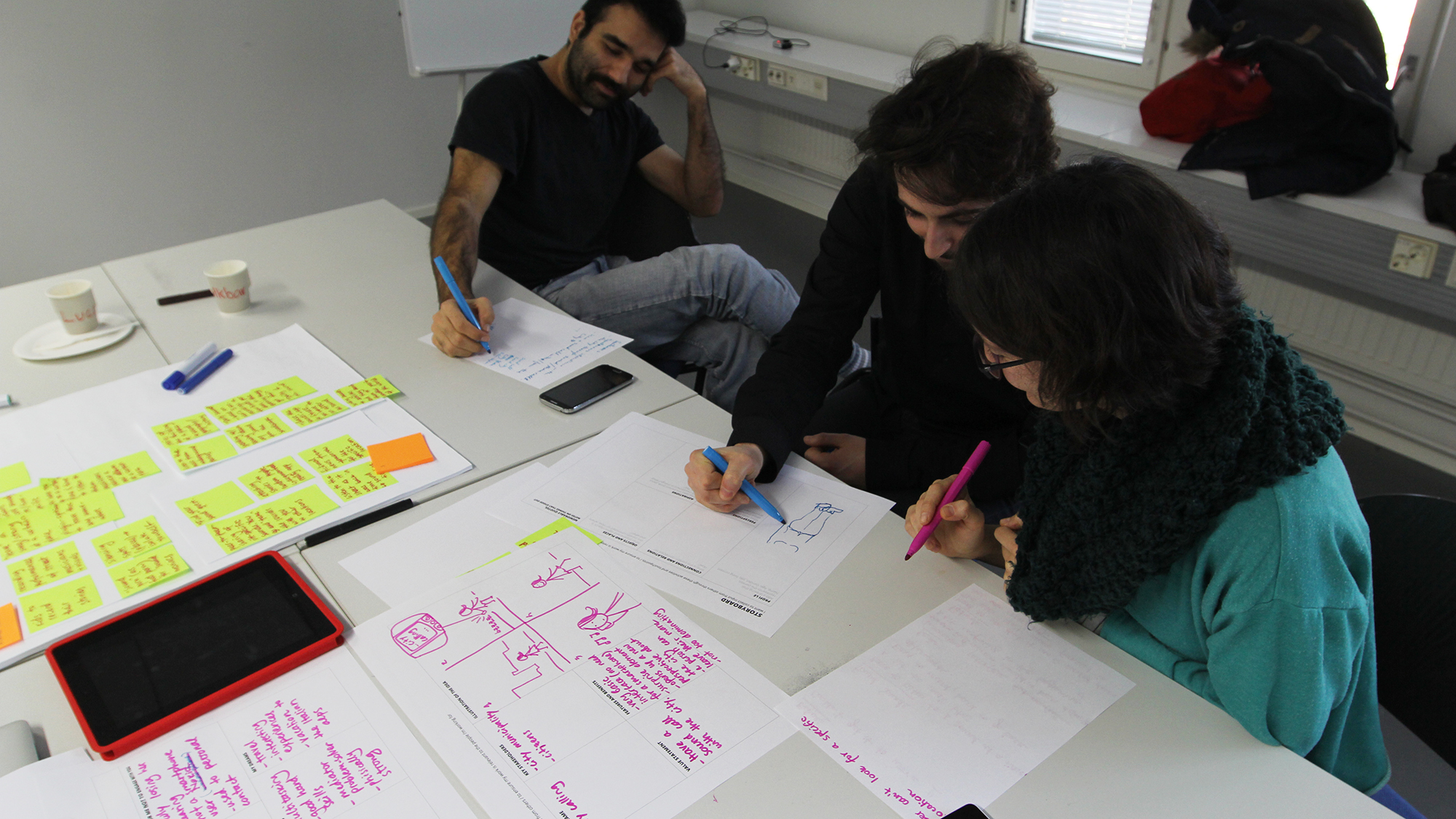
This is where participatory design comes into play. This idea is not new; in the area of health communication/health literacy interventions, two decades of studies show that when users participate in designing and testing communication, outcomes are more successful, including for vulnerable groups. Neuhauser discusses the origin and scientific foundation of participatory design in social sciences and in design sciences. Human and design sciences overlap in the area of participatory action research in which health and social interventions are collaboratively developed and studied iteratively. Researchers and practitioners from both human and design sciences are increasingly drawing on methods - outside their traditional disciplines - that share the commonality of engaging intended users in design and implementation. The Institute of Design at the University of California, Berkeley, has developed a repository of design methods called The Design Exchange that includes many design methods and cases.
In brief, design thinking methods originated at the Stanford University Institute of Design and include five stages: empathise with users, define issues, generate ideas, and prototype and test solutions. The requirement to reach a deep level of empathy with users before moving on to other steps differs from traditional research strategies that begin with identifying problems. In early design thinking exercises, users and stakeholders engage in rapid problem and solution identification. Neuhauser describes these exercises as especially effective because both experts and end users participate as equals, and processes are highly visual and interactive, rather than primarily cognitive and data-oriented. "User-centered design is effective at individual, organizational, community and societal levels."
"Although evidence is increasing about the value of integrating health literacy and participatory design strategies in health interventions, there is a lack of detailed guidance for researchers, developers and practitioners about how to do so in a way that gets to the deep personal and contextual levels needed for scientific inquiry and successful interventions." Having outlined challenges to integrating participatory design and health literacy, Neuhauser recommends six summary steps related to designing and testing health communication resources. They emerge from her work at the Health Research for Action centre (HRA) at the University of California, Berkeley School of Public Health. In brief:
- Identify participants and set up an advisory committee with representatives of participant groups. Participants include end-users and sub-groups of users, researchers, and all relevant stakeholder groups, such as health and social service providers, community groups, government officials, policymakers, funders, media, etc.
- Conduct formative work with participants using varied participatory methods. Use multiple formative methods, such as design thinking exercises, focus groups, surveys, health literacy assessments of existing resources, etc. Examine results with the advisory committee to iteratively define and refine project goals and strategies.
- Draft health communication resources adhering to health literacy principles; develop initial dissemination plans, including advisory committee members and other relevant end-users, providers, funders, etc. in the planning.
- Iteratively test and revise communication prototypes and implementation plans with intended users and stakeholders. Use design thinking or other strategies with users and stakeholders to refine the implementation plan.
- Continuously evaluate and revise the health communication resource. Gather data using mixed qualitative and quantitative methods, such as interviews, design thinking exercises, focus groups, on-site observations, surveys, randomised trials, etc. Tailor reports to the communication abilities and preferences of audiences (scientific publications, user-tested brief reports, etc.).
- Sustain and extend successful programmes to other populations or regions. If the initial intervention is well crafted with intense participatory design and detailed documentation, adaptation elsewhere is typically easier and less expensive.
Case studies illustrate these steps in practice. They focus on: participatory development of mass communication for Medicaid beneficiaries; participatory design of a community wellness project with Chinese factory workers; ChronologyMD mobile app; and other participatory health literacy projects focusing on statewide parenting education kits, maternity leave resources for pregnant women, and emergency preparedness communication for deaf and hard-of-hearing populations.
In conclusion, Neuhauser writes: "Participatory design theory and methods drawn from human/social sciences and design sciences can significantly improve health literacy models and interventions and vice versa. Participatory design is essential to understand deeper and elusive factors that impact health and specific ways to address them. If those most affected by these problems are not involved in identifying and addressing them, research models, interventions and broader policy changes will not likely improve. Currently, most health literacy researchers and practitioners, such as those in public health, medicine, psychology, and communication, come from a social sciences perspective. However, the design sciences offer an existing, robust theoretical foundation that is currently underused....The design sciences offer powerful techniques with demonstrated success in the socio-technical fields. Combining them with our current health literacy approaches is an important direction and requires that we cultivate an active, multi-disciplinary dialogue to share new ways of thinking about health literacy, designing interventions and researching their impact."
Information Services & Use 37 (2017) 153-176. DOI 10.3233/ISU-170829. Image credit: Pouyan Mohseninia
- Log in to post comments