










































How Can Evidence Bolster Citizen Action? Learning and Adapting for Accountable Public Health in Guatemala
Center for the Study of Equity and Governance in Health Systems (CEGSS), Accountability Research Center
"A decade ago, CEGSS [Centro de Estudios para la Equidad y la Gobernanza de los Sistemas de Salud (the Center for the Study of Equity and Governance in Health Systems] began with an emphasis on generating rigorous evidence to influence public policy implementation. Over the course of its existence, however, the organization has evolved to situate evidence in the political and social context of Guatemala’s rural indigenous municipalities."
This note on the use of evidence for public health advocacy in Guatemala analyses the question of how to use evidence to influence authorities and promote participation by users of public services in rural indigenous municipalities of Guatemala. Initially, CEGSS relied on producing rigorous evidence through the surveying of health care facilities using random samples. However, on finding that this type of evidence did not have any influence on authorities, the organisation expanded the understanding of evidence from "an academic construct built on scientific rigor (i.e. hierarchy of evidence)" to include "any information (photography, video, testimonies, life-stories) that may be used to open-up a channel of engagement with authorities to resolve existing problems in public services. The approach has come to include maximizing synergy between the participatory process of generating evidence and using that to inform action. As importantly, CEGSS monitors how authorities respond."
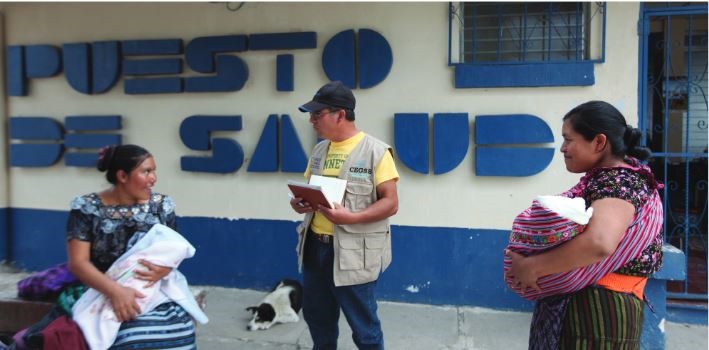
CEGSS offers "training, basic equipment, and technical assistance to a network of volunteer community-based defenders of the right to health who have been chosen by their own communities. The involvement of users of services in evidence collection was accompanied by civic action strategies to engage with authorities in the resolution of problems."
Because, due to health governance decentralisation, local authorities are in a position to address issues of service quality, corruption, and abuse; thus, community-based defenders may focus actions at the local and regional levels and engage with national level officials, Parliament, Ombudsman, and national human rights bodies. CEGSS finds that participatory approaches to generating and interpreting evidence empowers service users by activating their roles as citizens and voters.
The organisation has monitored its methods of gathering evidence for the effects on two outcome variables: "1) the level of community participation in planning, data collection and analysis; and 2) the responsiveness of the authorities to the evidence presented."
Methods include the following: "1) Surveys of health clinics with random sampling, 2) Surveys using tracers and convenience-based sampling, 3) Life histories of the users of health services, 4) User complaints submitted via text messages, 5) Video and photography documenting service delivery problems. "
Indicators are charted in Table 1, page 8, and may include: for measures of community participation - number of community leaders' participations, number of information campaigns, and, number of complaints by users; for government responsiveness - number of meetings between community defenders and authorities, number of complaints resolved, number of municipalities and provinces with channels of communication between defenders and authorities, and changes in officials' perceptions of users of services and their complaints.
Table 2, page 9, provides evidence of the two measures by method used. It shows the highest participation and responsiveness from texted complaints and video and photo documentation. Communities have used evidence through a variety of means depending on kinds of problems and openness of authorities to complaint resolution. Methods include: publishing evidence in the media and displaying it at public exhibits, street demonstrations, requests to parliamentarians, reporting cases of abuse and corruption to public prosecutors, and calls for observation from the official human rights ombudsman.
The document concludes with results of the December 2017 annual assembly of the network of community defenders and CEGSS, results of which are incorporated into action planning for 2018: "During the assembly, there was a participatory exercise to assess, discuss and reflect about the successes, challenges and lessons learned related to our interventions to improve accountability in public health services. As result of this exercise, it was agreed by all participants that we should further adapt our actions and pursue a new strategy that would include:
- Integrating strategies within municipal, provincial and national levels
- Expanding alliances (with broader social movements and technical organizations)
- Engaging and influencing public budgets in the short, medium, and long term
- Tackling structural causes of poor public health services (budget, management, corruption, rule of law) Implementing preventive accountability tactics and actions."
Accountability Research Center (ARC) website, Date 2016. Image caption and credit: Health Post, San Pedro Jocopilas municipality, Quiché Province, Guatemala. Health Rights Defender: Armando Peláez. Credit: © Sandra Sebastián
- Log in to post comments