










































First Nations People's Perspectives on Barriers and Supports for Enhancing HPV Vaccination: Foundations for Sustainable, Community-Driven Strategies
Cumming School of Medicine (Henderson, Shea-Budgell, Mrklas, Barnabe, Guichon, Bedingfield, Glaze, Kellner, Nelson); Alberta First Nations Information Governance Centre (C. Healy, Bill, B. Healy); Alberta Cancer Prevention Legacy Fund (Letendre); Emory University (Bednarczyk); University of Alberta (MacDonald); Alberta Ministry of Health (Colquhoun, Bell); Indigenous Mental Health Program (Nash); First Nations and Inuit Health Branch (Richardson); Elder, Eden Valley Nation (Dixon ); Elder, Tsuut'ina Nation (Starlight, Runner)
"The importance of verbal forms of education was among the strongest themes, underscoring that prevention without relationships would be unlikely to improve HPV vaccine uptake or related health outcomes."
Reports indicate that cervical cancer among First Nations (FN), a diverse subset of recognised Indigenous people in Canada, and Inuit women in the province of Alberta is 2.3 times higher than among non-FN and Inuit counterparts, and there is evidence to suggest that HPV vaccination is lower in Indigenous populations. In response, the Enhancing HPV Vaccination In First Nations Populations in Alberta (EHVINA) project - a university, health services, and FN partnership - seeks to increase HPV vaccination among girls and boys living in FN communities. Carried out as part of EHVINA, this study provides evidence around barriers and supports to HPV vaccination identified by community members, helping to inform the development of evidence-based, theory-informed, and context-sensitive/population-based intervention strategies. Findings may also provide relevant information for jurisdictions in other geographic regions with large Indigenous populations.
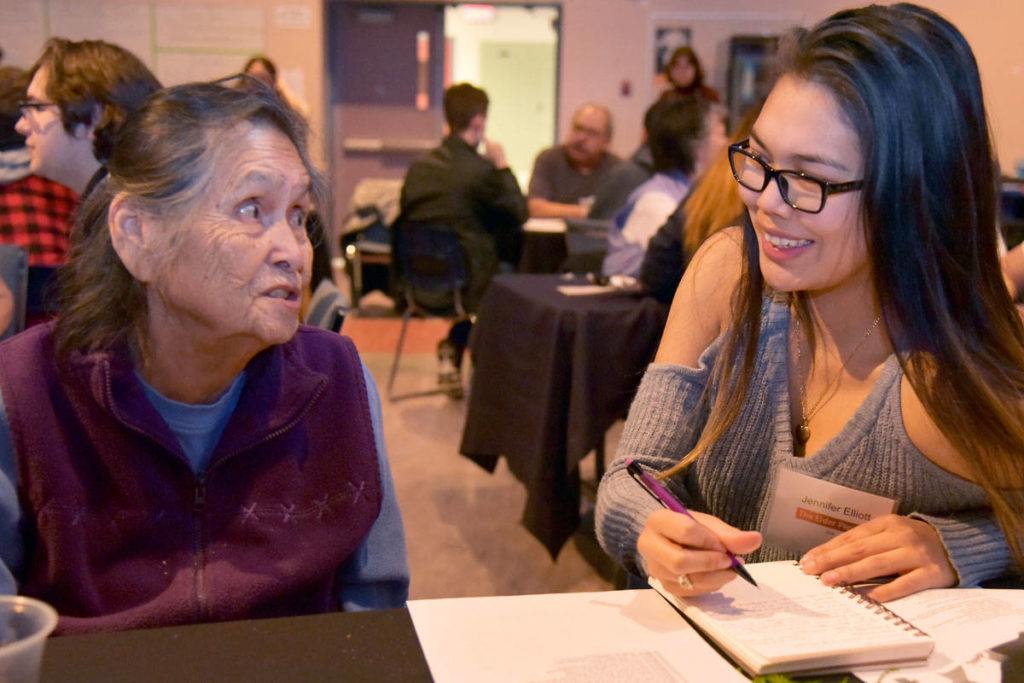
The stakeholders in this project included primarily Elders from 6 FN communities, who are individuals recognised by their communities as having accumulated knowledge and skills with which they mentor and/or lead others for the benefit of their culture and communities. Their perspectives were gathered at an event that took place in June 2017 to engage the Elders, health directors, and health services researchers in dialogue around unique barriers and supports to HPV vaccination in Alberta. In addition to presentations and discussions, participants were separated into 2 groups and took part in 3 rounds of "sharing circles", addressing sequential questions that had been developed with guidance from the team's Elder Advisors.
Voices of community Elders, parents, health directors, and cancer survivors (n = 24) - all of whom self-identified as Indigenous (from Cree, Dene/Sarcee, Stoney Nakoda, and Blackfoot cultural backgrounds), 3 of whom were men, and the majority of whom were grandparents - are presented as qualitative evidence.
Decolonising and post-colonial theory guided analysis of the transcripts that emerged, prioritising FN voices throughout the research process, emphasising practice-oriented impact, and affirming a trauma-informed approach to understanding how colonisation shapes health and healthcare experiences. Key findings, in brief:
- Cancer and HPV experiences: Awareness of cancer and its burden was high among this group. Explanations for the causes of cancer and experiences with treatment were characterised by doubt and mistrust of influences external to communities.
- Trauma-informed lens: Disrupted relationships resulting from the Canadian government's efforts to forcibly remove children from their families and communities throughout the twentieth century were evident in comments about residential schools having suppressed talk about sex and the communication of knowledge about sexual organs. Also, those in the child welfare system were described as having few supports to learn about their own bodies, let alone to have anyone following up on whether they receive the HPV vaccine within school-based programmes. In short, "the burden of HPV in FN people is rooted, at least in part, in efforts by people across the lifespan to cope with the violent disruption of family and community connectedness, as well as connection to land and spirituality. This burden is manifested not only in risk-taking behaviour, but also in avoidance of wider health system."
- Family and community: In earlier generations, girls and boys would learn from Elders through ceremonies about sexuality and respect for their bodies; the legislated prohibition of ceremony throughout the early half of the twentieth century was seen to have affected this intergenerational sharing. The involvement of men was considered key to several speakers - in transmitting messages of respecting women's bodies and in regaining and celebrating the role of all parents as community educators and leaders. These speakers also emphasised that effective prevention depends on building trust, which requires spreading the word orally, and being prepared to sit with people to answer their questions. School-based programmes appear not to tap into the resource of inter-generational educators within communities.
- Changing information landscape: Several speakers expressed concern that young people today are too open about their bodies and even immodest on social media. Proposing a shift toward oral forms of health promotion, each sharing circle wound up proposing the possibility of enhancing prevention via short educational videos using traditional languages, as well as English, and sharing accurate and respectful illustrations of the body. The videos could be a mechanism to equip parents and grandparents with information for educating youth, while also embedding traditional knowledge and language to catch people's attention. The technology was also seen as adaptable for diverse populations within communities (e.g., Two-Spirit, Elders, youth) with unique perspectives on HPV and its impacts.
Several speakers reflected on their experiences with HPV vaccination specifically, highlighting gaps in strategies that depended on written materials alone to raise confidence in the vaccine. Participants described children as educators of one another; this supportive environment among youth receiving the vaccine was encouraged in some communities by celebrating the event of vaccination itself (e.g., through a special meal). Nevertheless, some speakers were disappointed to learn after the fact that their grandchild had been vaccinated, lamenting that they had lost an opportunity to discuss issues related to sexual intercourse and to foster the kind of openness between generations believed to be protective of health. "An unexpected insight from the gathering in this respect is the historical openness of FN Elders toward sexual health education and a desire to take up their roles as teachers and carriers of this knowledge, which has been repressed through European colonization."
In proposing recommendations for improved prevention, participants noted that not all FNs are the same. Religious difference led to caution that messaging about sexual health be non-denominational, and that any strategy that connects to traditional practices also recognise that some people are no longer traditional. At the same time, the integration of Indigenous languages in messaging was considered by speakers of all ages to be empowering. Indeed, a message in a traditional language could call one to attention even if one did not speak it.
Table 2 depicts the EHVINA initiative's efforts to map community perspectives from the gathering onto evidence-based, theory-informed, and context-sensitive intervention strategies.
Among the themes the researchers explore in the paper's discussion section is the ways in which this EHVINA experience contrasts with the tendency of Western research to compartmentalise knowledge and information. "In analyzing the information shared by FN participants during this event, the interconnectedness and relationships that emerged indicate a need for further exploration from within these contexts, such as the knowledge contained within traditional teachings and the exercise of traditional health and wellness practice and beliefs."
The researchers conclude that "future efforts to develop materials, curricula, and community champions through the EHVINA initiative must continue culturally-competent and safe engagement to test impact in diverse FN contexts and ensure that messages about vaccines and the diseases that they prevent are locally appropriate."
Gynecologic Oncology, Volume 149, Issue 1, April 2018, Pages 93-100. https://doi.org/10.1016/j.ygyno.2017.12.024. Image credit: Mike Gregory
- Log in to post comments