










































Facilitators and Barriers to the Implementation of the HPV VACs (Vaccinate Adolescents Against Cancers) Program: A Consolidated Framework for Implementation Research Analysis
Emory University (Escoffery, Halpin, Rhiness, Wiggins, Kegler); Health Management Associates (Riehman); American Cancer Society (Watson, Priess, Borne)
"It is important to understand which factors have shaped the success or failure of implementations of evidence-based interventions for HPV vaccination in health centers that reach low-income populations, such as FQHCs."
The HPV VACs (Vaccinate Adolescents Against Cancer) Program was a multilevel, evidence-based intervention conducted by the American Cancer Society (ACS) in 30 federally qualified health centres (FQHCs) in the United States (US) in a quest to increase human papillomavirus (HPV) vaccination rates among adolescents aged 11 or 12 nationwide. Many barriers to HPV vaccination exist, including providers' ability to give a confident recommendation to vaccinate, parental hesitancy, and missed opportunities to vaccinate. In the context of the HPV VACs, this study used the Consolidated Framework for Implementation Research (CFIR), which is a theoretical model used to study factors that affect implementation through quantitative or qualitative methods, to explore barriers and facilitators related to HPV vaccination.
Thirty FQHC systems implemented the project in 2015 in 130 clinical or school-based sites. ACS randomly placed the systems into 3 intervention groups, with 10 systems in each group: one group received a US$90,000 2-year grant, another group received a US$10,000 12-month grant, and a third group received training and technical assistance but no funding. The intervention included both system-focused components aimed at removing systemic barriers to vaccination and provider-focused components (e.g., training, provider prompts, standing orders, assessment and feedback) aimed at improving the quality of providers' recommendations for the HPV vaccine. Some FQHC systems also implemented patient-focused reminder and recall components. In all 3 groups, FQHC systems worked with ACS partners to educate their staff on HPV vaccination and train providers to make an effective recommendation for the HPV vaccine. All 3 groups were also required to complete a capacity assessment tool, calculate baseline HPV vaccination rates, and modify their electronic health record (EHR) systems to support the project. Beyond these core strategies, FQHC systems were encouraged to choose additional strategies for evidence-based interventions on the basis of needs identified during the capacity-building phase.
From May to August 2016, the researchers conducted 32 in-depth interviews by telephone with representatives of 9 FQHC partners. Sample results:
- Common implementation strategies were training (5 of 9 FQHCs trained at least 75% of their staff members) and provider prompts (5 of 9 FQHCs used provider prompts).
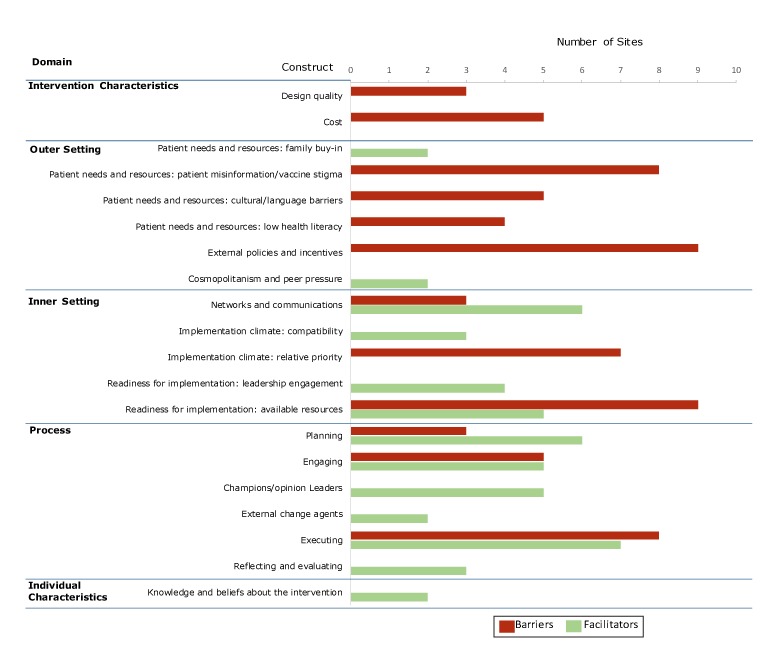
- In addition to usefulness of EHR systems and ACS staff support, some of the communication-centred facilitators included:
- Provider champions: It was found that engaging with influential people who actively support an intervention can be a boost to implementation. Designating a provider champion who helped encourage programme objectives reinforced HPV vaccination as a priority. In addition to affirming the importance of HPV vaccination, this symbolic appointment helped ensure that education and messaging spread consistently among clinic personnel.
- Training and education: Many FQHCs reported that training from ACS and/or pharmaceutical representatives was important for medical assistants, in particular, who are assigned to educate patients about the HPV vaccine. Providers expressed greater confidence in the vaccine and their ability to talk with patients about vaccination after the training.
- Concrete tools and resources: Having accessible tools, such as posters highlighting HPV vaccination, was considered critical for successfully increasing HPV vaccination. FQHCs described how having available patient resources helped initiate conversation; at times these resources would prompt parents to begin the discussion.
- Teamwork, clinical staff support, and communication: FQHCs acknowledged the importance of active involvement of clinic staff in communicating and promoting awareness among their peer network. Those who described verbal communication among staff members as a facilitator appreciated the complexity of communicating with a large group of individuals with competing demands and priorities. These FQHCs described identifying effective methods of communication, which could possibly adapt over time given changing needs, as particularly important given the network of providers spread over multiple clinics.
- In addition to EHR issues, staff resources, and competing priorities, some of the communication-related barriers included:
- Staff buy-in: Although a system was in place whereby clinical staff communicated with their peers to get buy-in, this communication did not happen for some staff members.
- Training needs: Although formal education facilitated implementation, some FQHCs faced problems disseminating information to clinical and nonclinical staff using terminology and examples that were appropriate across their roles.
- Patient misinformation and vaccine stigma: Providers reported that many parents had either general antivaccine sentiments - whereby they refused all optional vaccines - or they had negative opinions of the HPV vaccine specifically. Many parents believed the vaccine promoted sexual activity in their children or thought children only needed the vaccine if they were sexually active.
- Cultural or language barriers: Frequently, FQHCs required more skills and materials to accommodate their non-English-speaking patients.
- Low health literacy: Four FQHCs said that increased resources were necessary for educating patients with low health literacy. Many patients with low health literacy had very little experience with primary care, and thus were not accustomed to receiving preventive care.
Unfunded FQHCs were found to have used similar implementation strategies (e.g., training, technical assistance, facilitation) and had similar outcomes to funded FQHCs, suggesting that ACS staff support or committed FQHC staff members, rather than funding, was the key to project success.
The results indicate that organisations should consider the implementation process and organisational context when adopting evidence-based interventions. The findings highlight the importance of early planning, engaging staff members and champions, and planning for implementation during the intervention process. The primary facilitators were the use of EHRs and training (corresponding to the CFIR domain of intervention process) and education for providers ("inner setting", in CFIR language). Some of the suggestions made in the article for future implementation include:
- Provide adequate support to health systems over time about the importance and use of their EHR system to prompt clinic staff to offer a vaccination, document vaccinations, follow up on series completion, and track their health system's progress on vaccination.
- Offer training and skill-building activities to promote provider self-efficacy to counsel parents about vaccination.
- Build the capacity for alerts or reminders for parents and facilitate communication about vaccine series completion with state immunisation registries.
- Strive to understand patient issues about the vaccine and social and external influences that affect community awareness and vaccine delivery.
- Make use of training and tools exist to help bolster the self-efficacy of providers and to counsel vaccine-uninformed or -hesitant parents.
The article concludes with ideas for future research; for example: "Use of an implementation theoretical framework such as CFIR contributes to a broader understanding of contextual barriers and facilitators. Future implementation study can use theory to inform a deeper understanding of factors that affect implementation." Also, future studies could evaluate multiple components of interventions, such as this VACs initiative, on increasing the initiation and completion of HPV vaccine series among adolescents and young adults.
Preventing Chronic Disease 2019;16:180406. DOI: https://doi.org/10.5888/pcd16.180406
- Log in to post comments