










































Studying Public Perception about Vaccination: A Sentiment Analysis of Tweets
Brooklyn College of the City University of New York (Raghupathi); Fordham University (Ren, Raghupathi)
"By understanding the public sentiment about vaccination, government officials and public health policy makers can design more effective communication, education and policy implementation strategies to reach out to the public..."
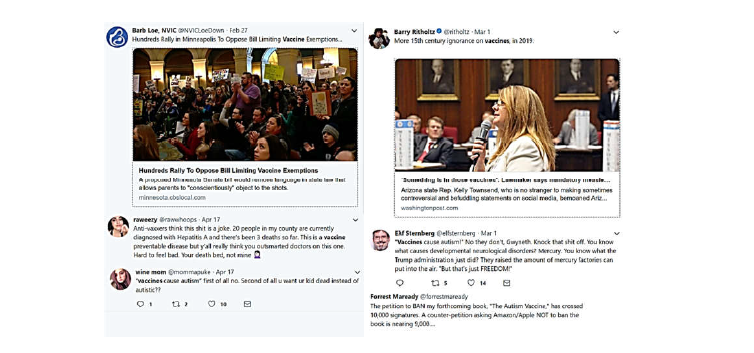
Anti-vaccine sentiment has been building in the United States (US) for decades. A majority of measles cases reported since the beginning of the US measles outbreak in October 2018 involved unvaccinated children in Hasidic Jewish communities. In response, in June 2019, New York state lawmakers approved a new law that banned religious exemptions to school vaccination requirements, a law that was opposed by thousands of parents. Anti-vaccination sentiment is in part a byproduct of misinformation on the internet (e.g., the later-discredited/retracted Andrew Wakefield study in the Lancet falsely showing a link between autism and measles, mumps, and rubella (MMR) vaccination) and remains a driving factor for reduced vaccination rates. To understand sentiment around vaccination in the US, this study used text analysis of Twitter during the time frame of the measles outbreak.
Previously, researchers have explored online anti-vaccination misinformation by analysing arguments on anti-vaccination websites, studying the levels of misinformation, and examining discourses to support anti-vaccination claims. Some of these studies have found, for example, that people who have strong negative attitudes and opinions are more active in posting information on social media and therefore exert a strong influence on people's attitudes. As the demand for transparency in the experiences from vaccination had increased, social media has evolved to become a platform not only for patient engagement but also for empowerment. Formal evaluations of vaccine studies can benefit from incorporating social media discussions of vaccine users; there is rich potential for extracting health information and studying the dynamics of health behaviours on Twitter.
This article augments this literature by employing the natural language toolkit (NLTK) to perform sentiment analysis to explore patterns and trends among collected Twitter data to understand the opinions of people towards measles vaccination. The study uses a sample of 9,581 vaccine-related tweets in the period January 1 2019 to April 5 2019, during the US measles outbreak. Sentiment analysis is applied to the sample, clustering the data into topics using the term frequency-inverse document frequency (TF-IDF) technique.
Of the tweets in this dataset, 43.3% were negative tweets, 40.4% were positive tweets, and 16.3% were neutral tweets. The negative sentiments mostly centred on the (unproven) link between the MMR vaccine and autism, and the fear that the vaccine could cause injury to children. The positive sentiments related to the vaccine being effective and the vaccine saving lives. The discussions converge in 3 clusters: discussions on innovations in the arena of vaccines; discussions on outbreaks in the US; and discussions on medical exemptions of vaccines by the states in the US. This landscape depicts public concern on a range of issues related to disease and disease prevention, thus offering a lens into the level of awareness of public health.
Thus, while there is social media chatter about the association between vaccination and autism (misinformation discussed previously), much of the public discussion is about how vaccination can save lives and is safe and effective. There is a positive trend in attitudes towards public health, as revealed in the discussion of the role of overall science and research in regard to vaccination, and the association between measles, contagion, and a lack of vaccination. However, the researchers advise scientists and public health policy officials to be on high alert regarding the potential for the rapid spread of misinformation that tends to get firmly entrenched in the public mindset. Stakeholders and government officials the world over - being informed through monitoring social media discussion and sentiment - should engage the public aggressively and continually in risk communication and education, they say.
According to the researchers, one avenue for future study is whether people post negative sentiments on vaccines just as an attention-seeking gesture of offering radically differing opinions. Particularly in health care, it is worth looking at a means to motivate people with positive sentiments to remain active and contribute more online. Future research could investigate whether there is an optimal period in which information can be presented online to create a positive influence and keep it active in memory. Positive emotions have been suggested to incite people to consider long-term benefits over short-term costs. Lastly, considering the affinity of users in different age groups to certain platforms, future studies can incorporate hybrid methods involving multiple platforms.
In conclusion, as old infectious diseases surface again (e.g., Ebola) and new viruses emerge (e.g., COVID-19), and rapid progress is made in the development of new vaccines, the researchers urge policymakers to be fully mindful of the fact that paying attention to what the public thinks can lead to informed decisions. They end by stressing that the use of advanced technology such as machine learning, natural language processing, sentiment analysis, and text analysis can be useful in understanding public opinion in the context of the spread of infectious diseases.
International Journal of Environmental Research and Public Health 2020, 17, 3464; doi:10.3390/ijerph17103464.