










































Vaccine Hesitancy on Social Media: Sentiment Analysis from June 2011 to April 2019
University of Valencia (Piedrahita-Valdés); International University of La Rioja (Piedrahita-Castillo, J. Bermejo-Higuera, J.R. Bermejo-Higuera, Sicilia- Montalvo, Machío-Regidor); European University of Valencia (P. Guillem- Saiz); Institute of Health Carlos III (P. Guillem-Saiz); International University of Valencia (J. Guillem-Saiz)
"The emergence of the Internet as a key source of vaccine-related content...has made it essential to incorporate online information monitoring in the strategies for addressing vaccine hesitancy."
Social media sites allow users from different countries to have public discussions about any topic, including vaccination, in real time. In the context of concerns about the increase in misinformation and rumours spreading online, social media can serve not only as communication tool for global health actors but also a platform for real-time surveillance of vaccine hesitancy. Sentiment analysis (SA) is a text-mining subfield that allows for the classification of opinions according to the polarity (positive, negative, or neutral), the emotion (happiness, fear, etc.), or the intensity of agreement based on a numerical rating scale. This study sought to evaluate public perceptions regarding vaccination on Twitter by performing a sentence-level SA on a dataset composed of 1,499,227 vaccine-related tweets, in English and Spanish, published from June 1 2011 to April 30 2019.
The study used a hybrid approach, selected due to its perceived superiority to independently applied lexicon-based approaches and machine-learning approaches. Among the findings:
- There were 2,700 vaccine-related tweets in June 2011. The number of tweets showed an increasing monthly trend until April 2015, with a peak of 57,544 tweets in February 2015 (the latter being concurrent with a media-heavy political debate over mandatory vaccination in the United States, or US). This was followed by a decreasing trend until December 2015. There was then a mean increase of 8,952 tweets per month from December 2018 to April 2019, reaching the highest peak (57,667 tweets) in the last month of this study. (April highs reflect hashtags around the annual celebration of World Immunization Week and European Immunization Week.)
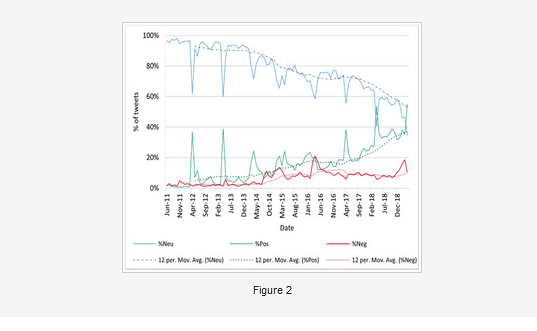
- The algorithm classified 1,039,864 (69.36%) tweets as neutral, 326,497 (21.78%) tweets as positive, and 132,866 (8.86%) tweets as negative. The percentage of neutral tweets showed a decreasing tendency, while the proportion of positive and negative tweets increased over time. The proportion of negative tweets remained under 20% along all the study period, except in April 2016, simultaneously with a controversy raised by a documentary that linked vaccines and autism. Again due perhaps to Immunization Weeks, positive tweets were predominant in the dataset twice, in April 2018 and April 2019; in fact, peaks in positive tweets were observed every April. Notably, there was not an impact on the frequency of negative tweets during April. This could be explained by the echo-chamber effect, in which people are more likely to interact with users who share their opinion towards vaccines.
- The proportion of positive tweets was significantly higher in the middle of the week and decreased during weekends. Negative tweets followed the opposite pattern. People setting up vaccine promotion interventions might wish to consider these types of patterns.
- Among users with 2 or more tweets, 91.83% had a homogeneous sentiment polarity towards vaccination in all their tweets: 52,020 (75.61%) users were totally neutral, 9,626 (13.99%) totally positive, and 1,535 (2.23%) totally negative.
- Positive tweets had a higher mean of retweets (4.99) than negative (2.17) and neutral tweets (1.37). Positive tweets also had a larger number of favourites/likes (7.97) than negative (2.34) and neutral tweets (1.52). The number of replies showed no statistically significant differences between positive (0.42) and negative (0.39) tweets. Both groups received more replies than neutral tweets (0.19).
- Geolocation was available for 144,651 (55.87%) users, responsible for 779,430 (51.99%) tweets. Positive tweets were more prevalent in Switzerland (71.43%) - perhaps because many international organisations have their headquarters in that country and actively use Twitter to promote vaccination. Negative tweets were most common in the Netherlands (15.53%), Canada (11.32%), Japan (10.74%), and the US (10.49%). Importantly, however, the distribution of vaccine hesitancy by country varied significantly from findings of other studies on vaccine confidence. This highlights the present researchers' theory that Twitter users are not comparable to the general public. In addition, the country analysis is probably biased by the selected languages (only English and Spanish) and the location-retrieving method.
Among the findings that have practical implications: Most users separate into polarised groups that barely communicate with each other and, when they do, they engage in arguments that reinforce their previous ideas about vaccination. For this reason, some researchers have asserted that current public health interventions may not improve vaccination acceptance, and, in some cases, they could reinforce vaccinate hesitancy. Instead, they propose strategies such as using hashtags and keywords that hesitant users usually search, encouraging the participation of community members as spokespeople for immunisation campaigns, and engaging in direct conversations with hesitant people aiming to understand the motives of their doubts and build their trust.
The data indicating an increasing proportion of polarised tweets over the years - see the figure, above - underline "the need to implement continuous vaccine-hesitancy surveillance on social media. The information extracted by this kind of monitorisation could be useful to build and adapt vaccine promotion strategies."
In conclusion, this study "highlights the importance of relying on machine learning for opinion-mining in big data and the need to keep improving the algorithms to overcome the present challenges, such as the identification of irony and sarcasm. The application of artificial intelligence has allowed us to perform a fast and low-cost analysis of sentiment polarity towards vaccination in a large number of tweets written over several years."
Vaccines 2021, 9(1), 28; https://doi.org/10.3390/vaccines9010028.
- Log in to post comments