










































The Structure of Tweets About Vaccine Safety Between Health Organizations, Experts, and the Public: Analyzing Risk Communication Conversations
Health and Risk Communication Research Center, University of Haifa School of Public Health
"Improving social media risk communication is not a 1-time effort restricted to a single class of misinformation or acute event, but it is part of a continuing need in public health."
Twitter is a vehicle for health education organisations and experts to communicate with each other and with the public, not just to broadcast messages. Having an interactive discussion is critical for risk communication. Such conversations, rather than the validity or convincingness of the arguments made, are particularly critical in light of the public's declining trust in institutions and vaccine misinformation circulating online. This article considers how members of the World Health Organization (WHO)'s Vaccine Safety Network (VSN) use Twitter to communicate about vaccines with the public, and whether they answer questions and engage in conversations. The analysis considers key risk communication goals and whether they are being met. In doing so, it applies and validates a methodology for analysing discourse among users on social media with what the researchers describe as a widely applicable (if data- and time-intensive) sampling strategy.
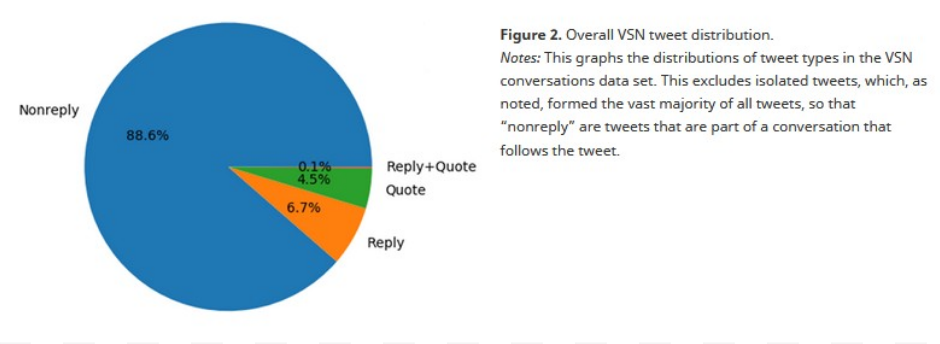
Starting with 1,017,176 tweets by relevant users, the researchers constructed 2 corpuses of multi-tweet conversations. The first was 1,814 conversations that included VSN members directly, and the second was 2,283 conversations mentioning vaccines or vaccine denialism. The tweets and user metadata were then analysed using an adaptation of rhetorical structure theory (RST). RST provides a topology of conversation and interaction, which is extended here to allow the identification of conversational flow between multiple speakers. This is distinct from the more widely explored topology of follower networks, or conversation analyses where conversation is defined by shared hashtag usage.
Thus, using the adapted RST framework, where organisations in the study engaged in any form of interaction, the researchers categorised conversations into: monologues, where the account replied only to itself; reply conversations, where replies were received but no dialogue occurred; dialogues, where 2 or more users replied to one another; and multilogues, where more than 2 users responded within a single discussion.
In the studied data, VSN members tweeted 12,677 times within conversations, compared to their 37,587 lone tweets. While most members rarely replied, some did so heavily. Overall, VSN members' conversations were shorter than those in the comparison corpus (P < 0.0001), and they were involved in 14% fewer multilogues (12% to 16%, P < 0.0001). "Given the number of relevant conversations and the number of reply conversations, this was not for lack of opportunity."
On other social media services, there is work showing that questions are common, and answers by experts are sought out. In the relevant conversations data set from the present study, most of the answers, 3,450, were from users that were not identifiable organisations or experts. "Given the focus on providing information, it seems unfortunate that these [health] organizations are often unresponsive when answers are sought. Perhaps even worse, if it is clear that organizations don't typically reply to questions, the public will instead seek answers from sources, which may not provide authoritative or even correct responses."
In short, this study found that the organisations in VSN "mostly use Twitter to make announcements. The provision of reliable health information is critical, and these organizations continue to carry out that mission well. Still, many fail to capitalize on social media as a way to interact with the public." Health organisations' "lack of coordinated response and engagement with the public has left individual experts with the burden of addressing these issues. While domain experts have performed admirably, and even large parts of the broader public have been helpful in spreading useful health education messages, they are filling in a role that health organizations are not".
Based on the analysis, recommendations for health organisations seeking to create engagement around vaccines on Twitter include:
- Focus more on replying to those who respond and ask questions, in addition to focusing on using hashtags and images or on follower counts and retweets. ("It would be concerning if metrics for replies were to completely crowd out current metrics for social media use in organizations, but a more comprehensive approach that included different metrics could certainly encourage a balance.")
- Reconsider the communication strategies used on Twitter, and dedicate people and resources to interaction. ("This goes farther than tweeting more, or even replying and conversing more. Risk communication requires consideration of the context of questions. This will require engagement with the public that extends beyond the health education organizations' role as dispassionate providers of truth, to greater real engagement with the public.")
In conclusion: "Despite the great importance that health organizations attach to the use of social media, and despite existing guidelines and accumulated knowledge at the application level, there are still gaps. If organizations want to begin allocating appropriate resources, they can begin to create a continuous conversation with the public."
Disaster Medicine and Public Health Preparedness. doi: https://doi.org/10.1017/ dmp.2020.404.
- Log in to post comments