










































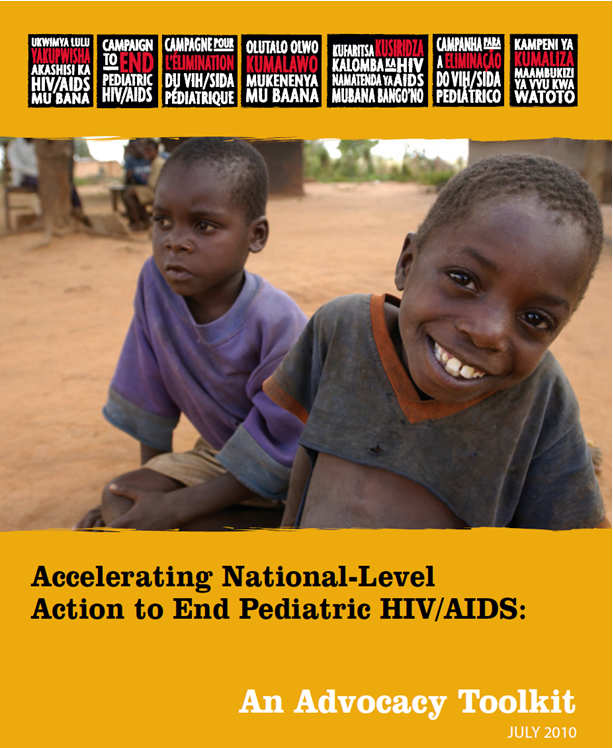
Accelerating National-Level Action to End Paediatric HIV/AIDS: An Advocacy Toolkit
Image
SummaryText
Published by the Children Investment Fund Foundation (CIFF), this advocacy toolkit is a step-by-by step guide to planning advocacy campaigns, based on the experiences of the Campaign to End Paediatric AIDS (CEPA). CEPA is an advocacy campaign that was initially launched in 2009 in Kenya, Mozambique, Nigeria, Tanzania, Uganda, and Zambia, with the goal of scaling up prevention, treatment, and care of paediatric HIV/AIDS. According to CEPA, successful advocacy campaigns are based on a carefully designed workplan that lays out clear and focused goals, activities, timelines, roles and responsibilities of relevant actors, and steps for monitoring and learning from progress and impact, which in turn set the direction for ongoing advocacy. This toolkit was published to support such planning activities.
The toolkit describes how to build or expand a national action network, as well as how to select relevant stakeholders, partners, and targets to work with and influence in order to achieve advocacy goals. This includes taking readers through the steps of identifying concrete objectives and bottlenecks to progress. It explains how to create an ongoing monitoring and advocacy evaluation process to help track progress during campaign implementation, a process that allows for course correction should readers encounter unexpected obstacles or opportunities. In addition, the toolkit’s resource section includes background materials and information sources, including examples of the CEPA National Advocacy Action Plans developed by national action networks in the six CEPA initiating countries.
This toolkit is intended for any organisation involved in advocacy on HIV/AIDS, maternal and child health, children’s rights or protection, or other related issues. Publishers say the toolkit reflects the dynamic nature of the process for developing a National Advocacy Action Plan, a carefully designed workplan that provides a framework for effective advocacy. However, as it outlines concrete steps, the toolkit creates space for the unique experience, strengths, and challenges of each country team.
The toolkit describes how to build or expand a national action network, as well as how to select relevant stakeholders, partners, and targets to work with and influence in order to achieve advocacy goals. This includes taking readers through the steps of identifying concrete objectives and bottlenecks to progress. It explains how to create an ongoing monitoring and advocacy evaluation process to help track progress during campaign implementation, a process that allows for course correction should readers encounter unexpected obstacles or opportunities. In addition, the toolkit’s resource section includes background materials and information sources, including examples of the CEPA National Advocacy Action Plans developed by national action networks in the six CEPA initiating countries.
This toolkit is intended for any organisation involved in advocacy on HIV/AIDS, maternal and child health, children’s rights or protection, or other related issues. Publishers say the toolkit reflects the dynamic nature of the process for developing a National Advocacy Action Plan, a carefully designed workplan that provides a framework for effective advocacy. However, as it outlines concrete steps, the toolkit creates space for the unique experience, strengths, and challenges of each country team.
Publication Date
Languages
English
Number of Pages
40
Source
CIFF website on May 15 2011.
- Log in to post comments