











































Addis Birhan (New Light)
According to the Population Council, when programmes designed for married girls in Ethiopia became increasingly popular, demand for support programmes for husbands also arose. As a result, qualitative, in-depth interviews were undertaken among adolescents exploring the roles of men and women, risk taking behaviours, and patterns of HIV and reproductive health vulnerability. Findings of this survey were used to guide the development of the Addis Birhan programme.
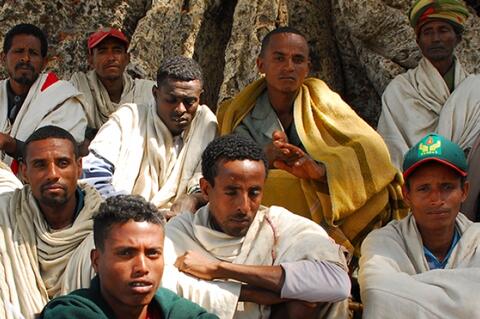
The programme uses trained male mentors who organise meetings with groups of married men on a weekly basis for a period of three months. Mentors range in ages from 24 to 40 and have at least six years of education. The sessions comprise 25 to 30 men, last no longer than an hour, and are held in casual settings that promote dialogue, self-exploration, and self expression in a nonjudgmental environment.
Based on existing curriculums from the Population Council/India, Promundo, and EngenderHealth, the Population Council/Ethiopia tailored a curriculum for rural Ethiopian men. The curriculum includes modules on gender, relationships, caring for children and families, drugs and alcohol, HIV and AIDS, sexual and reproductive health, and violence. Because the programme is designed for men with very low levels of education, the curriculum includes pictures of contextually relevant situations that are used as teaching aids. The project also made some changes to the curriculum based on ongoing feedback. For example, members requested additional content on management of natural resources and nutrition.
In the first six months of implementation, sixty mentors were recruited and trained, reaching over 3500 men. Following that, the programme was expanded to 11 new project sites where 33 male mentors were recruited and trained. So far, nearly 30,000 men have participated in Addis Birhan.
After two years of the intervention, Population Council will conduct an endline evaluation to monitor changes against a baseline conducted in mid-2008. Population Council researchers will measure changes in reproductive health knowledge, gender attitudes, domestic violence, and family planning use, among others. The study results are expected by the end of 2010.
HIV/AIDS, Gender, Reproductive Health
Through qualitative research by Population Council, participants and their families have described changes resulting from participation, such as increased communication among couples and dialogue that is two-way, rather than directive. Men report that they return from the group meetings and share what they have learned with their wives and children, effectively opening up dialogue in the home. Men have started to change the way they think about distribution of labour in the home, with many men now undertaking traditionally female roles, such as fetching water or assisting with cooking or childcare. Many members also reported that they had changed risky behaviour, such as drinking, as well as their perceptions of gender norms.
Population Council and Amhara Regional Bureau of Youth and Sports.
Population Council website and "Addis Birhan ('New Light'): Fostering husbands' involvement and support in Amhara Region, Ethiopia [PDF] on November 1, 2010.
Photo Credit: Zeleman Productions
- Log in to post comments