










































Analysis of the Interactive Meaning of Journalistic Images of the Human Papillomavirus Vaccine and the Perceptions of Female Undergraduate Students
Beijing Jiaotong University (Chen); Peking University (Tao, Guo)
"Current visual persuasive information on the HPV vaccine needs further improvement due to the high demand for information about HPV from the Chinese female audience."
Kress and Leeuwen's visual grammar theory asserts that, through the process of image viewing, the viewer and the image producer create a new, meaningful social relationship, which makes the image viewing process part of a social interaction. In that framework, this paper discusses Chinese women's perceptions of health information as it is presented visually in an online medical journal, focusing on cervical cancer data. The human papillomavirus (HPV) vaccine can significantly reduce the likelihood of the disease, which poses a threat to women's health internationally.
For the eye-tracking experiment, 20 female college students were recruited through an official We Chat group for the School of Languages and Communication Studies of Beijing Jiaotong University. The researchers chose 13 journalistic images - 1 infographic and 12 journalistic pictures - from the Chinese online open image database Visual China. They divided the journalistic images into 2 subcategories: nonfictional and fictional. Following the eye-tracking sessions, which involved assessment of eye movement sequences based on areas of interest (AOIs), the researchers conducted in-depth semi-structured interviews and surveys with all participants.
Selected findings:
- Regarding the infographic, which is about HPV vaccine introduction in China, the AOIs show that the participants indicated the most concern for diseases that can be prevented by the HPV vaccine, the prevention rate, and information concerning the nine-valent HPV vaccine, while they paid little attention to the price of the vaccine. In fact, they showed little concern for the price of the HPV vaccine across all categories and types of vaccines.
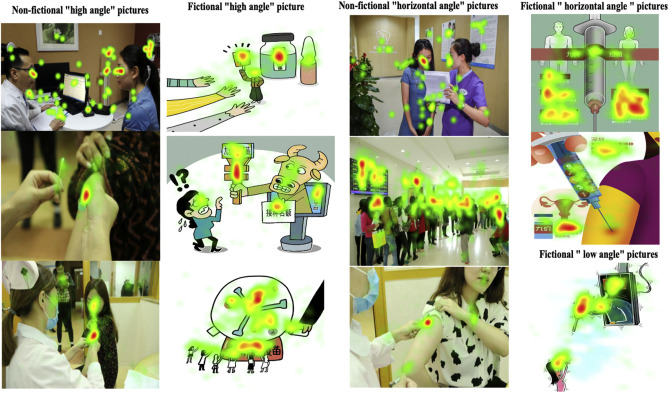
- Most of the journalistic pictures in the sample were not intended to evoke the attention of the viewer. The interactive meaning of this form of journalistic image production is therefore that the world represented in the picture is not important to the viewer or has no relationship with the viewer; thus, neither of the two types of journalistic pictures (nonfictional and fictional) strongly influenced the viewer.
- Participants were more emotionally connected to images containing close-up images of the vaccination process (e.g., injections), images of people waiting in line for vaccinations, and images depicting the high price of the vaccine, and they were less emotionally connected to images portraying interactions between doctors and patients.
- In the high-, horizontal-, and low-angle fictional pictures, the participants' fixated their gaze the longest on direct HPV health-related information. A comparison of the pictures showed that in the low-angle pictures (the viewer is situated beneath the represented participant (person depicted in the image), it is the represented participant who attracted most of the viewing participants' attention. Instead of constructing a set of relationships, the participants focused the majority of their attention on the viewpoint of the producer of the picture: vaccine sellers.
The analysis of the interactive meaning of the fictional and nonfictional journalistic pictures showed that the image producers did not implement useful viewer involvement strategies to persuade the viewer. In terms of the acquisition of HPV-related information, regardless of how the power relationship between the represented participant and the viewer changed, the participants focused mainly on doctor-patient interactions in the nonfictional picture group. However, in the fictional picture category, the participants' attention to the imaginary doctor-patient relationship changed significantly: from a projection of themselves onto the relationship to more symbolic representations of the scarcity of the HPV vaccine.
The researchers suggest that, regarding Chinese media image production, "interactive meaning strategies that lead to higher viewer involvement, such as using more eye contact, creating a closer social distance, and providing more key information directly to the social groups that need the information the most, should be adopted."
In conclusion: "Future research should focus on the interaction between health knowledge and social consciousness instead of relying on experts to disseminate medical information to the public."
International Journal of Nursing Sciences, Volume 7, Supplement 1, 10 September 2020, Pages S61-S66. https://doi.org/10.1016/j.ijnss.2020.07.004.
- Log in to post comments