










































Better Learning in Schools to Improve Attitudes Toward Abstinence and Intentions for Safer Sex Among Adolescents in Urban Nepal
Graduate School of Medicine, The University of Tokyo (Manadhar Shrestha, Otsuka, Yasuoka, Jimba), School of Public Health and Health Sciences, University of Massachusetts Amherst (Poudel), Ullens School, Nepal (Lamichhane)
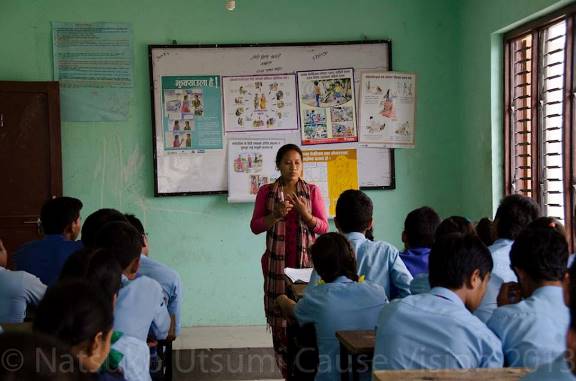
This journal article is on school-based sex education in Nepal, conducted because, while "school-based sex education is an effective medium to convey health information and skills about preventing sexually transmitted infections (STIs) and unwanted pregnancies among adolescents, there is little research about the topic for much of the developing world, including Nepal." The study sought (1) to assess students' evaluation of school-based sex education and (2) to examine the associations between students' evaluations of school-based sex education and their (a) attitudes toward abstinence and (b) intentions for safer sex.
Data was collected from May to July 2010 from students at school through a self-administered Nepali-language questionnaire.
The study found that many students perceived that they didn’t receive enough information about HIV counselling and testing centres through school. They also ranked parent participation as very low and said that audiotapes were among the least used as "teaching aids for sexual health education." Students who filled out the questionnaire also said that receiving "more information on HIV and sexual health" was positively associated with better attitudes towards abstinence. By the same token, students reported that when parents and teachers are more involved, there are more positive "attitudes toward abstinence."
The authors conclude that strategies to improve future school-based interventions that more successful change adolescents' attitudes toward abstinence and safer sex include:
- Facilitating greater teacher and parent involvement which provides adolescents with "communication with …trusted adults about sexual health topics."
- Providing more comprehensive information about HIV and sexual health in diverse formats - for example, audiotapes as well as textbooks.
BMC Public Health website, accessed July 25 2013. Image credit: Samrakshak Samuha Nepal (SASANE)
- Log in to post comments