










































Bring Voices in from the Margins Project

The Creative Centre for Communication and Development (CCCD) identified a need to build women's computer and communication skills in order for them to enjoy their communication rights, which would in turn enable them to enjoy and advance other human rights and fundamental freedoms. The Bring Voices in from the Margins Project employed a full-time programme coordinator who trained women and girls in basic computer skills and communication. A Communication Rights Manual was produced to help guide the project trainers but can be used by any trainers who want to implement a communication rights programme in an environment where communication rights are not recognised, appreciated and upheld.
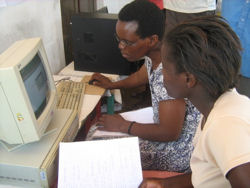
The project converted a veranda into a computer lab with two desktop computers for the training, and organised participants into small group who attended lessons two days a week. Although the original project was designed to reach 30 women living with HIV and 30 girls, the scope of participants was expanded and a total of 90 people attended the trainings, including 15 men. Each participant had access to the computer twice a week for a minimum of two hours per session. According to the organisers, beyond the training activities, the makeshift computer lab became a popular meeting place for women and girls where they could freely have discussions with their peers and share their concerns, give advice, and motivate each other.
The organisers noted that when the programme started, some men initially accompanied their wives with the intention of monitoring their movements. As the programme progressed, the women’s self-confidence increased and as well as their negotiation skills. Some also began approaching health service providers requesting information on HIV and services available in their community.
The training lab also became a space for participants to connect with civil society organisations working on HIV and AIDS, who regularly give talks to the women and provide them with condoms and information brochures. The women have also formed creative communication clubs, which are safe spaces for them to discuss their sexual and reproductive health and rights, as well as issues around HIV stigma. The organisers report that some of the women have become more vocal in their communities, especially in their churches, where as they raise awareness about the need for women and girls to be heard and about the need to advance their rights to freely express their needs and concerns.
Women's Rights, Information and Communication Technologies (ICTs), HIV/AIDS
The project was designed to address the failure to recognise and uphold communication rights by the government of Zimbabwe, which has resulted in serious infringement of basic human rights and fundamental freedoms. As a result of the training, two women got jobs at local supermarkets and six young women who had dropped out of school because of unplanned pregnancies were encouraged by other women to go back to school. Despite various challenges such as acute electric power cuts in Zimbabwe, limited number of computers, and the weakening of the local currency, the project was considered a success and plans are underway to further expand it and focus more on capacity building on advanced ICT skills.
Creative Centre for Communication and Development (CCCD) and the World Association for Christian Communication (WACC).
WACC website on September 10 2010.
Comments

job well done
Information Technology Communication is a powerful tool, in our day to day life. Therefore i would like to congratulate u for the job well done. Keep it up. i hope u shall spread such projects to remote
This is a powerful tool
This is a powerful tool especially in this today life, this is great job you are doing, keep it up guys....
- Log in to post comments