










































A Community-based Survey on Influenza and Vaccination Knowledge, Perceptions and Practices in Peru
Universidad Peruana Cayetano Heredia (Reinders, Carcamo, Valderrama, La Rosa, Mallma); U.S. Naval Medical Research Unit No. 6 (Romero, Tinoco, Neyra, Soto); Centers for Disease Control and Prevention, or CDC (Azziz-Baumgartner)
"Risk communication is critical for community mobilization."
Despite a government subsidised vaccine programme and free vaccination at plazas and markets during "Vaccination week of the Americas", coverage of the influenza vaccine among priority groups remains low in Peru. This survey among mothers of young children, pregnant women, and older adults was designed to help those working in risk communication understand Peruvians' knowledge, perceptions, and practices about influenza illness and vaccination to guide health promotion messages and increase vaccine uptake.
Conducted from July through August 2016, the study sites included 3 geographically and ecologically distinct cities in Peru: Lima, Peru's capital; Cuzco, located in the Andes highlands; and Iquitos, located in Peru's Amazon Basin. The cross-sectional, community-based survey was meant to reach communities near large hospitals where it was assumed persons in priority groups for vaccination would be exposed to influenza-related public health messages as part of the Ministry of Health national campaign to promote influenza vaccines. Questions in the survey about the reasons for and against vaccination were grouped and presented according to the Health Belief Model (HBM). The HBM postulates that perceptions about susceptibility to infection and severe of illness, benefits and barriers of vaccination, and cues to action determine whether a person chooses to be vaccinated or not
Highlights of findings among the 624 non-pregnant mothers, 54 pregnant women, and 622 older adults who participated in the survey:
- The percent reporting influenza vaccination in the previous year was low and very similar in the 3 groups: 28% for mothers, 19% for pregnant women, and 27% among older adults.
- Most of the mothers (94%), pregnant women (96%), and older adults (91%) agreed that influenza could cause serious illness.
- Most participants perceived that vaccines are good for health (mothers 93.3%, pregnant women 100%, and older adults 89.9%) and that vaccines protect people from diseases (mothers 98.7%, pregnant women 98%, and older adults 95.8%).
- Most mothers (70%), pregnant women (74%), and older adults (64%) reported that influenza vaccination should be received every year.
- Most pregnant women (86%) believed influenza vaccines could prevent disease during pregnancy, reported willingness to receive vaccination during pregnancy even if they have to pay for it (87.4%), and believed influenza illness could hurt their baby during pregnancy (70%). However almost half of them (47.4%) perceived that is unlikely they will get influenza during pregnancy, and 41% perceived that vaccination can have bad effects during pregnancy.
- Among participants who did not get vaccinated against influenza in the previous year, "being afraid of vaccination and its effects" was the most commonly cited barrier for getting vaccinated against influenza (53% of mothers, 52% of pregnant women, and 52% of older adults). At least 91% of mothers, 88.9% of pregnant women, and 87.6% of older adults perceived that people are afraid of vaccines.
- Protecting others was rarely (<10%) cited as a reason for vaccination, and issues of effectiveness or safety were rarely mentioned.
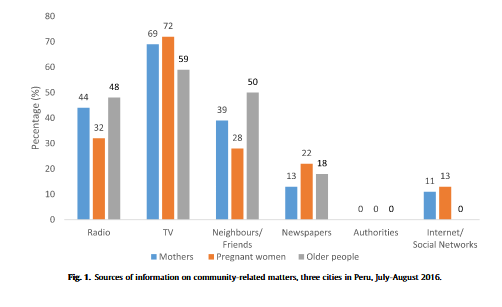
- Most mothers and pregnant women cited television (69% and 72%, respectively) as their primary source of information about their community, followed by radio (44% and 32%, respectively) and neighbours/friends (39% and 28%, respectively). Older adults stated that television (59%), neighbours/friends (50%), and radio (48%) were their most important sources of information. Internet or social networks had low importance for mothers and pregnant women (≤13%) and no importance for older persons seeking information. Authorities were not cited as a source of information by any of the participants.
- Most mothers and pregnant women owned a mobile phone (84% and 85%, respectively), most stated they receive text messages (75% and 83%, respectively), and about two-thirds (73% and 80%, respectively) were interested in receiving information about influenza vaccination via text message. In contrast, only 47% of older adults had mobile phones, 18% receive text messages, and 16% were willing to receive text messages about influenza vaccination.
- Few mothers (≤2%) and none of the pregnant women reported that reading or hearing about influenza vaccines in the media or that getting a physician recommendation was a reason to be vaccinated. The media and physician recommendations seldom were cues to action among older adults (6% and 4%, respectively).
- The majority of pregnant women (93%) trusted the recommendation to get vaccinate if it was done by their doctor and to a lesser extent by their family (47.5%).
Selected implications of the findings include:
- In light of the fact that only 13% of surveyed pregnant women and approximately one-third of older adults self-identified as an influenza vaccine priority group, there is a need to strengthen risk communication messages to promote vaccination and the value of vaccination to those at higher risk of influenza illness complications.
- Considering that most of pregnant women were willing to be vaccinated, particularly if vaccines were recommended by physicians, providing information in the healthcare setting on groups considered a priority for influenza vaccination and explanation of the risks of influenza disease and the potential benefits of vaccination might help improve vaccination coverage.
- Insufficient knowledge about influenza illness, including its routes of transmission, was found as a barrier to vaccination, especially among pregnant women. Health promotion messages about the spread of influenza might promote preventive behaviours, including influenza vaccination. Insufficient information about the safety of influenza vaccines was also a barrier to vaccination. The study findings highlight the need to target communication strategies to the broader community to increase knowledge about the route of influenza transmission and the potential for severe and/or fatal illness among all persons - especially among risk groups.
- The researchers recommend training and creating awareness among healthcare providers through medical societies, continuing education, and policies on the protection influenza vaccines provide for themselves and for the community, the safety of vaccines, and the key role they have to facilitate vaccinate acceptance and coverage in at-risk groups.
As the researchers observe, influenza vaccination campaigns in Peru have traditionally focused on distribution of pamphlets at health centres and dissemination of information regarding vaccine availability through newspapers, TV, or radio. Specifically, televised health promotion messages might reinforce influenza vaccine recommendations from providers and family, especially among pregnant women. Radio messages might similarly reinforce messages among older adults. Text (SMS) messages could be used because of the frequent use of cellular phones among younger participants.
In conclusion: "Providing, as part of the communication campaigns and at the point of care, information not only about vaccine availability but also about the disease itself, groups at higher risk for influenza and safety of influenza vaccines might be useful in Peru."
The results of this study were used by the Ministry of Health of Peru in 2017 to strengthen and target the communication messages to increase the number of people vaccinated for influenza.
Vaccine 38 (2020) 1194–1201. https://doi.org/10.1016/j.vaccine.2019.11.016
- Log in to post comments