










































Community Mobilisation through Women's Groups to improve the Health of Mothers and Babies: Good Practice Guide
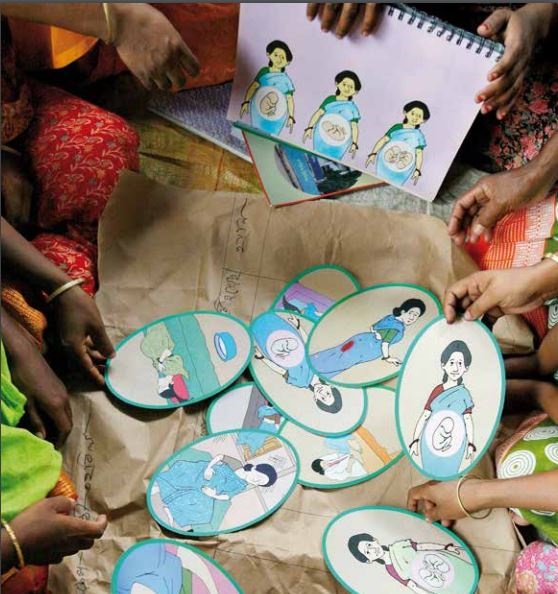
"This 'good practice' guide, based on the experience of a project in India and Bangladesh called Saving Mothers and Children, describes an approach that has the potential to reduce maternal and newborn deaths, and to address other health problems. The project worked through women’s groups, using a participatory learning and action cycle, to mobilise community action to improve the health of mothers and babies."
The aim of the guide is "to provide a case study of good practice in working with women's groups to address maternal and newborn health and to share lessons learned from this experience." This guide on mobilising communities through women's groups, developed by the BADAS Perinatal Care Project (Bangladesh), Ekjut (India), University College London's Institute for Global Health, and Women and Children First UK, used the participatory learning and action cycle's four phases: "...assessing the situation and identifying maternal and newborn health problems; identifying strategies to address these problems; taking action; and measuring progress and impact." It is a two year process of women's group meetings, locally facilitated by leaders trained in participatory methods and provided with basic information about maternal and newborn health.
"Strategies identified by women’s groups to address maternal and newborn health problems included establishing emergency funds to cover transport and medical fees, providing pregnant women with advice and support and, in some cases, promoting the use of clean delivery kits for home birth. Women’s groups also held community meetings to raise awareness of maternal and newborn health problems, discuss their proposed strategies and provide feedback to the community on actions and progress."
The guide cites evaluation results, for example: a 45% reduction in newborn deaths in India, reduction of maternal deaths, and a 57% reduction of maternal depression. " A meta-analysis of seven trials conducted in Bangladesh, India, Nepal and Malawi, including the above, found that women’s groups can dramatically reduce maternal as well as newborn deaths..." and increase uptake of health services and use of safe delivery kits, hygienic home delivery practices, and exclusive breastfeeding.
Lessons learned include:
- careful planning, especially in learning about and approaching the communities.
- "using a systematic approach allows women's groups to develop cohesion and mutual support, work together to identify problems and solutions and take collective action, and is more effective than ad hoc approaches to community mobilisation."
- Women's group facilitators play a central role in this approach and must have the right attitudes and skills.
- Focus must be on women of reproductive age, in particular pregnant and newly married women and the poorest and most marginalised women, achieving high coverage.
- "Covering different topics and using different methods in each meeting – and informing women about the topic for the next meeting – helps to ensure good participation."
- Strategies are needed to address barriers to participation: political, social, cultural, religious and practical factors. An emergency fund can promote women's independence.
- "Efforts to mobilise community action to address maternal and newborn health problems must be complemented by efforts to strengthen health systems and increase access to quality maternal, neonatal and child health care. The support and involvement of community and facility health workers and local health officials can help to strengthen community links with health services and enable communities to demand improvements in service provision."
102
Women and Children First UK website, July 25 2017.
- Log in to post comments