










































Community Perceptions of Behaviour Change Communication Interventions of the Maternal Neonatal and Child Health Programme in Rural Bangladesh: An Exploratory Study
BRAC
"Our findings about community perceptions of the BCC tools, reveal that a well co-ordinated, simultaneous and repeated use of different channels are likely to continue to be useful to communicate and reinforce key, carefully structured messages and support changing behaviours throughout the community, including men and older persons."
This qualitative study explores community perceptions of the components of the behaviour change communication (BCC) intervention of the non-governmental organisation (NGO) BRAC's Improving Maternal, Neonatal and Child Survival (IMNCS) programme in rural Bangladesh. With a focus on economically poor communities, IMNCS started in Nilphamari district in northern Bangladesh in 2006 - with BCC interventions a part of the programme from the beginning - and was gradually expanded to 3 other districts in 2008 and a further 6 in 2010. This study was not designed to demonstrate behaviour change (before and after) the BRAC MNCH BCC intervention.
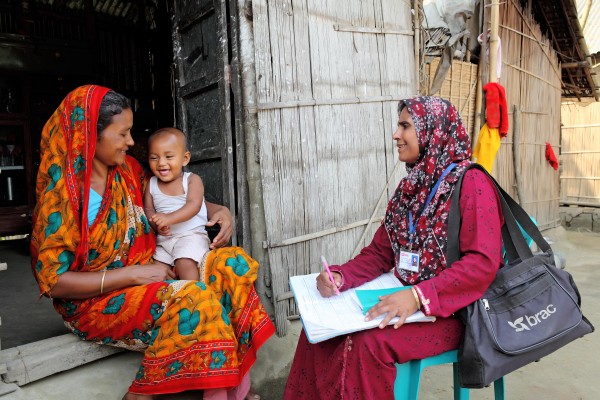
While the programme mainly reaches out to pregnant women, mothers of newborns, and under-5 children, it also includes family members and influential community people in its intended population. Community health workers (CHW) - namely, Shasthya Shebika (SS) and Shasthya Karmi (SKs) - are the core providers of the programme. SSs, the frontline CHWs, are selected from the community and then receive basic training from programme organiser (PO) and managers. ("The CHWs are key in communicating and chosen as peer educators because they belong to the same community and have similar socio-cultural backgrounds and face challenges akin to those of the programme participants....BCC theories, mostly social learning and diffusion of innovations theory, assert that credible peers can influence health behaviour change.") Like the SS, after joining the programme, SKs are residents of the community and receive training on pregnancy identification, antenatal care (ANC), identification of maternal complications, postnatal care (PNC), essential newborn care, and under-5 child care services. In addition, SKs are trained to treat 10 common illnesses as well as to identify tuberculosis (TB) patients and provide directly observed treatment, short-course (DOTS). Both SSs and SKs provide information and support for behaviour change through face to face counselling and group discussion with family members. The interpersonal communication (IPC) between the SK, the pregnant woman, and her family members is buttressed by showing illustrations printed on flipcharts. The CHWs post materials on the walls of the woman's house to reinforce knowledge and awareness. There are 4 different types of posters and 2 stickers that focus on children's danger signs (e.g., images of newborns who are unable to suck breast milk); the materials also highlight procedures for accessing health facilities. The PO's mobile phone numbers are listed at the bottom of each poster and sticker so that they can be contacted in case of emergencies. The mass media approach to maternal, neonatal, and child health (MNCH) BCC includes folk songs ("jaarigan") and street theatre ("naatak"). The programme generally hires a local team to organise and perform the events according to prepared script delivering messages on ANC, safe delivery, post-partum care, family planning, and infant and child health. The street theatre also introduces the role of SSs and SKs and demonstrates how traditional practices can negatively affect pregnancy outcomes.
Semi-structured interviews, key informant interviews, focus group discussions, and informal group discussions were conducted to elicit community views on IPC, printed materials, entertainment education (EE), and mass media - specifically: (i) acceptance of and challenges presented by different forms of media, (ii) comprehensibility of terms; printed materials and EE, and (iii) reported influence of BCC messages.
The researchers found that the respondents were found to be fully cognisant of the BCC tools used by the BRAC IMNCS programme.
- IPC was appreciated by people because firstly, it involved the use of a common local dialect and mutual understanding of cultural issues that led to easy understanding of the messages. Secondly, IPC led to rapport building and consequently the ability and confidence on the part of community members to communicate directly with CHWs. However, respondents also expressed concerns about CHWs lower level of education, training, limited skill in detecting health problems, and low social status. Several respondents urged that CHWs should have scheduled meetings with the community in group settings. One common demand was for the presence of higher officials in the meetings, which would bring more credibility to local workers. Many participants recommended increasing the number of home visits by CHWs to help in repetition and memorising the messages and to place more emphasis on visits for the neonates and children under 5.
- Printed materials assisted in comprehension and memorisation of messages, particularly when explained by CHW during IPC. It was found that, among all the posters, the one with a smiling and healthy looking mother and a child was accepted by most. Some limitations were identified in design of illustrations which hampered message comprehension. As a result, some respondents were unable to differentiate between pregnancy, delivery, and postpartum danger signs. Furthermore, some women were afraid to view the illustrations of danger signs, as they believed seeing that might be associated with the development of these complications in their own lives.
- Enactment of MNCH narratives and traditional musical performances in EE helped to give insight into life's challenges and the decision making that is inherent in pregnancy, childbirth, and childcare. EE also improved memorisation of the messages. It was found that folk songs attracted people's attention very quickly. Songs were a means of disseminating multiple messages in a short time and in an amusing way. Most of the female respondents reported that during CHW visits at home, usually their children, household head and other family members were absent. Therefore, all the family members could enjoy and learn from these events taking place in open community settings like marketplaces. Street theatre was valued by many because the dramatic enactment of messages supplemented the use of song and speaking alone. It would have been easier for the women to access if EE was arranged nearer to their homes, or if adequate prior notice was given.
- A variety of health-related television programmes on polio vaccination, diet of pregnant women, and family planning were also enjoyed by the women. Among them, Shukhi paribar was the most viewed and enjoyed programme, with rich information on MNCH as well as general health. Generally, female household members, neighbours, and children enjoyed the programme together. The general viewers felt that the stories were clearly based on experiences of rural communities, that the actors and actresses spoke with rural accents, and that their movements, attire, and attitude were similar to those of the viewers.
Participants stated that the IMNCS BCC interventions had influenced them to take health promoting decisions and seek MNCH services. People were sensitised about maternal and newborn care, especially the danger signs. Conversations occurred between husband and wife regarding MNCH issues. Mutual understandings were influential in decision making regarding family planning, the use of health services, and child rearing. Sharing of MNCH messages had increased among peer groups, relatives, neighbours, and the elderly. According to the CHWs, this made pregnancy identification easier for them than before. Participants could easily recall MNCH messages and considered themselves to be more conscious in taking the right health promoting decisions for their own wellbeing and development.
The researchers conclude that community-based maternal and newborn programmes should revise BCC interventions to strengthen IPC, using rigorously tested print materials as aids and standalone media. Messages about birth preparedness (especially savings), recognition of danger signs, and immediate self-referral to biomedical health services should be carefully aligned and effectively delivered to women, men, and older members of the community. Messaging should utilise gendered storylines and address the seasonal cycles of conception, birth, ANC, PNC, and childhood illnesses. The authors recommend that messages and media be rigorously pretested before going to scale. While live street theatre and folk song (Jarigan) are well accepted, their usefulness could be expanded by uploading videos of these programmes to social media. Similarly, print materials could be uploaded to the web. To increase synchronicity of messaging, mass texting to both CHWs and community members could be used to increase coverage and sustainability. Future research should identify how best to combine IPC, printed materials, traditional cultural forms, social media, and mass media in different field situations. "Because we are looking to effect ongoing behaviour change, research should continue to understand in a more nuanced way the community's changing perceptions regarding BCC, the barriers to behaviour change; the opportunities for improved integration and widening coverage of messaging, together with building community support for new behaviours leading to improved health outcomes for mothers, newborns and children."
BMC Health Services Research 2016 16:389. DOI: 10.1186/s12913-016-1632-y. Image credit: BRAC
- Log in to post comments