










































Confidence in the National Immunization Program among Parents in Sweden 2016 - A Cross-sectional Survey
Public Health Agency of Sweden (Byström, Bergström, Roth); Lund University (Byström, Riesbeck, Roth); World Health Organization, WHO (Lindstrand)
"...there have been concerns about growing vaccine hesitancy in Europe..."
An individual's perception of vaccination is complex, based not only on scientific evidence and facts, but also on economic and political policies, as well as psychological factors and social determinants. Vaccination coverage may drop dramatically due to single events such as media reporting after a vaccine safety signal, even if the signal turns out to be unfounded. Furthermore, negative vaccine information shared online may influence parental decisions about childhood vaccinations. Therefore, systematic monitoring of attitudes towards vaccination and assessment of confidence in vaccines is thought to provide important information for effectively responding to events and helping to maintain resilience in the National Immunization Program (NIP). To that end, this study examined vaccine confidence and attitudes towards vaccinations among parents in the Swedish population, as well as their use of and trust in vaccine-related information sources.
Participants included 911 parents with children aged 0-15 years, who completed a web-based survey with questions on vaccination awareness, safety, and information channels. Data were weighted to adjust for non-responders and for representativeness of the Swedish population.
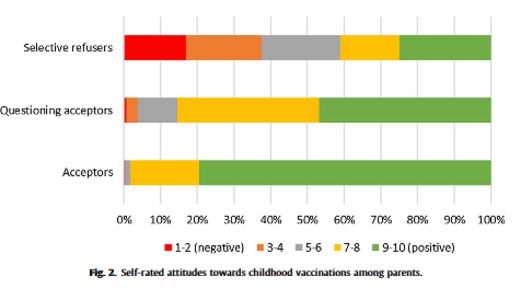
Parents were categorised as: (i) acceptors (79%): vaccinated with all vaccinations offered within the NIP, (ii) questioning acceptors (19%): vaccinated but felt hesitancy towards at least one vaccination, and (iii) selective refusers (2%): actively refused or delayed at least one vaccination for other than medical reasons. (None of the parents rejected all vaccinations for their child.) When excluding responses for human papillomavirus (HPV) vaccination, the proportion of acceptors increased to 91%. Among acceptors, 97.3% had the intention to vaccinate next time, in contrast to 88.8% of questioning acceptors and 34.6% of selective refusers.
The main reasons for questioning or refusing any vaccine were worry about adverse events, having read or heard negative information, and lacking good and reliable information about vaccinations. None of the selective refusers and less than 1% of questioning acceptors responded that "diseases are not serious" as a reason for refusing or questioning vaccines. Being hesitant towards vaccinations in general and wanting to delay vaccination until the child was older were also common reasons among parents refusing vaccinations. Convenience was only noted by one parent as a reason for not vaccinating.
Questioning acceptors were asked what made them vaccinate their child despite feeling hesitant. Many felt that the trust both for the recommendations given and also the knowledgeable nurses at Child Healthcare Centers (CHCs) was greater than their worry. Others felt that group pressure made them vaccinate or that they wanted to avoid the diseases. Risk-benefit analyses were common where parents perceived that benefits outweighed the potential risks.
Nurses at CHCs were the most used sources of information for all 3 groups. Information searches online were mostly used by selective refusers and also questioning acceptors, whereas acceptors used internet to a less extent. All 3 groups used the national healthcare guide 1177 ("1177 Vårdguiden", reached by phone or internet, www.1177.se) for information, as well as pamphlets and school health services to a similar extent. Media, social media family members, and friends were more commonly used by selective refusers in comparison to questioning acceptors and acceptors.
Parents emphasised the need for transparent, unbiased, and trusted sources of information, where pharmaceutical companies have no input. Several parents also expressed an interest in receiving better access to scientific studies in popular scientific writing so that they could read and judge for themselves.
In sum, the study demonstrates that parents in Sweden have confidence in vaccines given within the NIP. Overall, parents had a positive attitude towards vaccinations of children, except for selective refusers. One in 5 parents question vaccines, particularly regarding the HPV vaccine, but still adhere to the NIP.
Recommendations based on the findings include:
- Provide information on vaccines online and at vaccination appointments to maintain confidence in vaccination.
- Address and communicate safety concerns transparently, using tools and tailored information to meet the needs of parents.
- Support and provide tools for the nurses at CHCs and at school health services to communicate effectively with parents, both online and at vaccination appointments, especially concerning HPV vaccination.
- Repeat this study in Sweden on a regular basis to continuously monitor vaccine confidence for sustaining high vaccine acceptance and boosting the resilience and demand of the NIP.
- Log in to post comments